
Solar-Powered Environmental Monitoring System with ESP32 and GSM Reporting
View and Edit Project In Cirkit Designer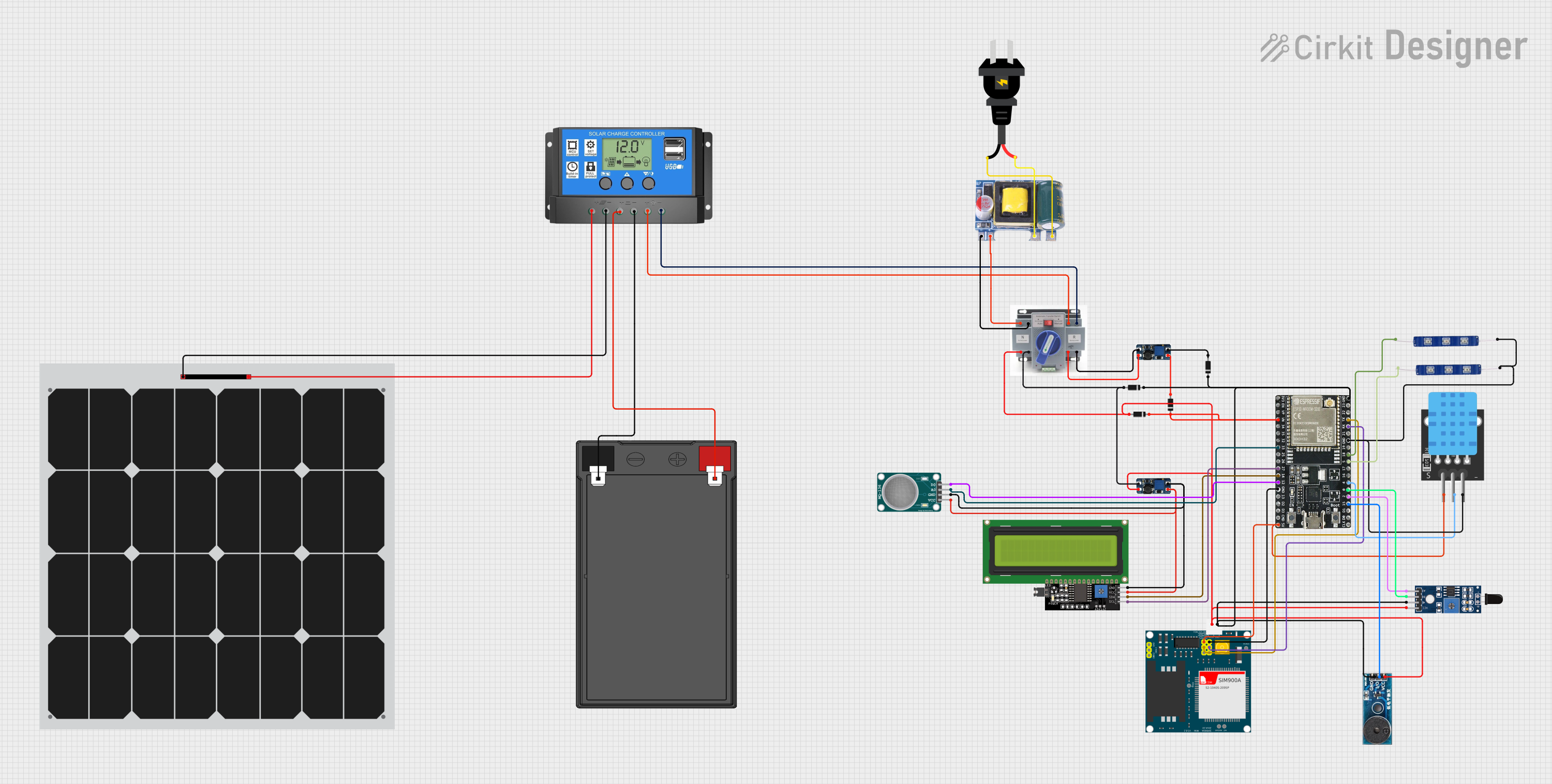
Circuit Documentation
Summary
The circuit in question is designed to harness solar energy using a solar panel, manage the power with a solar charge controller, and store it in a 12V 7Ah battery. The system includes an Automatic Transfer Switch (ATS) to switch between solar and AC power sources, ensuring continuous power supply. The circuit also features a DC-DC boost converter to step up voltage where necessary, and a Mini AC-DC module to convert AC to a regulated 5V DC supply.
For communication, a SIM900A module is included, interfacing with an ESP32 microcontroller, which is the central processing unit of the circuit. The ESP32 also connects to various sensors and output devices, including an MQ-136 hydrogen sulfide gas sensor, a temperature sensor (TEMP), an LCD display, a flame sensor (Sensor SHT113), and two 12V blue LEDs. A buzzer module provides audible alerts. Diodes are used throughout the circuit for directional current flow and protection.
Component List
Solar Panel
- Description: A photovoltaic panel for converting sunlight into electrical energy.
- Pins:
+,-
12V 7Ah Battery
- Description: A rechargeable battery for energy storage.
- Pins:
12V +,12V -
Solar Charge Controller
- Description: Regulates the energy flow from the solar panel to the battery and load.
- Pins:
Solar Cell +,Solar Cell -,Battery +,Battery -,Load +,Load -
ATS (Automatic Transfer Switch)
- Description: Switches between solar and AC power sources.
- Pins:
+,-
AC Source
- Description: An alternate source of AC power.
- Pins:
-,+
DC-DC Boost Converter
- Description: Steps up the voltage to a higher level.
- Pins:
VIN-,VIN+,VOUT+,VOUT-
SIM900A
- Description: GSM/GPRS module for cellular communication.
- Pins:
GND,DB9-3 (RXD),DB9-2 (TXD),5V,3VR,5VR,3VT,5VT,VCC,Ring,RESTART,RESET,STATUS
Diode
- Description: Allows current to flow in one direction only.
- Pins:
cathode,anode
ESP32-WROOM-32UE
- Description: A microcontroller with Wi-Fi and Bluetooth capabilities.
- Pins:
3v3,EN,VP,VN,34,35,32,33,25,26,27,14,12,GND,13,D2,D3,5V,23,22,TX,RX,21,19,18,5,17,16,4,0,2,15,D1,D0,CKL
MQ-136 Sensor Hydrogen Sulfide Gas
- Description: Detects the presence of hydrogen sulfide gas.
- Pins:
VCC,GND,A0,D0
TEMP (Temperature Sensor)
- Description: Measures ambient temperature.
- Pins:
5V,D3,GND
LCD Display 16x4 I2C
- Description: An alphanumeric display with I2C interface.
- Pins:
SCL,SDA,VCC,GND
Sensor SHT113 Flame
- Description: Detects the presence of flames or fire.
- Pins:
A0,D0,GND,VCC
12V Blue LED
- Description: A light-emitting diode for indication purposes.
- Pins:
GND,VCC
Buzzer Module
- Description: Provides audible alerts.
- Pins:
GND,Vcc,I/O
Mini AC-DC 110V-230V to 5V 700mA Module
- Description: Converts AC power to a regulated 5V DC supply.
- Pins:
GND,5v,Neutral,Life
Wiring Details
Solar Panel
+to Solar Charge ControllerSolar Cell +-to Solar Charge ControllerSolar Cell -
12V 7Ah Battery
12V +to Solar Charge ControllerBattery +12V -to Solar Charge ControllerBattery -
Solar Charge Controller
Load +to ATS+Load -to ATS-
ATS
+to Mini AC-DC Module5v-to Mini AC-DC ModuleGND
AC Source
-to Mini AC-DC ModuleNeutral+to Mini AC-DC ModuleLife
DC-DC Boost Converter
VIN-to ATS-through Diode (anode)VIN+to ATS+VOUT+to Diode (anode)VOUT-to Diode (anode)
SIM900A
GNDto ESP32GND5Vto Diode (anode)VCCto TEMP5Vand ESP325V5VTto ESP32TX5VRto ESP32RX
Diode
- Multiple diodes used for directional current flow and protection.
ESP32-WROOM-32UE
VNto Diode (cathode)33to MQ-136A027to LCD DisplaySCL14to LCD DisplaySDA12to MQ-136D0GNDto various components'GND5Vto SIM900AVCC18to 12V Blue LEDVCC5to 12V Blue LEDVCC4to TEMPD30to Sensor SHT113 FlameD02to Sensor SHT113 FlameA015to Buzzer ModuleI/O
MQ-136 Sensor Hydrogen Sulfide Gas
VCCto DC-DC Boost ConverterVOUT+GNDto DC-DC Boost ConverterVOUT-
TEMP (Temperature Sensor)
5Vto SIM900AVCCD3to ESP324GNDto ESP32GND
LCD Display 16x4 I2C
SCLto ESP3227SDAto ESP3214VCCto DC-DC Boost ConverterVOUT+GNDto DC-DC Boost ConverterVOUT-
Sensor SHT113 Flame
A0to ESP322D0to ESP320GNDto ESP32GNDVCCto SIM900A5V
12V Blue LED
GNDto ESP32GNDVCCto ESP3218and5
Buzzer Module
GNDto Diode (cathode)Vccto Diode (anode)I/Oto ESP3215
Documented Code
No code was provided for the microcontrollers in the circuit. If code becomes available, it should be documented here with explanations for each function and routine, including setup and loop structures, interrupt service routines, and any communication protocols implemented.