
Arduino UNO-Based Environmental Monitoring System with Gas and Temperature Sensors
View and Edit Project In Cirkit Designer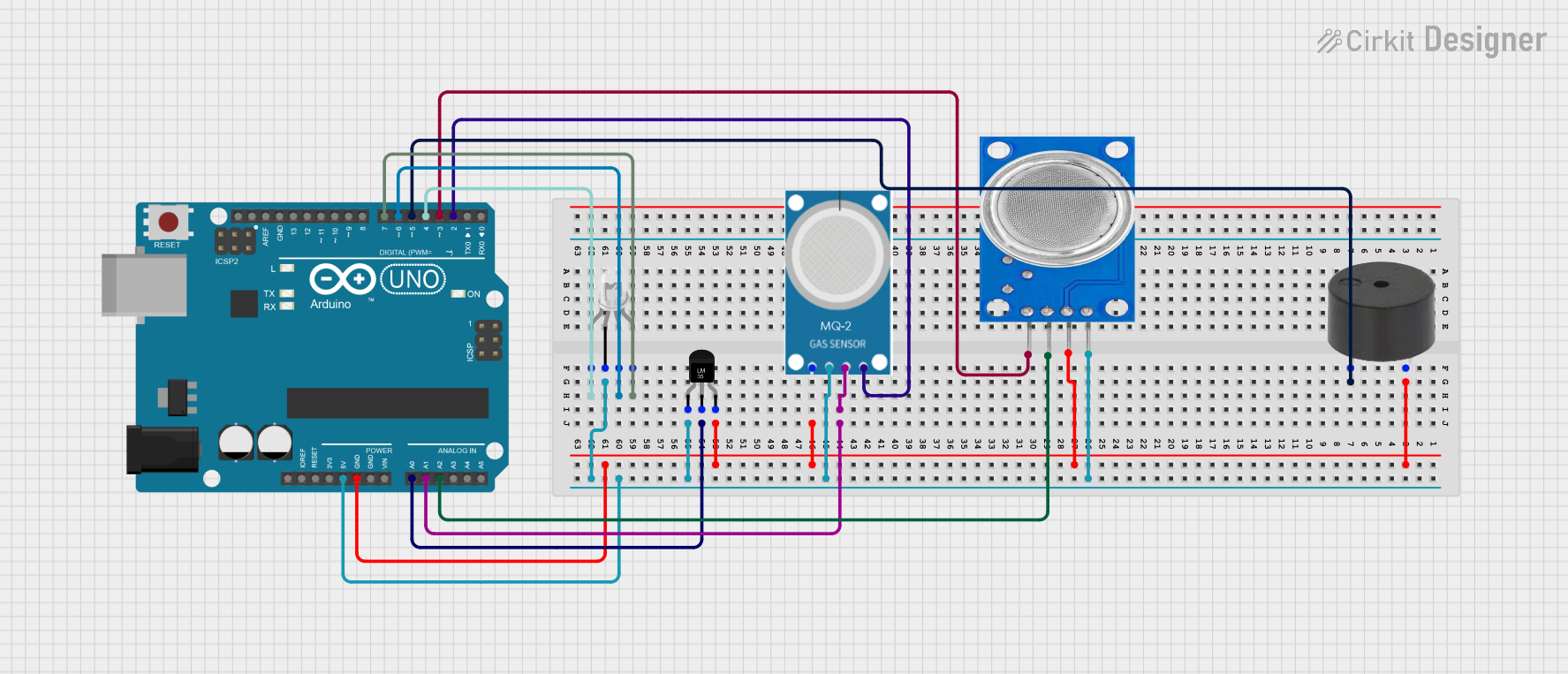
Circuit Documentation
Summary
This circuit is designed to monitor environmental conditions using various sensors and provide feedback through LEDs and a buzzer. The system is built around an Arduino UNO microcontroller, which reads data from a temperature sensor (LM35), an MQ-2 gas sensor, and an MQ-135 gas sensor. Based on the sensor readings, the system controls a four-pin LED and a buzzer to indicate different environmental statuses.
Component List
Arduino UNO
- Description: A microcontroller board based on the ATmega328P.
- Pins: UNUSED, IOREF, Reset, 3.3V, 5V, GND, Vin, A0, A1, A2, A3, A4, A5, SCL, SDA, AREF, D13, D12, D11, D10, D9, D8, D7, D6, D5, D4, D3, D2, D1, D0
MQ135
- Description: A gas sensor used to detect air quality.
- Pins: VCC, GND, A0, D0
Temperature Sensor (LM35)
- Description: A temperature sensor that provides an analog output proportional to the temperature.
- Pins: +Vs, Vout, GND
MQ-2
- Description: A gas sensor used to detect combustible gases.
- Pins: GND, VCC, ANALOG, Digital
Buzzer
- Description: An audio signaling device.
- Pins: PIN, GND
LED: Four Pin
- Description: A four-pin LED with red, green, and blue cathodes and a common anode.
- Pins: red cathode, common anode, green cathode, blue cathode
Wiring Details
Arduino UNO
GND connected to:
- Buzzer GND
- MQ-2 GND
- Temperature Sensor (LM35) GND
- MQ135 GND
5V connected to:
- Temperature Sensor (LM35) +Vs
- LED: Four Pin common anode
- MQ135 VCC
- MQ-2 VCC
A0 connected to:
- Temperature Sensor (LM35) Vout
A1 connected to:
- MQ-2 ANALOG
A2 connected to:
- MQ135 A0
D2 connected to:
- MQ-2 Digital
D3 connected to:
- MQ135 D0
D4 connected to:
- LED: Four Pin red cathode
D5 connected to:
- Buzzer PIN
D6 connected to:
- LED: Four Pin green cathode
D7 connected to:
- LED: Four Pin blue cathode
MQ135
GND connected to:
- Arduino UNO GND
VCC connected to:
- Arduino UNO 5V
A0 connected to:
- Arduino UNO A2
D0 connected to:
- Arduino UNO D3
Temperature Sensor (LM35)
GND connected to:
- Arduino UNO GND
+Vs connected to:
- Arduino UNO 5V
Vout connected to:
- Arduino UNO A0
MQ-2
GND connected to:
- Arduino UNO GND
VCC connected to:
- Arduino UNO 5V
ANALOG connected to:
- Arduino UNO A1
Digital connected to:
- Arduino UNO D2
Buzzer
GND connected to:
- Arduino UNO GND
PIN connected to:
- Arduino UNO D5
LED: Four Pin
common anode connected to:
- Arduino UNO 5V
red cathode connected to:
- Arduino UNO D4
green cathode connected to:
- Arduino UNO D6
blue cathode connected to:
- Arduino UNO D7
Documented Code
// Pin definitions
const int tempSensorPin = A0;      // Temperature sensor on A0
const int mq2AnalogPin = A1;       // MQ-2 analog on A1
const int mq2DigitalPin = 2;       // Changed from D2 to 2
const int mq135AnalogPin = A2;     // MQ-135 analog on A2
const int mq135DigitalPin = 3;     // Changed from D3 to 3
const int redLEDPin = 4;           // Changed from D4 to 4
const int buzzerPin = 5;           // Changed from D5 to 5
const int greenLEDPin = 6;         // Changed from D6 to 6
const int blueLEDPin = 7;          // Changed from D7 to 7

// Thresholds
const float TEMP_HIGH = 30.0;
const float TEMP_MEDIUM = 20.0;
const int GAS_THRESHOLD = 300;

void setup() {
  // Initialize serial communication
  Serial.begin(9600);

  // Set pin modes
  pinMode(tempSensorPin, INPUT);
  pinMode(mq2AnalogPin, INPUT);
  pinMode(mq2DigitalPin, INPUT);
  pinMode(mq135AnalogPin, INPUT);
  pinMode(mq135DigitalPin, INPUT);
  pinMode(redLEDPin, OUTPUT);
  pinMode(greenLEDPin, OUTPUT);
  pinMode(blueLEDPin, OUTPUT);
  pinMode(buzzerPin, OUTPUT);

  // Initial LED test
  digitalWrite(redLEDPin, HIGH);
  delay(500);
  digitalWrite(redLEDPin, LOW);
  digitalWrite(greenLEDPin, HIGH);
  delay(500);
  digitalWrite(greenLEDPin, LOW);
  digitalWrite(blueLEDPin, HIGH);
  delay(500);
  digitalWrite(blueLEDPin, LOW);

  Serial.println("System Initialized");
}

void loop() {
  // Read temperature sensor value
  int tempValue = analogRead(tempSensorPin);
  // Modified temperature calculation for LM35 sensor
  float temperature = (tempValue * 5.0 * 100.0) / 1024.0;

  // Read MQ-2 sensor values
  int mq2AnalogValue = analogRead(mq2AnalogPin);
  int mq2DigitalValue = digitalRead(mq2DigitalPin);

  // Read MQ135 sensor values
  int mq135AnalogValue = analogRead(mq135AnalogPin);
  int mq135DigitalValue = digitalRead(mq135DigitalPin);

  // Print sensor values to serial monitor with better formatting
  Serial.println("--------------------");
  Serial.print("Temperature: ");
  Serial.print(temperature, 1);  // One decimal place
  Serial.println(" °C");

  Serial.print("MQ-2 Sensor - Analog: ");
  Serial.print(mq2AnalogValue);
  Serial.print(" Digital: ");
  Serial.println(mq2DigitalValue ? "HIGH" : "LOW");

  Serial.print("MQ-135 Sensor - Analog: ");
  Serial.print(mq135AnalogValue);
  Serial.print(" Digital: ");
  Serial.println(mq135DigitalValue ? "HIGH" : "LOW");

  // Control LEDs based on temperature with status message
  if (temperature > TEMP_HIGH) {
    setLEDs(HIGH, LOW, LOW);
    Serial.println("Status: HIGH Temperature Alert!");
  } else if (temperature > TEMP_MEDIUM) {
    setLEDs(LOW, HIGH, LOW);
    Serial.println("Status: Normal Temperature");
  } else {
    setLEDs(LOW, LOW, HIGH);
    Serial.println("Status: Low Temperature");
  }

  // Control buzzer based on gas detection with pattern
  if (mq2DigitalValue == HIGH || mq135DigitalValue == HIGH) {
    Serial.println("WARNING: Gas Detected!");
    // Beeping pattern
    for (int i = 0; i < 3; i++) {
      tone(buzzerPin, 1000);  // 1kHz tone
      delay(200);
      noTone(buzzerPin);
      delay(200);
    }
  } else {
    noTone(buzzerPin);
  }

  // Calculate gas concentrations as percentage
  int mq2Percentage = map(mq2AnalogValue, 0, 1023, 0, 100);
  int mq135Percentage = map(mq135AnalogValue, 0, 1023, 0, 100);

  Serial.print("Gas Levels - MQ2: ");
  Serial.print(mq2Percentage);
  Serial.print("%, MQ135: ");
  Serial.print(mq135Percentage);
  Serial.println("%");

  Serial.println("--------------------\n");

  // Main loop delay
  delay(2000);  // Increased to 2 seconds for better readability
}

// Helper function to set LED states