
Circuit Documentation
Summary of the Circuit
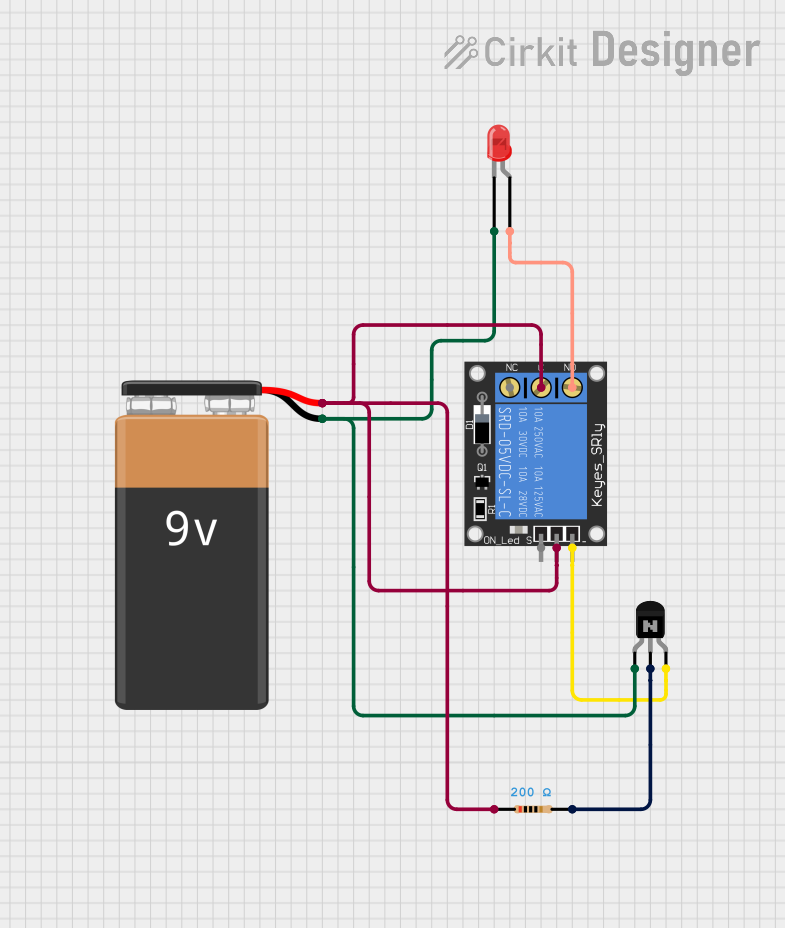
This circuit appears to be a simple control circuit that uses a 9V battery to power an LED through a relay, with the relay's coil being controlled by an NPN transistor. The transistor is in turn controlled by a resistor, which could be connected to a microcontroller or another control signal (although no microcontroller is included in the provided code). The relay allows for the LED to be switched on and off without directly passing the control signal's power through the LED, providing electrical isolation.
Component List
1-Channel Relay (5V 10A)
- Description: A relay is an electrically operated switch that allows you to control a high-power circuit with a low-power signal.
- Pins: NC (Normally Closed), signal, C (Common), power, NO (Normally Open), ground
NPN Transistor (EBC)
- Description: An NPN transistor is a semiconductor device that can amplify or switch electronic signals.
- Pins: emitter, base, collector
9V Battery
- Description: A standard 9V battery provides power to the circuit.
- Pins: -, +
LED: Two Pin (red)
- Description: A red LED that emits light when a forward current passes through it.
- Pins: cathode, anode
Resistor
- Description: A resistor is a passive two-terminal electrical component that implements electrical resistance as a circuit element.
- Pins: pin1, pin2
- Properties: Resistance: 200 Ohms
Wiring Details
1-Channel Relay (5V 10A)
- C (Common): Connected to the anode of the LED and one terminal of the 9V battery (+).
- power: Connected to one terminal of the 9V battery (+).
- NO (Normally Open): Connected to the anode of the LED.
- ground: Connected to the collector of the NPN transistor.
NPN Transistor (EBC)
- emitter: Connected to the cathode of the LED and the negative terminal of the 9V battery (-).
- base: Connected to one pin of the resistor.
- collector: Connected to the ground pin of the relay.
9V Battery
- +: Connected to the power and C (Common) pins of the relay.
- -: Connected to the emitter of the NPN transistor and the cathode of the LED.
LED: Two Pin (red)
- anode: Connected to the NO (Normally Open) pin of the relay and C (Common) pin of the relay.
- cathode: Connected to the emitter of the NPN transistor and the negative terminal of the 9V battery (-).
Resistor
- pin1: Connected to the C (Common) pin of the relay.
- pin2: Connected to the base of the NPN transistor.
Documented Code
No code has been provided for any microcontrollers in the circuit. If a microcontroller is to be used to control the relay via the NPN transistor, the code would need to set the appropriate pin connected to the base of the transistor to a high state to activate the relay and light the LED, and to a low state to deactivate the relay and turn off the LED.