
Arduino UNO Bluetooth-Controlled Robotic Car with Motor Drivers and Servos
View and Edit Project In Cirkit Designer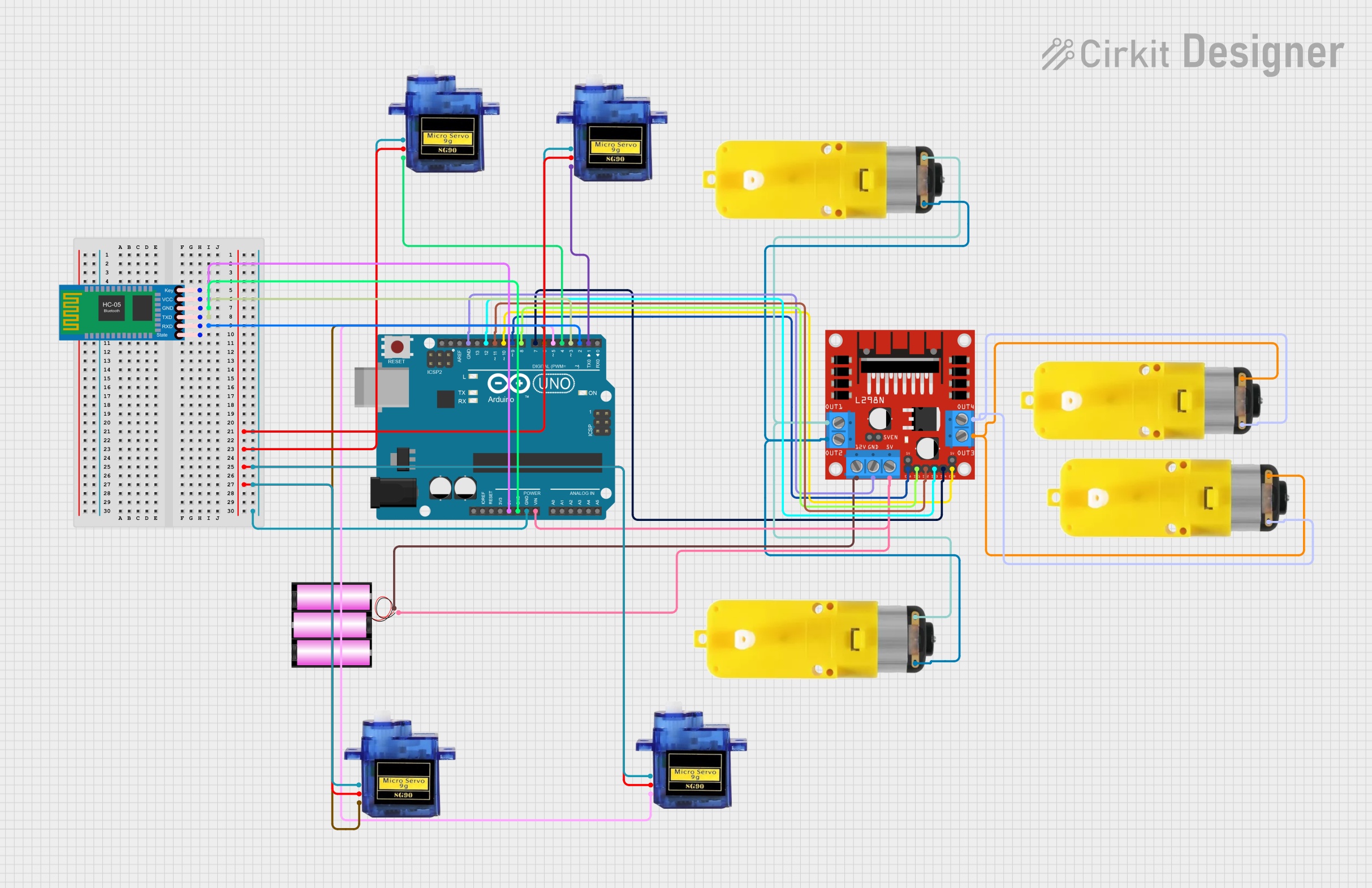
Circuit Documentation
Summary
This circuit is designed to control a Bluetooth-enabled car using an Arduino UNO. The car is equipped with multiple motors and servos, which are controlled via an L298N motor driver. The HC-05 Bluetooth module allows for wireless communication, enabling the car to be controlled remotely. The circuit is powered by a 12V battery.
Component List
Arduino UNO
- Description: Microcontroller board based on the ATmega328P.
- Pins: UNUSED, IOREF, Reset, 3.3V, 5V, GND, Vin, A0, A1, A2, A3, A4, A5, SCL, SDA, AREF, D13, D12, D11, D10, D9, D8, D7, D6, D5, D4, D3, D2, D1, D0
Motor with reducer
- Description: DC motor with a built-in reducer.
- Pins: 3 - 6 VCC, GND
L298N DC motor driver
- Description: Dual H-Bridge motor driver.
- Pins: OUT1, OUT2, 12V, GND, 5V, OUT3, OUT4, 5V-ENA-JMP-I, 5V-ENA-JMP-O, +5V-J1, +5V-J2, ENA, IN1, IN2, IN3, IN4, ENB
Battery 12V
- Description: 12V battery for powering the circuit.
- Pins: +, -
Micro servo 9G
- Description: Small servo motor.
- Pins: GND, +5V, PWM
HC-05 Bluetooth Module
- Description: Bluetooth module for wireless communication.
- Pins: Key, VCC, TXD, RXD, State, GND
Wiring Details
Arduino UNO
- 5V to VCC of HC-05 Bluetooth Module
- GND to GND of HC-05 Bluetooth Module
- D3 to TXD of HC-05 Bluetooth Module
- D2 to RXD of HC-05 Bluetooth Module
- Vin to 5V of L298N DC motor driver
- GND to GND of L298N DC motor driver
- D12 to IN3 of L298N DC motor driver
- D11 to IN2 of L298N DC motor driver
- D10 to ENB of L298N DC motor driver
- D9 to ENA of L298N DC motor driver
- D8 to IN1 of L298N DC motor driver
- D7 to IN4 of L298N DC motor driver
- D6 to PWM of Micro servo 9G
- D5 to PWM of Micro servo 9G
- D4 to PWM of Micro servo 9G
- D1 to PWM of Micro servo 9G
Motor with reducer
- 3 - 6 VCC to OUT1 of L298N DC motor driver
- GND to OUT2 of L298N DC motor driver
L298N DC motor driver
- 5V to Vin of Arduino UNO
- GND to GND of Arduino UNO
- IN3 to D12 of Arduino UNO
- IN2 to D11 of Arduino UNO
- ENB to D10 of Arduino UNO
- ENA to D9 of Arduino UNO
- IN1 to D8 of Arduino UNO
- IN4 to D7 of Arduino UNO
- OUT1 to 3 - 6 VCC of Motor with reducer
- OUT2 to GND of Motor with reducer
- 12V to + of Battery 12V
Battery 12V
- + to 12V of L298N DC motor driver
- - to 5V of L298N DC motor driver
Micro servo 9G
- +5V to +5V of other Micro servo 9G
- GND to GND of other Micro servo 9G
- PWM to D6 of Arduino UNO
HC-05 Bluetooth Module
- VCC to 5V of Arduino UNO
- GND to GND of Arduino UNO
- TXD to D3 of Arduino UNO
- RXD to D2 of Arduino UNO
Code Documentation
#include <SoftwareSerial.h>

// Bluetooth module connected to pins 2 (RX) and 3 (TX)
SoftwareSerial mySerial(2, 3);

// Motor driver pins
int Rightmotor1 = 4;
int Rightmotor2 = 5;
int leftmotor1 = 6;
int leftmotor2 = 7;
int en1 = 9;
int en2 = 10;

// String to hold incoming Bluetooth data
String command = "";

void setup() {
  // Initialize motor pins
  pinMode(Rightmotor1, OUTPUT);
  pinMode(Rightmotor2, OUTPUT);
  pinMode(leftmotor1, OUTPUT);
  pinMode(leftmotor2, OUTPUT);
  pinMode(en1, OUTPUT);
  pinMode(en2, OUTPUT);

  // Start serial communication for debugging and Bluetooth
  Serial.begin(9600);
  mySerial.begin(9600);

  Serial.println("Bluetooth Car Ready!");
}

void loop() {
  if (mySerial.available()) {
    char received = mySerial.read(); // Read the single character command
    if (received == 'F') {
      moveForward(); // Move forward
    } else if (received == 'B') {
      moveBackward(); // Move backward
    } else if (received == 'L') {
      turnLeft(); // Turn left
    } else if (received == 'R') {
      turnRight(); // Turn right
    } else if (received == 'S') {
      stopMotors(); // Stop
    }
  }
}

// Movement functions
void moveForward() {
  digitalWrite(Rightmotor1, HIGH);
  digitalWrite(Rightmotor2, LOW);
  digitalWrite(leftmotor1, HIGH);
  digitalWrite(leftmotor2, LOW);
  analogWrite(en1, 200);  // Adjust speed as needed (0-255)
  analogWrite(en2, 200);
  Serial.println("Moving Forward");
}

void moveBackward() {
  digitalWrite(Rightmotor1, LOW);
  digitalWrite(Rightmotor2, HIGH);
  digitalWrite(leftmotor1, LOW);
  digitalWrite(leftmotor2, HIGH);
  analogWrite(en1, 200);
  analogWrite(en2, 200);
  Serial.println("Moving Backward");
}

void turnLeft() {
  digitalWrite(Rightmotor1, HIGH);
  digitalWrite(Rightmotor2, LOW);
  digitalWrite(leftmotor1, LOW);
  digitalWrite(leftmotor2, HIGH);
  analogWrite(en1, 150); // Reduced speed for turning
  analogWrite(en2, 150);
  Serial.println("Turning Left");
}

void turnRight() {
  digitalWrite(Rightmotor1, LOW);
  digitalWrite(Rightmotor2, HIGH);
  digitalWrite(leftmotor1, HIGH);
  digitalWrite(leftmotor2, LOW);
  analogWrite(en1, 150);
  analogWrite(en2, 150);
  Serial.println("Turning Right");
}

void stopMotors() {
  digitalWrite(Rightmotor1, LOW);
  digitalWrite(Rightmotor2, LOW);
  digitalWrite(leftmotor1, LOW);
  digitalWrite(leftmotor2, LOW);
  analogWrite(en1, 0);
  analogWrite(en2, 0);
  Serial.println("Motors Stopped");
}
This code initializes the motor driver pins and sets up serial communication for both debugging and Bluetooth. The loop function reads commands from the Bluetooth module and calls the appropriate movement functions to control the motors.