
Battery-Powered ESP32 CAM with DC Buck Converter for Efficient Power Management
View and Edit Project In Cirkit Designer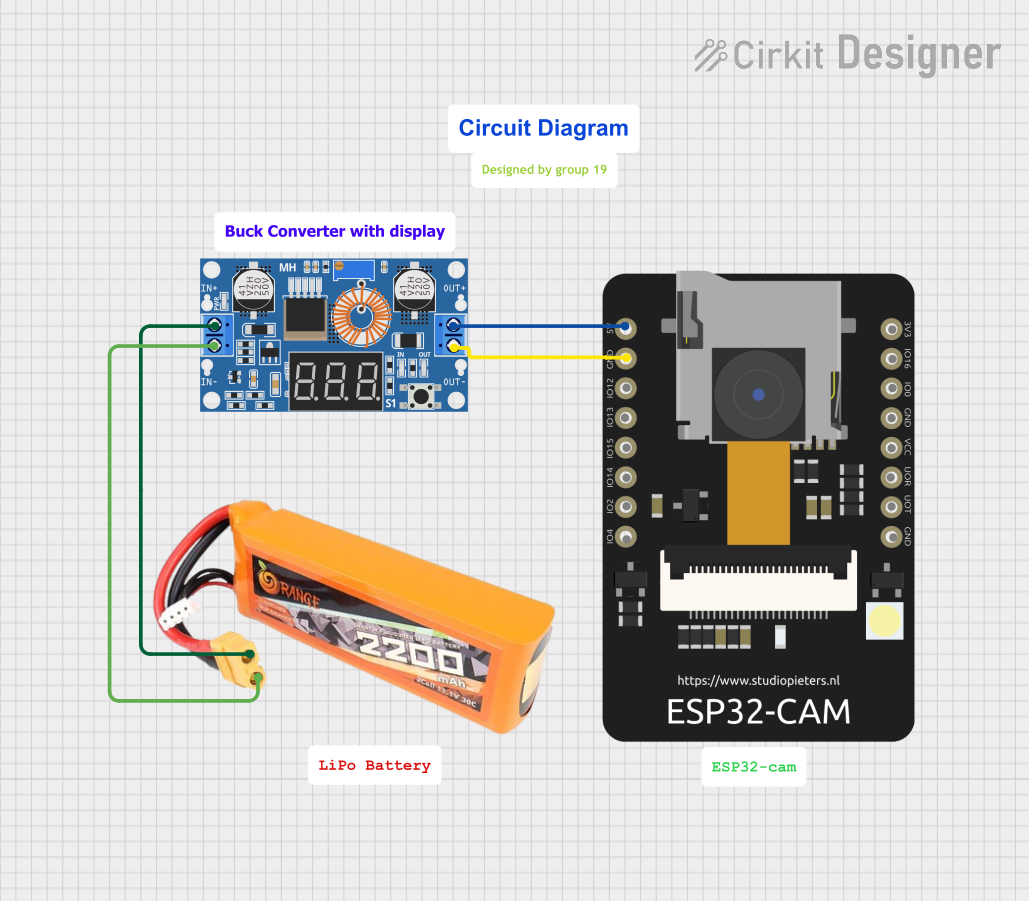
Circuit Documentation
Summary
This circuit consists of a LiPo battery, a DC-DC buck converter, and an ESP32 CAM module. The LiPo battery provides power to the buck converter, which steps down the voltage to a level suitable for the ESP32 CAM. The ESP32 CAM is programmed to perform specific tasks as defined in the provided code.
Component List
LiPo Battery 2200mAH 30C
- Description: A rechargeable lithium polymer battery with a capacity of 2200mAH and a discharge rate of 30C.
- Pins: VCC, GND
XL4015 5A DC Buck Step-down
- Description: A DC-DC buck converter capable of stepping down voltage with a maximum output current of 5A.
- Pins: Output +, Output -, Input +, Input -
ESP32 CAM
- Description: A microcontroller module with integrated WiFi and Bluetooth, featuring a camera interface.
- Pins: 5V, GND, GPIO12, GPIO13, GPIO15, GPIO14, GPIO2, GPIO4, 3.3V, GPIO16, GPIO0, 3.3V / 5V / P_OUT, GPIO3 / RX, GPIO1 / TX
Wiring Details
LiPo Battery 2200mAH 30C
- VCC is connected to Input + of the XL4015 5A DC Buck Step-down.
- GND is connected to Input - of the XL4015 5A DC Buck Step-down.
XL4015 5A DC Buck Step-down
- Output + is connected to 5V of the ESP32 CAM.
- Output - is connected to GND of the ESP32 CAM.
- Input + is connected to VCC of the LiPo Battery 2200mAH 30C.
- Input - is connected to GND of the LiPo Battery 2200mAH 30C.
ESP32 CAM
- 5V is connected to Output + of the XL4015 5A DC Buck Step-down.
- GND is connected to Output - of the XL4015 5A DC Buck Step-down.
Code Documentation
ESP32 CAM Code
sketch.ino
void setup() {
  // put your setup code here, to run once:

}

void loop() {
  // put your main code here, to run repeatedly:

}
documentation.txt
This document provides a comprehensive overview of the circuit, including a summary, detailed component descriptions, wiring details, and the code used for the ESP32 CAM.