
Circuit Documentation
Summary of the Circuit
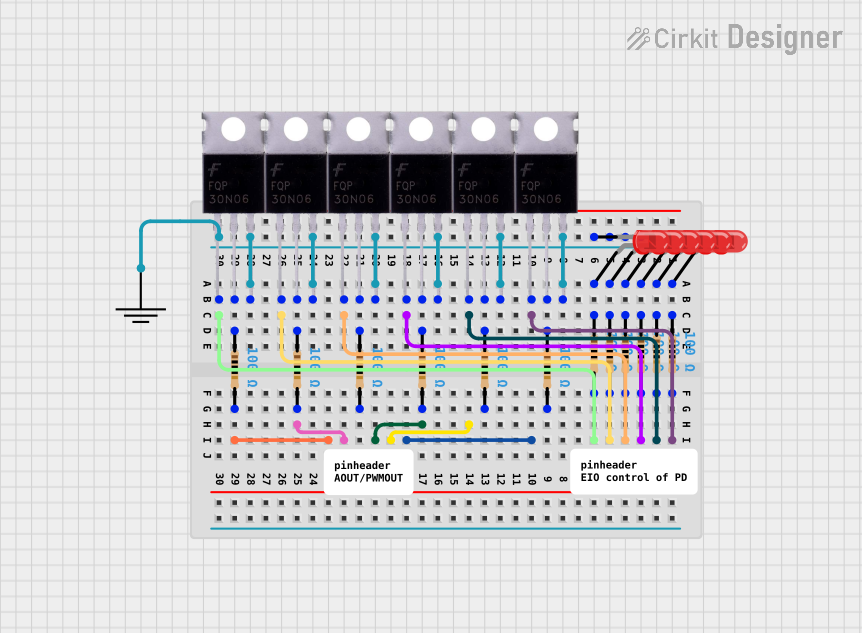
The circuit in question appears to be a series of MOSFET-driven LED arrays. Each MOSFET controls a parallel array of LEDs, with a resistor in series with each LED to limit the current. The gates of the MOSFETs are each connected to a resistor, which may be for the purpose of gate voltage control or pull-down functionality. The sources of all MOSFETs are connected together and to the ground (GND), forming a common ground for the circuit. There is no microcontroller code provided, indicating that the MOSFETs may be driven by an external signal not included in this documentation.
Component List
Ground (GND)
- Description: Common ground reference point for the circuit.
Resistor
- Description: Passive two-terminal electrical component that implements electrical resistance as a circuit element.
- Properties: 100 Ohms resistance.
MOSFET
- Description: Type of field-effect transistor used for amplifying or switching electronic signals.
LED: Two Pin (red)
- Description: A two-pin light-emitting diode that emits red light when powered.
Wiring Details
MOSFETs
- Gate: Connected to a 100 Ohm resistor.
- Drain: Connected to the anode of a series of LEDs through a 100 Ohm resistor.
- Source: Commonly connected to GND along with the cathodes of all LEDs.
Resistors
- Connected between the gate of a MOSFET and an unspecified voltage source (not included in the documentation).
- Connected in series with the anode of each LED to limit the current through the LED.
LEDs
- Cathode: Connected to the source of a MOSFET and to GND.
- Anode: Connected to the drain of a MOSFET through a 100 Ohm resistor.
Documented Code
No code has been provided for any microcontrollers in the circuit. If the circuit is intended to be controlled by a microcontroller or other digital logic, the code responsible for driving the MOSFET gates is not included in this documentation.
Please note that the actual functionality of the circuit would depend on the external signals applied to the gates of the MOSFETs, which are not detailed in the provided documentation.