
Circuit Documentation
Summary of the Circuit
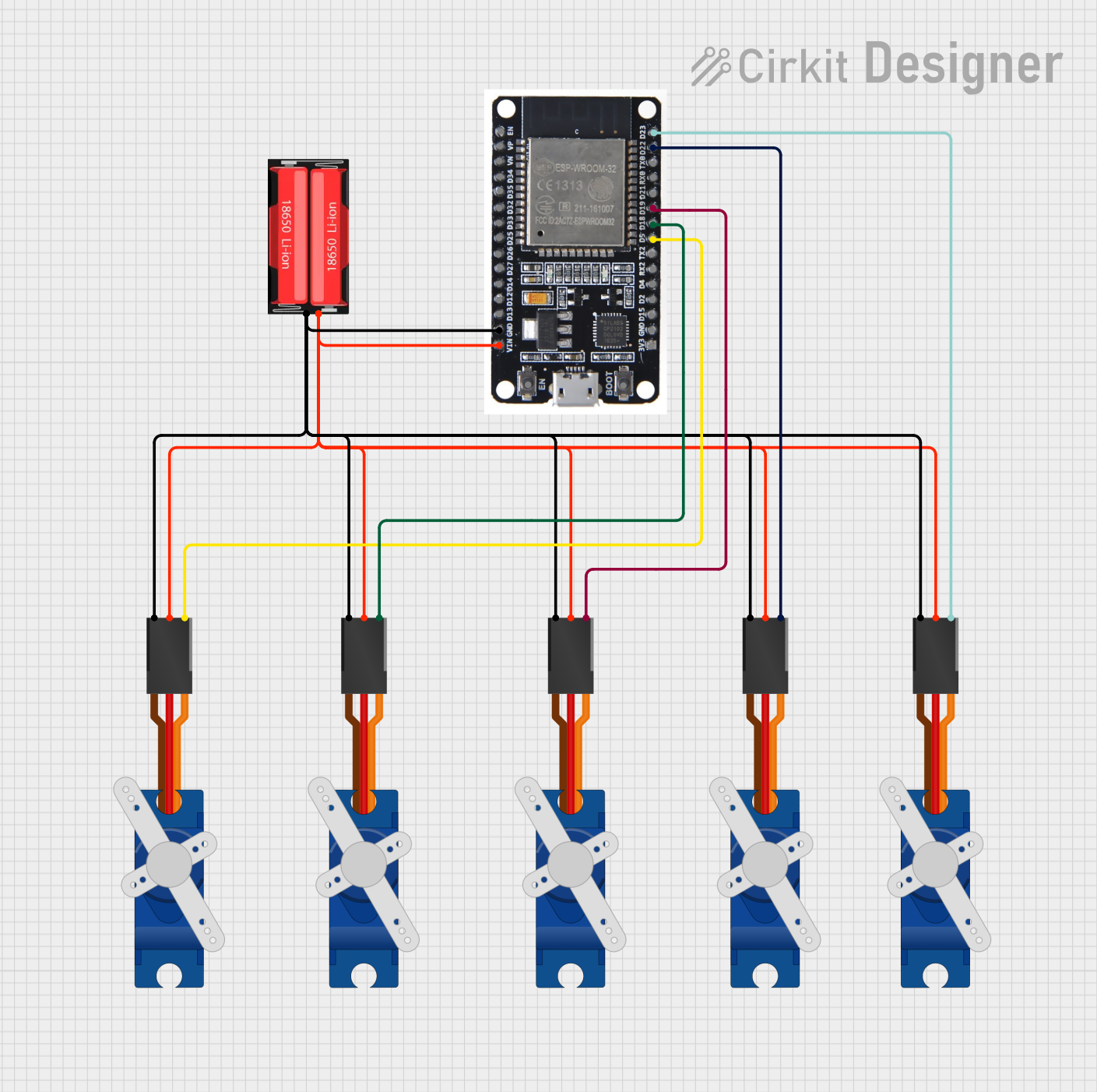
This circuit is designed to control multiple Tower Pro SG90 servos using an ESP32 microcontroller. The ESP32 is responsible for generating the control signals for the servos and is powered by an 18650 Li-Ion battery. The ground connections of all components are tied together, and the servos are powered directly from the battery through the ESP32's VIN pin. The servos are controlled by the ESP32 through its GPIO pins.
Component List
ESP32
- Description: A microcontroller with Wi-Fi and Bluetooth capabilities, suitable for a wide range of applications.
- Pins: EN, VP, VN, D34, D35, D32, D33, D25, D26, D27, D14, D12, D13, GND, VIN, 3V3, D15, D2, D4, RX2, TX2, D5, D18, D19, D21, RX0, TX0, D22, D23, BOOT
Tower Pro SG90 Servo
- Description: A small and lightweight servo motor suitable for RC vehicles, robotics, and small-scale projects.
- Pins: Signal, +5V, GND
18650 Li-Ion Battery
- Description: A rechargeable lithium-ion battery commonly used in portable electronics and electric vehicles.
- Pins: Positive, Negative
Wiring Details
ESP32
- GND: Connected to the ground plane shared with all servos and the negative terminal of the battery.
- VIN: Connected to the positive terminal of the battery and provides power to all servos.
- D5, D18, D19, D22, D23: Control signal outputs to the servos.
Tower Pro SG90 Servos
- Signal: Each servo's signal pin is connected to a corresponding GPIO pin on the ESP32 for control.
- +5V: All servos are connected in parallel to the VIN pin of the ESP32.
- GND: All servos share a common ground connection with the ESP32 and the battery's negative terminal.
18650 Li-Ion Battery
- Positive: Provides power to the ESP32 and all servos through the VIN pin.
- Negative: Common ground for the entire circuit.
Documented Code
The code for the ESP32 microcontroller is not provided in the input. However, the typical code structure for controlling Tower Pro SG90 servos with an ESP32 would include setting up the GPIO pins as PWM outputs and writing functions to control the angle of the servos based on the PWM signal.
// Example ESP32 code to control Tower Pro SG90 servos would go here.
// Since no code was provided, this section is a placeholder for the actual embedded code.
Please note that the actual code would need to be provided to complete this section of the documentation.