
Circuit Documentation
Summary
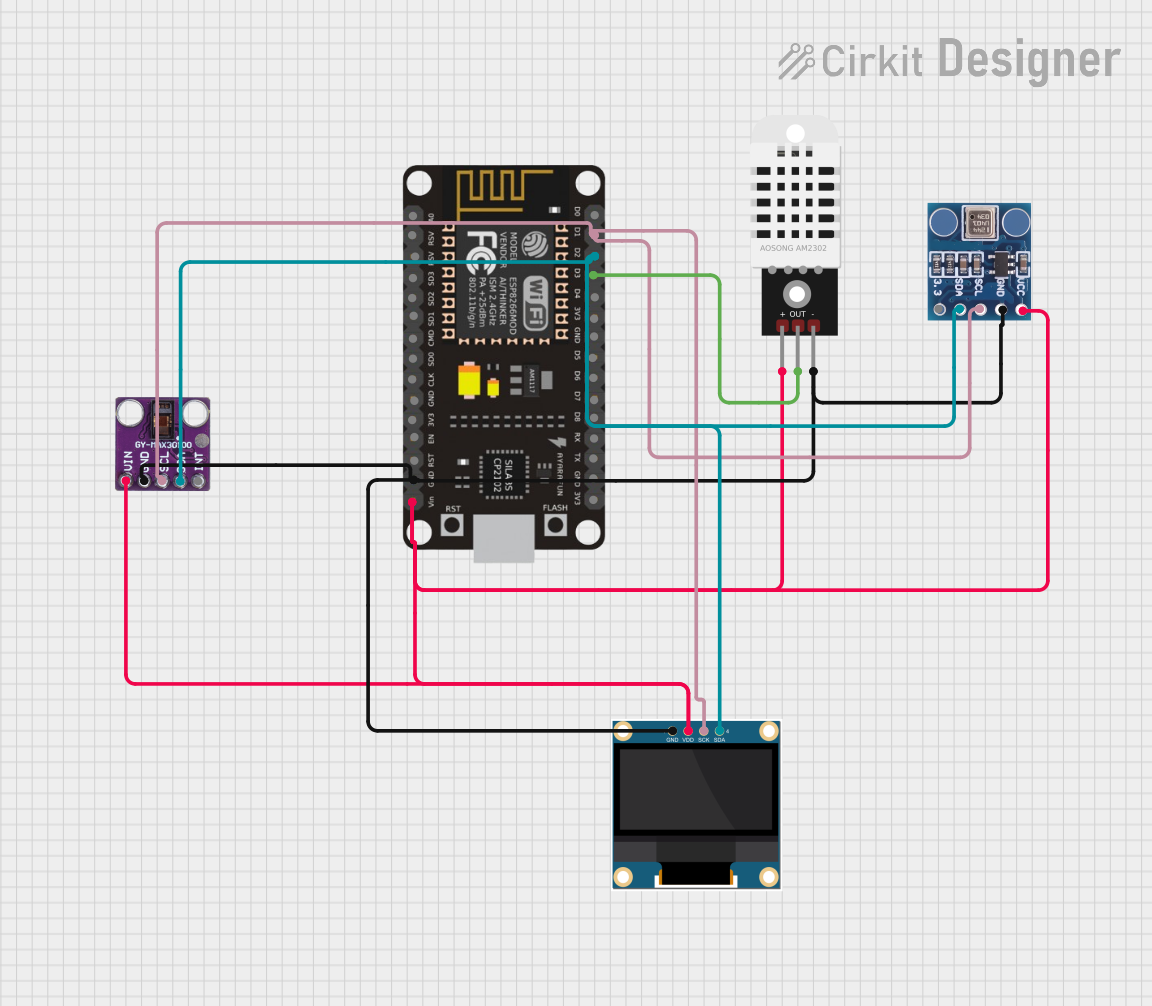
This document provides a detailed overview of a circuit that integrates various sensors and a display module with an ESP8266 NodeMCU microcontroller. The circuit includes a MAX30100 pulse oximeter, a 0.96" OLED display, a DHT22 temperature and humidity sensor, and a BMP180 barometric pressure sensor. The components are interconnected to facilitate data acquisition and display.
Component List
ESP8266 NodeMCU
- Description: A low-cost Wi-Fi microcontroller with GPIO, ADC, and other interfaces.
- Pins: D0, D1, D2, D3, D4, 3V3, GND, D5, D6, D7, D8, RX, TX, A0, RSV, SD3, SD2, SD1, CMD, SD0, CLK, EN, RST, VIN
MAX30100
- Description: Pulse oximeter and heart-rate sensor.
- Pins: Vin, gnd, scl, sda, int
0.96" OLED
- Description: Small OLED display for visual output.
- Pins: GND, VDD, SCK, SDA
DHT22
- Description: Temperature and humidity sensor.
- Pins: +, Out, -
BMP180
- Description: Barometric pressure sensor.
- Pins: 3.3, SDA, SCL, GND, VCC
Wiring Details
ESP8266 NodeMCU
- D1: Connected to BMP180 (SCL), MAX30100 (scl), 0.96" OLED (SCK)
- D2: Connected to BMP180 (SDA), MAX30100 (sda), 0.96" OLED (SDA)
- D3: Connected to DHT22 (Out)
- GND: Connected to BMP180 (GND), MAX30100 (gnd), DHT22 (-), 0.96" OLED (GND)
- VIN: Connected to BMP180 (VCC), MAX30100 (Vin), DHT22 (+), 0.96" OLED (VDD)
MAX30100
- Vin: Connected to ESP8266 NodeMCU (VIN)
- gnd: Connected to ESP8266 NodeMCU (GND)
- scl: Connected to ESP8266 NodeMCU (D1)
- sda: Connected to ESP8266 NodeMCU (D2)
0.96" OLED
- GND: Connected to ESP8266 NodeMCU (GND)
- VDD: Connected to ESP8266 NodeMCU (VIN)
- SCK: Connected to ESP8266 NodeMCU (D1)
- SDA: Connected to ESP8266 NodeMCU (D2)
DHT22
- +: Connected to ESP8266 NodeMCU (VIN)
- Out: Connected to ESP8266 NodeMCU (D3)
- -: Connected to ESP8266 NodeMCU (GND)
BMP180
- 3.3: Not connected
- SDA: Connected to ESP8266 NodeMCU (D2)
- SCL: Connected to ESP8266 NodeMCU (D1)
- GND: Connected to ESP8266 NodeMCU (GND)
- VCC: Connected to ESP8266 NodeMCU (VIN)
Code
No code provided for this circuit.
This document provides a comprehensive overview of the circuit, including a summary, component list, wiring details, and code (if any). The wiring details ensure that each component is correctly connected to the ESP8266 NodeMCU, facilitating proper operation of the circuit.