
Arduino UNO-Based Battery-Powered Line Following and Obstacle Avoidance Robot
View and Edit Project In Cirkit Designer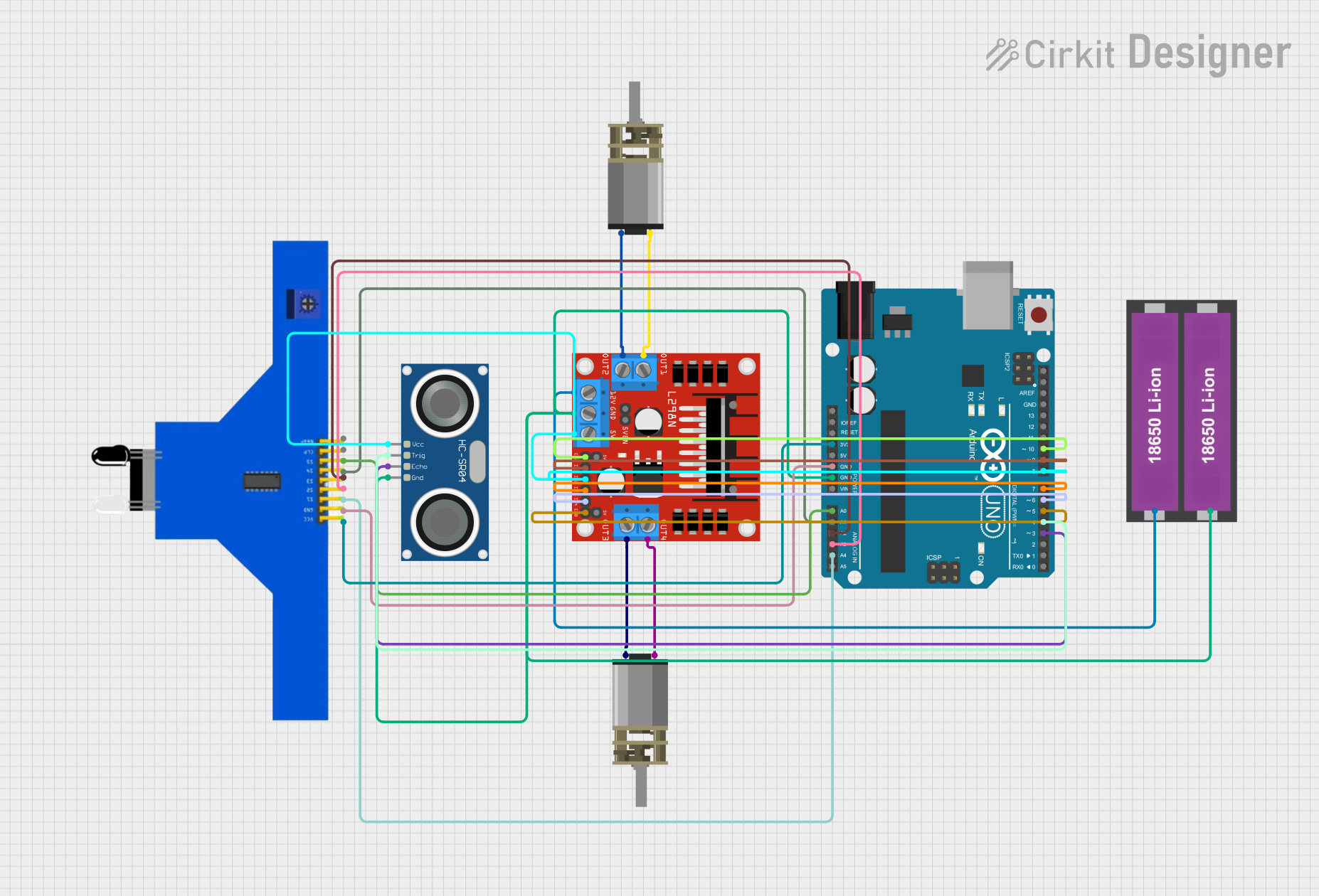
Circuit Documentation
Summary
This document provides a detailed overview of a circuit that includes an Arduino UNO microcontroller, an L298N DC motor driver, an HC-SR04 Ultrasonic Sensor, a 5-channel IR sensor, two DC Mini Metal Gear Motors, and a pair of 18650 Li-ion batteries. The circuit is designed to control the motors and sensors using the Arduino UNO, with power supplied by the Li-ion batteries.
Component List
Arduino UNO
- Description: A microcontroller board based on the ATmega328P.
- Pins: UNUSED, IOREF, Reset, 3.3V, 5V, GND, Vin, A0, A1, A2, A3, A4, A5, SCL, SDA, AREF, D13, D12, D11, D10, D9, D8, D7, D6, D5, D4, D3, D2, D1, D0
L298N DC Motor Driver
- Description: A dual H-Bridge motor driver that allows control of two DC motors.
- Pins: OUT1, OUT2, 12V, GND, 5V, OUT3, OUT4, 5V-ENA-JMP-I, 5V-ENA-JMP-O, +5V-J1, +5V-J2, ENA, IN1, IN2, IN3, IN4, ENB
HC-SR04 Ultrasonic Sensor
- Description: A sensor used for measuring distance using ultrasonic waves.
- Pins: VCC, TRIG, ECHO, GND
5-channel IR Sensor
- Description: A sensor module with 5 IR sensors used for line tracking and obstacle detection.
- Pins: VCC, GND, S1, S2, S3, S4, S5, CLP, Near
DC Mini Metal Gear Motor
- Description: A small DC motor with metal gears for increased durability.
- Pins: IN1, IN2
18650 Li-ion Battery x 2
- Description: Rechargeable lithium-ion batteries.
- Pins: +, -
Wiring Details
Arduino UNO
- 3.3V connected to 5-channel IR sensor VCC
- GND connected to 5-channel IR sensor GND, HC-SR04 Ultrasonic Sensor GND, L298N DC motor driver GND, 18650 Li-ion Battery -
- A0 connected to 5-channel IR sensor S5
- A1 connected to 5-channel IR sensor S4
- A2 connected to 5-channel IR sensor S3
- A3 connected to 5-channel IR sensor S2
- A4 connected to 5-channel IR sensor S1
- D10 connected to L298N DC motor driver ENA
- D9 connected to L298N DC motor driver IN1
- D8 connected to L298N DC motor driver IN2, L298N DC motor driver 5V, HC-SR04 Ultrasonic Sensor VCC
- D7 connected to L298N DC motor driver IN3
- D6 connected to L298N DC motor driver IN4
- D5 connected to L298N DC motor driver ENB
- D4 connected to HC-SR04 Ultrasonic Sensor TRIG
- D3 connected to HC-SR04 Ultrasonic Sensor ECHO
L298N DC Motor Driver
- OUT1 connected to DC Mini Metal Gear Motor IN2
- OUT2 connected to DC Mini Metal Gear Motor IN1
- 12V connected to 18650 Li-ion Battery +
- OUT3 connected to DC Mini Metal Gear Motor IN2
- OUT4 connected to DC Mini Metal Gear Motor IN1
HC-SR04 Ultrasonic Sensor
- GND connected to Arduino UNO GND, L298N DC motor driver GND, 18650 Li-ion Battery -
- VCC connected to L298N DC motor driver IN2, L298N DC motor driver 5V, Arduino UNO D8
- TRIG connected to Arduino UNO D4
- ECHO connected to Arduino UNO D3
5-channel IR Sensor
- VCC connected to Arduino UNO 3.3V
- GND connected to Arduino UNO GND
- S1 connected to Arduino UNO A4
- S2 connected to Arduino UNO A3
- S3 connected to Arduino UNO A2
- S4 connected to Arduino UNO A1
- S5 connected to Arduino UNO A0
DC Mini Metal Gear Motor (1)
- IN2 connected to L298N DC motor driver OUT1
- IN1 connected to L298N DC motor driver OUT2
DC Mini Metal Gear Motor (2)
- IN2 connected to L298N DC motor driver OUT3
- IN1 connected to L298N DC motor driver OUT4
18650 Li-ion Battery x 2
- + connected to L298N DC motor driver 12V
- - connected to Arduino UNO GND, HC-SR04 Ultrasonic Sensor GND, L298N DC motor driver GND
Documented Code
Arduino UNO Code (sketch.ino)
void setup() {
  // put your setup code here, to run once:

}

void loop() {
  // put your main code here, to run repeatedly:

}
Additional Documentation (documentation.txt)