
Arduino Nano-Controlled Joystick Interface with Fan Motor Actuation
View and Edit Project In Cirkit Designer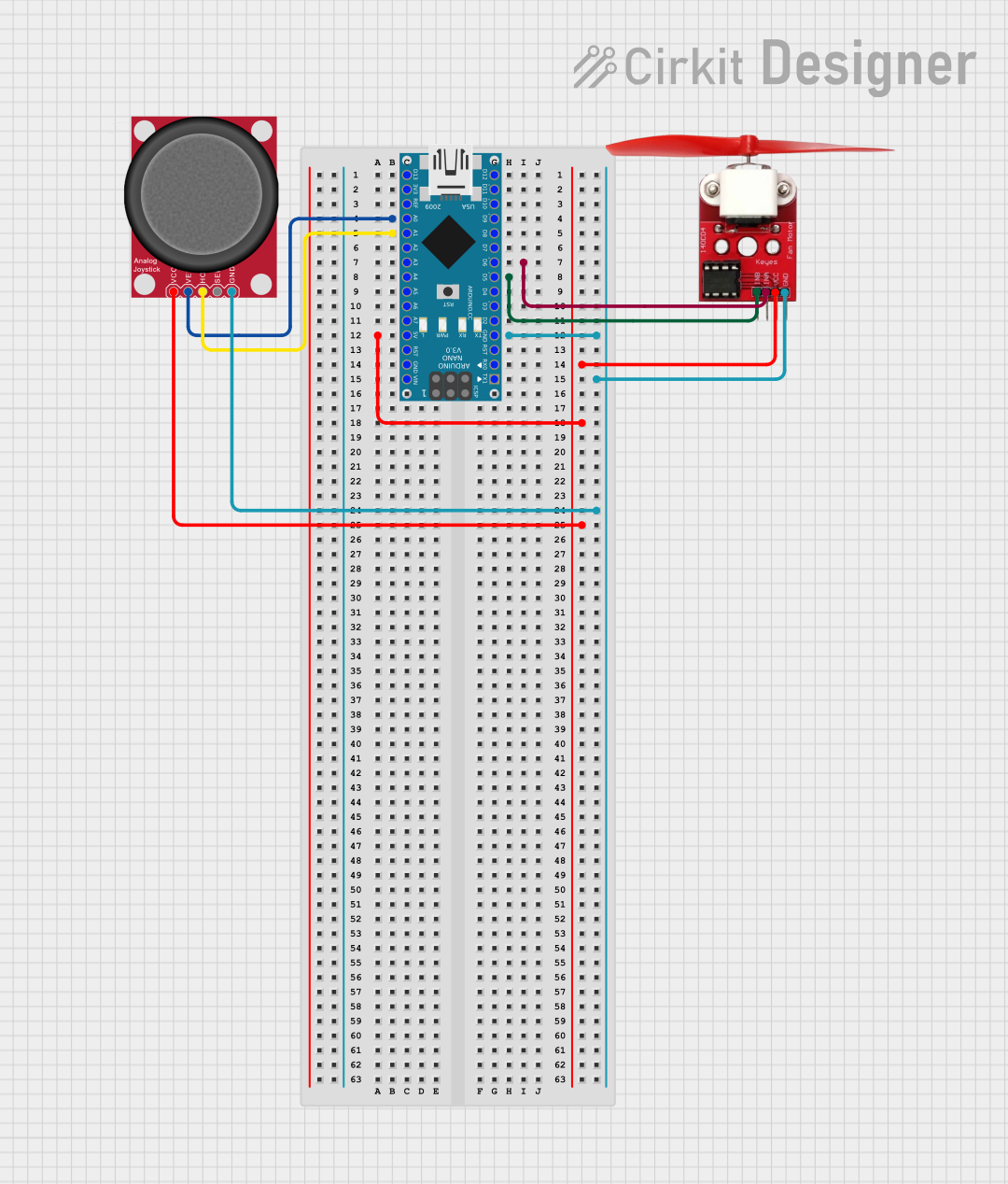
Circuit Documentation
Summary
This circuit integrates an Arduino Nano microcontroller with an analog joystick and a fan motor (L9110). The joystick provides two-dimensional input to the Arduino, which then controls the operation of the fan motor based on the joystick's position. The Arduino Nano is responsible for reading the analog signals from the joystick and driving the fan motor through its digital pins.
Component List
Arduino Nano
- Description: A compact microcontroller board based on the ATmega328P.
- Pins: D1/TX, D0/RX, RESET, GND, D2, D3, D4, D5, D6, D7, D8, D9, D10, D11/MOSI, D12/MISO, VIN, 5V, A7, A6, A5, A4, A3, A2, A1, A0, AREF, 3V3, D13/SCK.
Fan Motor L9110
- Description: A small motor driven by the L9110 driver, suitable for fan applications.
- Pins: INB, INA, VCC, GND.
Analog Joystick (Wokwi Compatible)
- Description: A two-axis analog joystick with a push-button.
- Pins: VCC, VERT, HORZ, SEL, GND.
Wiring Details
Arduino Nano
- A0 connected to Joystick VERT
- A1 connected to Joystick HORZ
- D6 connected to Fan Motor INA
- D5 connected to Fan Motor INB
- 5V connected to Fan Motor VCC and Joystick VCC
- GND connected to Fan Motor GND and Joystick GND
Fan Motor L9110
- INA connected to Arduino Nano D6
- INB connected to Arduino Nano D5
- VCC connected to Arduino Nano 5V
- GND connected to Arduino Nano GND
Analog Joystick (Wokwi Compatible)
- VERT connected to Arduino Nano A0
- HORZ connected to Arduino Nano A1
- VCC connected to Arduino Nano 5V
- GND connected to Arduino Nano GND
Documented Code
Arduino Nano Code (sketch.ino)
void setup() {
  // put your setup code here, to run once:

}

void loop() {
  // put your main code here, to run repeatedly:

}
Additional Notes (documentation.txt)
No additional documentation provided for the code.
This documentation provides an overview of the circuit components, their wiring, and the initial code structure for the Arduino Nano. Further details, such as the specific functionality of the code and the purpose of each part in the circuit, would be necessary to fully understand and replicate the circuit's intended operation.