
Circuit Documentation
Summary
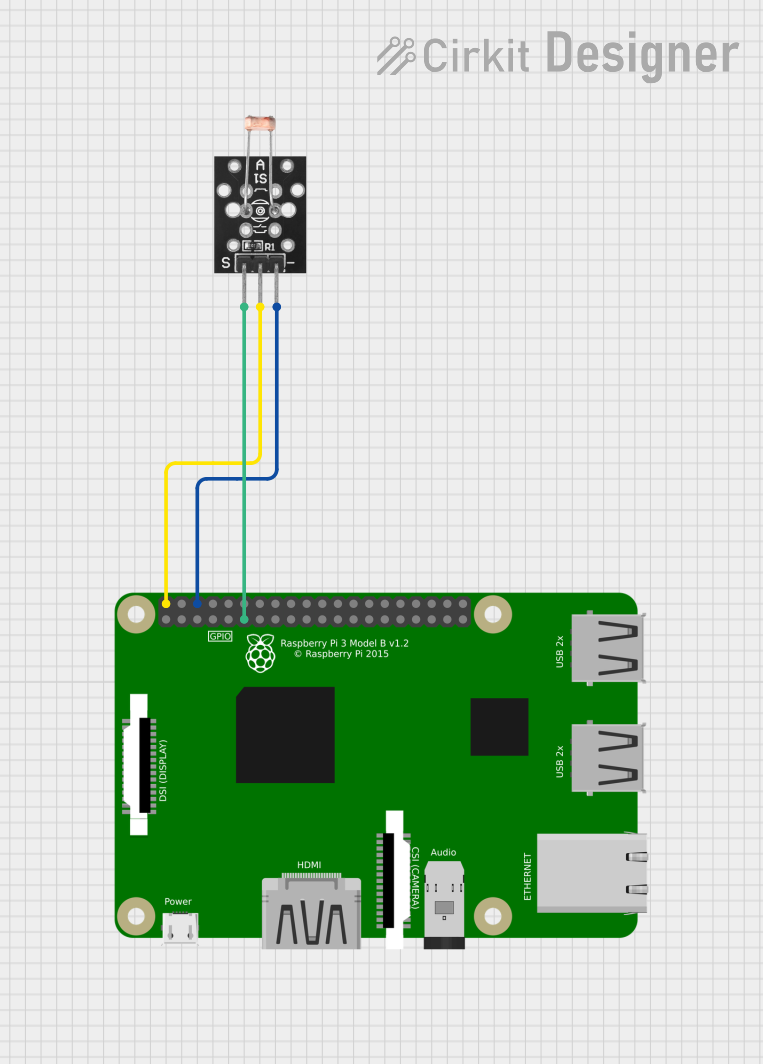
This document provides a detailed overview of a simple light-sensing circuit that interfaces a KY-018 LDR Photo Resistor with a Raspberry Pi 3B. The circuit is designed to detect the intensity of light and can be used for applications such as automatic brightness control or light level monitoring.
Component List
Raspberry Pi 3B
- Description: The Raspberry Pi 3B is a versatile single-board computer with a variety of GPIO pins that can be used for interfacing with various sensors and peripherals.
- Purpose: Acts as the main controller for the circuit, reading the signal from the LDR photoresistor and processing the data.
- Pins: 40 GPIO pins including power, ground, and general-purpose I/O.
KY-018 LDR Photo Resistor
- Description: An LDR (Light Dependent Resistor) or photoresistor is a sensor that changes its resistance based on the light intensity.
- Purpose: Senses the ambient light level and provides an analog signal to the Raspberry Pi for interpretation.
- Pins: Signal, VCC, Ground.
Wiring Details
Raspberry Pi 3B
- Signal (GPIO 11): Connects to the Signal pin of the KY-018 LDR Photo Resistor.
- Ground (Pin 6): Connects to the Ground pin of the KY-018 LDR Photo Resistor.
- 2(5V) (Pin 2): Provides power to the VCC pin of the KY-018 LDR Photo Resistor.
KY-018 LDR Photo Resistor
- Signal: Connected to GPIO 11 on the Raspberry Pi 3B.
- VCC: Connected to the 5V power supply from the Raspberry Pi 3B.
- Ground: Connected to the Ground pin on the Raspberry Pi 3B.
Documented Code
No code has been provided for the microcontrollers in the circuit. To fully utilize the circuit, code should be written and deployed to the Raspberry Pi 3B to read the analog signal from the KY-018 LDR Photo Resistor, interpret the light intensity, and perform desired actions based on the light level detected.
Please note that the Raspberry Pi does not have native analog input pins, so an analog-to-digital converter (ADC) or similar method would be required to read the analog signal from the LDR sensor. This documentation assumes that such a method is in place or will be implemented.