
ESP32-Based Air Quality Monitor with OLED Display and DHT11 Sensor
View and Edit Project In Cirkit Designer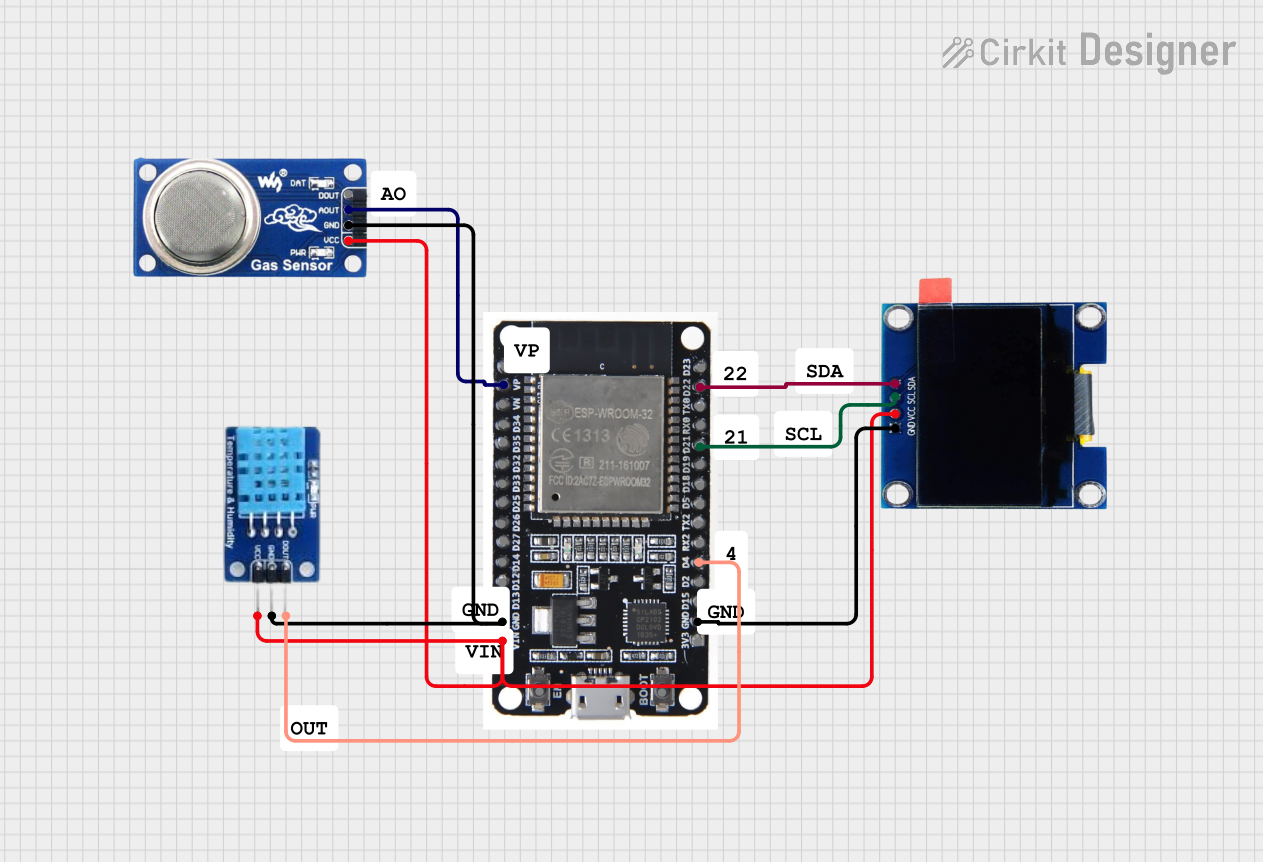
Circuit Documentation
Summary of the Circuit
This circuit integrates an ESP32 microcontroller with a DHT11 temperature and humidity sensor, an MQ6 gas sensor, and an OLED 1.3" display. The ESP32 serves as the central processing unit, interfacing with the sensors to collect environmental data and displaying the information on the OLED screen. The DHT11 sensor provides temperature and humidity readings, while the MQ6 sensor detects the presence of gases such as LPG, propane, and methane. The OLED display shows the collected data in real-time. The circuit is designed to be powered through the ESP32's VIN pin, which distributes power to the other components.
Component List
ESP32
- Description: A microcontroller with Wi-Fi and Bluetooth capabilities, featuring a variety of digital and analog I/O pins.
- Pins: EN, VP, VN, D34, D35, D32, D33, D25, D26, D27, D14, D12, D13, GND, VIN, 3V3, D15, D2, D4, RX2, TX2, D5, D18, D19, D21, RX0, TX0, D22, D23, BOOT
DHT11
- Description: A digital temperature and humidity sensor with a calibrated digital signal output.
- Pins: DATA, GND, VCC
OLED 1.3"
- Description: A small display module with I2C interface, suitable for displaying text and graphics.
- Pins: GND, VCC, SCL, SDA
MQ6
- Description: A gas sensor designed for detecting LPG, propane, and methane.
- Pins: VCC, GND, A0, DO
Wiring Details
ESP32
- VP connected to MQ6 A0
- GND connected to MQ6 GND, DHT11 GND, OLED GND
- VIN connected to MQ6 VCC, DHT11 VCC, OLED VCC
- D4 connected to DHT11 DATA
- D21 connected to OLED SCL
- D22 connected to OLED SDA
DHT11
- DATA connected to ESP32 D4
- GND connected to ESP32 GND
- VCC connected to ESP32 VIN
OLED 1.3"
- GND connected to ESP32 GND
- VCC connected to ESP32 VIN
- SCL connected to ESP32 D21
- SDA connected to ESP32 D22
MQ6
- A0 connected to ESP32 VP
- GND connected to ESP32 GND
- VCC connected to ESP32 VIN
Documented Code
No code has been provided for the microcontroller. The documentation of the code would typically include a description of the functionality, setup, and main loop, along with comments explaining the purpose of each function and code block. Since no code is available, this section cannot be completed. If code becomes available, it should be documented here following the structure mentioned above.