
Arduino UNO-Based NPK Soil Sensor with OLED Display and RS-485 Communication
View and Edit Project In Cirkit Designer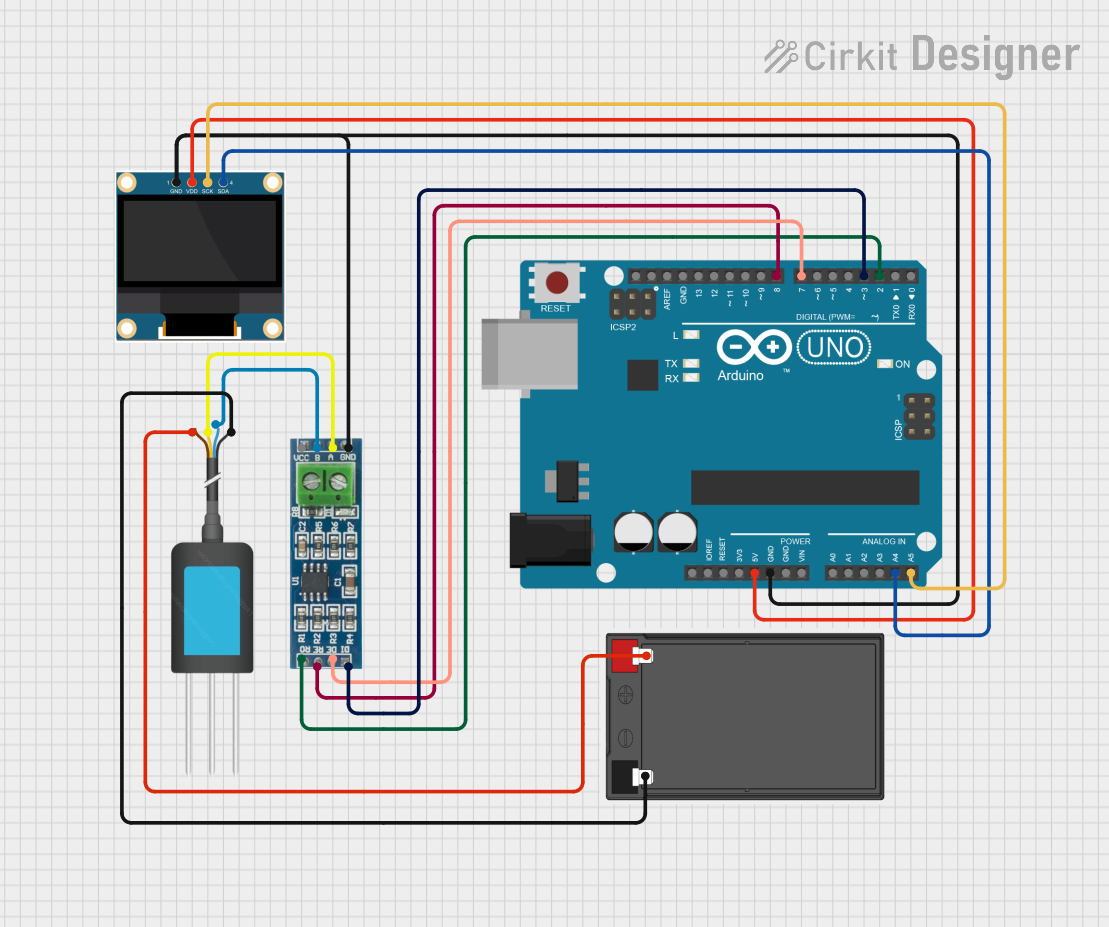
Circuit Documentation
Summary
This circuit is designed to measure soil nutrients (Nitrogen, Phosphorous, and Potassium) using an NPK Soil Sensor and display the results on a 0.96" OLED display. The circuit utilizes an Arduino UNO as the main microcontroller, an RS-485 module for communication with the soil sensor, and a battery for powering the soil sensor.
Component List
Arduino UNO
- Description: A microcontroller board based on the ATmega328P.
- Pins: UNUSED, IOREF, Reset, 3.3V, 5V, GND, Vin, A0, A1, A2, A3, A4, A5, SCL, SDA, AREF, D13, D12, D11, D10, D9, D8, D7, D6, D5, D4, D3, D2, D1, D0
NPK Soil Sensor
- Description: A sensor used to measure the levels of Nitrogen, Phosphorous, and Potassium in the soil.
- Pins: 12V DC, A, B, GND
RS-485 Module
- Description: A module used for RS-485 communication.
- Pins: VCC, B, A, GND, RO, RE, DE, DI
0.96" OLED
- Description: A small OLED display used to show the measured nutrient levels.
- Pins: GND, VDD, SCK, SDA
Battery
- Description: A power source for the NPK Soil Sensor.
- Pins: -, +
Wiring Details
Arduino UNO
- 5V connected to 0.96" OLED VDD
- GND connected to RS-485 Module GND and 0.96" OLED GND
- A4 connected to 0.96" OLED SDA
- A5 connected to 0.96" OLED SCK
- D8 connected to RS-485 Module RE
- D7 connected to RS-485 Module DE
- D3 connected to RS-485 Module DI
- D2 connected to RS-485 Module RO
NPK Soil Sensor
- 12V DC connected to Battery +
- A connected to RS-485 Module A
- B connected to RS-485 Module B
- GND connected to Battery -
RS-485 Module
- GND connected to Arduino UNO GND
- RE connected to Arduino UNO D8
- DE connected to Arduino UNO D7
- DI connected to Arduino UNO D3
- RO connected to Arduino UNO D2
- A connected to NPK Soil Sensor A
- B connected to NPK Soil Sensor B
0.96" OLED
- GND connected to Arduino UNO GND
- VDD connected to Arduino UNO 5V
- SCK connected to Arduino UNO A5
- SDA connected to Arduino UNO A4
Battery
- + connected to NPK Soil Sensor 12V DC
- - connected to NPK Soil Sensor GND
Documented Code
Arduino UNO Code
#include <Wire.h>
#include <LiquidCrystal_I2C.h>
#include <SoftwareSerial.h>

#define RE 8
#define DE 7
const byte nitro[] = {0x01,0x03, 0x00, 0x1e, 0x00, 0x01, 0xB5, 0xCC};
const byte phos[] = {0x01,0x03, 0x00, 0x1f, 0x00, 0x01, 0xE4, 0x0C};
const byte pota[] = {0x01,0x03, 0x00, 0x20, 0x00, 0x01, 0x85, 0xC0};

byte values[11];
SoftwareSerial mod(2, 3);  // RS485 TX (2) and RX (3)
LiquidCrystal_I2C lcd(0x27, 16, 2);  // LCD I2C address 0x27, 16x2 display

void setup() {
  Serial.begin(9600);
  mod.begin(9600);
  pinMode(RE, OUTPUT);
  pinMode(DE, OUTPUT);

  lcd.init();            // Initialize the LCD
  lcd.backlight();       // Turn on the backlight
  lcd.setCursor(0, 0);   // Set cursor to the first row
  lcd.print("  Initializing");
  delay(2000);
  lcd.clear();
  lcd.print("   NPK Sensor");
  delay(3000);
}

void loop() {
  byte val1, val2, val3;
  val1 = nitrogen();
  delay(250);
  val2 = phosphorous();
  delay(250);
  val3 = potassium();
  delay(250);

  Serial.print("Nitrogen: ");
  Serial.print(val1);
  Serial.println(" mg/kg");
  Serial.print("Phosphorous: ");
  Serial.print(val2);
  Serial.println(" mg/kg");
  Serial.print("Potassium: ");
  Serial.print(val3);
  Serial.println(" mg/kg");
  delay(2000);

  // Display NPK values on LCD
  lcd.clear();
  lcd.setCursor(0, 0);
  lcd.print("N: ");
  lcd.print(val1);
  lcd.print(" mg/kg");
  lcd.setCursor(0, 1);
  lcd.print("P:");
  lcd.print(val2);
  lcd.print(" K:");
  lcd.print(val3);
  delay(2000);
}

byte nitrogen() {
  digitalWrite(DE, HIGH);
  digitalWrite(RE, HIGH);
  delay(20);  // Increased delay
  if (mod.write(nitro, sizeof(nitro)) == 8) {
    digitalWrite(DE, LOW);
    digitalWrite(RE, LOW);
    delay(20);  // Added delay
    for (byte i = 0; i < 7; i++) {
      if (mod.available()) {
        byte readValue = mod.read();
        values[i] = readValue;
      } else {
        values[i] = 255;  // Default value if no data is available
      }
    }
  }
  return values[4];
}

byte phosphorous() {
  digitalWrite(DE, HIGH);
  digitalWrite(RE, HIGH);
  delay(20);  // Increased delay
  if (mod.write(phos, sizeof(phos)) == 8) {
    digitalWrite(DE, LOW);
    digitalWrite(RE, LOW);
    delay(20);  // Added delay
    for (byte i = 0; i < 7; i++) {
      if (mod.available()) {
        byte readValue = mod.read();
        values[i] = readValue;
      } else {
        values[i] = 255;  // Default value if no data is available
      }
    }
  }
  return values[4];
}

byte potassium() {
  digitalWrite(DE, HIGH);
  digitalWrite(RE, HIGH);
  delay(20);  // Increased delay
  if (mod.write(pota, sizeof(pota)) == 8) {
    digitalWrite(DE, LOW);
    digitalWrite(RE, LOW);
    delay(20);  // Added delay
    for (byte i = 0; i < 7; i++) {
      if (mod.available()) {
        byte readValue = mod.read();
        values[i] = readValue;
      } else {
        values[i] = 255;  // Default value if no data is available
      }
    }
  }
  return values[4];
}
NPK Soil Sensor Code
void setup() {
  // put your setup code here, to run once:
}

void loop() {
  // put your main code here, to run repeatedly:
}
0.96" OLED Code
void setup() {
  // put your setup code here, to run once:
}

void loop() {
  // put your main code here, to run repeatedly:
}