
Arduino Mega-Controlled DC Motor System with Bluetooth Connectivity
View and Edit Project In Cirkit Designer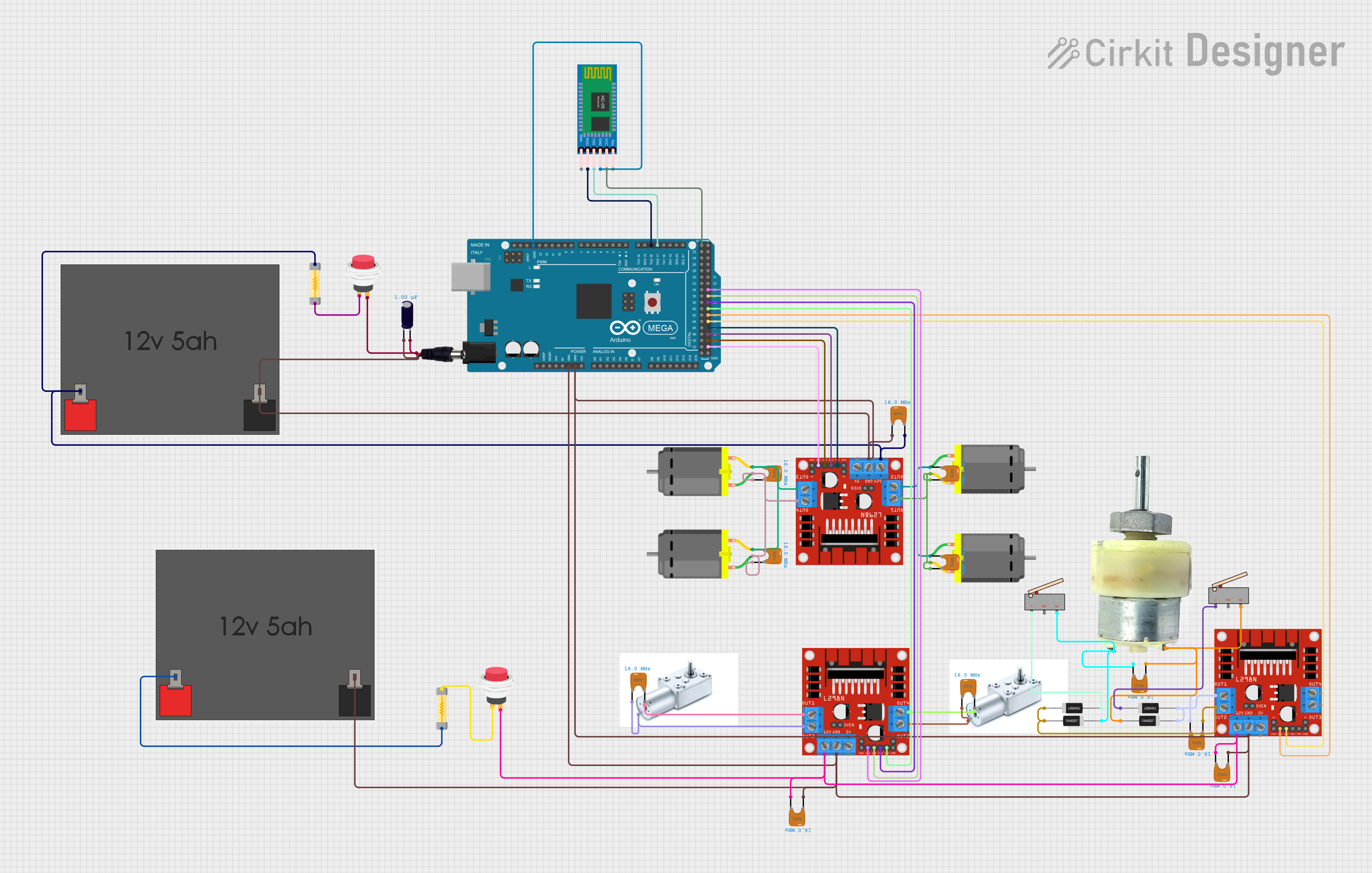
Circuit Documentation
Summary
The circuit in question appears to be a complex system involving power management, motor control, and communication modules. It includes multiple power sources, motor drivers for controlling DC motors, a microcontroller for logic operations, and a Bluetooth module for wireless communication. The circuit is designed to control several motors, possibly for a robotic or automation application, with the capability to receive commands via Bluetooth.
Component List
Power Components
- 12v5ah Batteries: Two batteries providing a 12V power source.
- 5A Fuses: Two fuses for overcurrent protection.
- Power Jack: Used to connect external power sources.
Control Components
- 2Pin Push Switches: Two switches to control the flow of current.
- L298N DC Motor Drivers: Three motor driver modules to control the speed and direction of DC motors.
- Arduino Mega 2560: A microcontroller board based on the ATmega2560, used for controlling the logic of the circuit.
Communication Components
- HC-05 Bluetooth Module: A wireless communication module for Bluetooth connectivity.
Motors
- Greartisan DC 12V 45RPM Turbo Worm Geared Motors: Two geared motors for applications requiring torque.
- DC Motors: Four standard DC motors for various motion applications.
- 12V Geared Motor: A motor with a gear reduction for increased torque.
Protection and Filtering Components
- 1N4007 Rectifier Diodes: Four diodes for preventing reverse current flow.
- Electrolytic Capacitor: A capacitor for filtering and stabilizing the voltage supply.
Miscellaneous Components
- Ceramic Resonators (2-pin): Multiple resonators, possibly for timing or oscillation purposes.
- Limit Switches: Two switches that act as sensors to limit or detect motion.
Wiring Details
Power Components
12v5ah Batteries
- One battery connects to a ceramic resonator, a 5A fuse, and an L298N motor driver.
- The other battery connects to another 5A fuse.
5A Fuses
- One fuse connects between a battery and a push switch.
- The other fuse connects between a battery and a push switch.
Power Jack
- Connected to a push switch and an electrolytic capacitor.
Control Components
2Pin Push Switches
- Each switch controls the connection between a fuse and the power jack or other components.
L298N DC Motor Drivers
- Each driver has connections to the Arduino Mega 2560 for control signals and to motors for driving them.
- Ground and power connections are made to the batteries and power jack.
Arduino Mega 2560
- Controls the L298N motor drivers via digital pins.
- Connected to the HC-05 Bluetooth module for wireless communication.
Communication Components
- HC-05 Bluetooth Module
- Powered by the Arduino Mega 2560.
- Communicates with the Arduino Mega 2560 via TX/RX pins.
Motors
Greartisan DC 12V 45RPM Turbo Worm Geared Motors
- Each motor is driven by an L298N motor driver.
DC Motors
- Each motor is connected to an L298N motor driver.
12V Geared Motor
- Connected to a limit switch and protected by diodes.
Protection and Filtering Components
1N4007 Rectifier Diodes
- Placed in series with motors and limit switches for protection.
Electrolytic Capacitor
- Connected across the power jack for voltage stabilization.
Miscellaneous Components
Ceramic Resonators (2-pin)
- Connected across various components, possibly for noise suppression or timing.
Limit Switches
- Used to detect or limit motion, connected to the 12V geared motor and diodes.
Documented Code
Arduino Mega 2560 Code (sketch.ino)
void setup() {
  // put your setup code here, to run once:

}

void loop() {
  // put your main code here, to run repeatedly:

}
This code is a template and does not contain any specific logic for controlling the circuit. The setup() function is intended for initialization code that runs once, while the loop() function contains code that runs repeatedly, forming the main part of the program. To control the motors and communicate with the Bluetooth module, the code needs to be developed further with appropriate function calls and logic.