
Raspberry Pi 4B and ADS1115-Based Turbidity Monitoring System
View and Edit Project In Cirkit Designer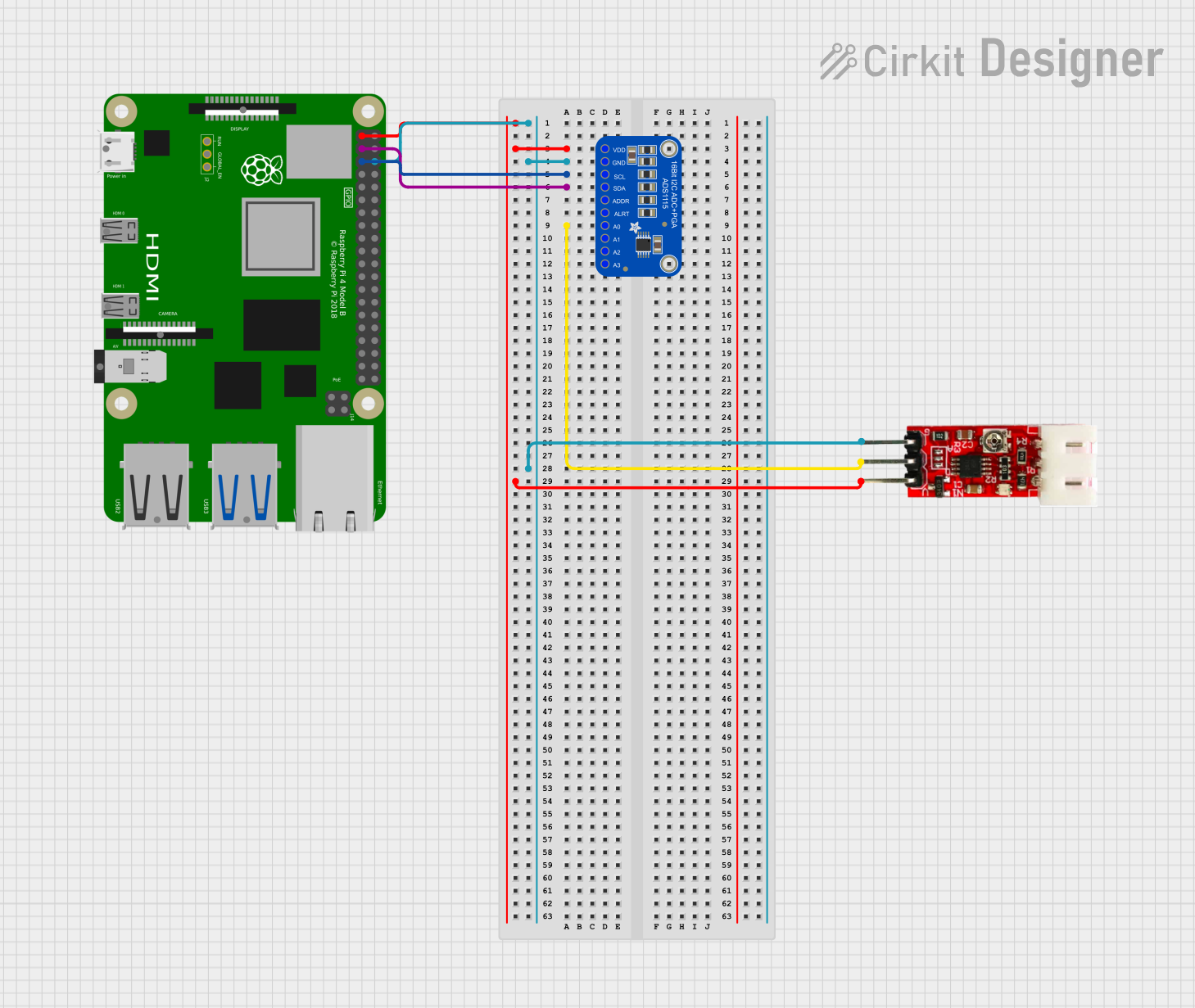
Circuit Documentation
Summary of the Circuit
This circuit integrates a Raspberry Pi 4B with an Adafruit ADS1115 16-Bit I2C ADC and a Turbidity Module to measure the turbidity of a liquid. The Raspberry Pi 4B serves as the central processing unit, controlling the data acquisition from the turbidity sensor through the ADS1115 ADC, which converts the analog signal from the sensor to a digital format that the Raspberry Pi can process.
Component List
Raspberry Pi 4B
- Description: A powerful microcomputer capable of running a full Linux distribution and interfacing with various peripherals through its GPIO pins.
- Pins: 3V3, 5V, multiple GPIOs, GND, and others for specific functions.
Adafruit ADS1115 16-Bit I2C ADC
- Description: A high-precision, 16-bit analog-to-digital converter that communicates over I2C, allowing for multiple channels of analog input.
- Pins: VDD, GND, SCL, SDA, ADDR, ALERT, AIN0-3.
Turbidity Module
- Description: A sensor module designed to measure the turbidity (cloudiness) of a liquid, which outputs an analog signal proportional to the turbidity level.
- Pins: VCC, GND, OUT.
Wiring Details
Raspberry Pi 4B
- 3V3: Connected to VDD of the Adafruit ADS1115 ADC and VCC of the Turbidity Module to provide power.
- GND: Connected to GND of the Adafruit ADS1115 ADC and GND of the Turbidity Module to provide a common ground reference.
- GPIO2 (SDA): Connected to SDA of the Adafruit ADS1115 ADC for I2C data communication.
- GPIO3 (SCL): Connected to SCL of the Adafruit ADS1115 ADC for I2C clock signal.
Adafruit ADS1115 16-Bit I2C ADC
- VDD: Powered by the 3V3 pin from the Raspberry Pi 4B.
- GND: Connected to the common ground with the Raspberry Pi 4B.
- SCL: Connected to GPIO3 (SCL) on the Raspberry Pi 4B for I2C clock signal.
- SDA: Connected to GPIO2 (SDA) on the Raspberry Pi 4B for I2C data communication.
- AIN0: Connected to the OUT pin of the Turbidity Module to read the analog turbidity signal.
Turbidity Module
- VCC: Powered by the 3V3 pin from the Raspberry Pi 4B.
- GND: Connected to the common ground with the Raspberry Pi 4B.
- OUT: Connected to AIN0 on the Adafruit ADS1115 ADC to output the analog turbidity signal.
Documented Code
There is no code provided for the microcontrollers in the circuit. To fully utilize this circuit, code would need to be written and deployed to the Raspberry Pi 4B to initialize and read data from the ADS1115 ADC, process the data, and perform any required actions based on the turbidity readings. The code would typically be written in Python, C++, or another suitable language that can interface with the I2C bus on the Raspberry Pi.