
Arduino-Based Smart Car Parking System with IR Sensors and LCD Display
View and Edit Project In Cirkit Designer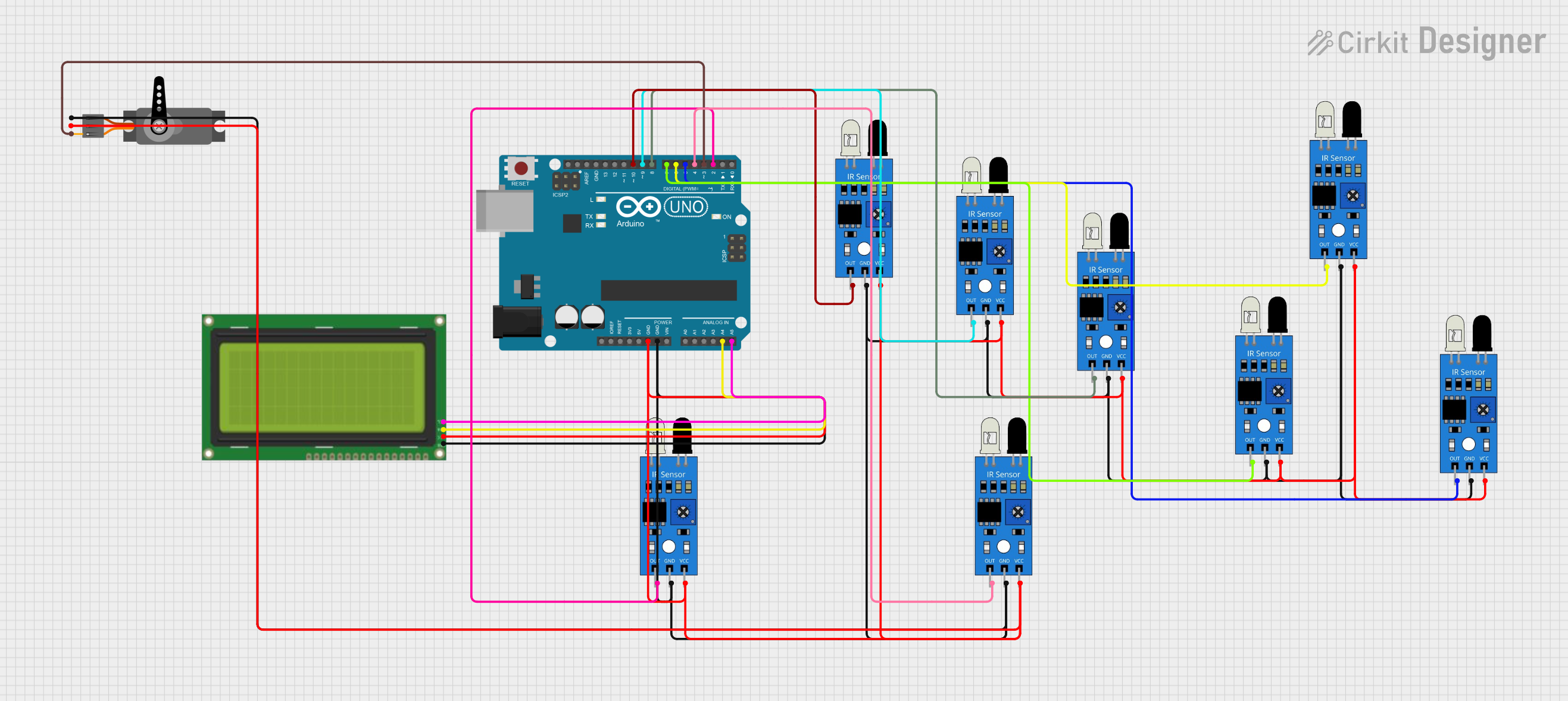
Circuit Documentation
Summary
This circuit is designed to manage a car parking system using an Arduino UNO microcontroller. The system includes multiple IR sensors to detect the presence of cars in different slots, a servo motor to control a gate, and an LCD display to show the status of the parking slots. The Arduino UNO reads the sensor inputs and controls the servo motor and LCD display accordingly.
Component List
IR Sensor
- Description: Infrared sensor used to detect the presence of a car.
- Pins: out, gnd, vcc
Servo
- Description: Servo motor used to control the gate.
- Pins: GND, VCC, PWM
Arduino UNO
- Description: Microcontroller used to control the entire system.
- Pins: UNUSED, IOREF, Reset, 3.3V, 5V, GND, Vin, A0, A1, A2, A3, A4, A5, SCL, SDA, AREF, D13, D12, D11, D10, D9, D8, D7, D6, D5, D4, D3, D2, D1, D0
LCD 20x4 I2C
- Description: LCD display used to show the status of the parking slots.
- Pins: GND, 5v, SCA, SCL
Wiring Details
IR Sensor
- VCC: Connected to the VCC net shared with other IR sensors, Servo, and LCD 20x4 I2C.
- GND: Connected to the GND net shared with other IR sensors, Servo, and LCD 20x4 I2C.
- OUT: Connected to the following Arduino UNO pins:
- IR Sensor 1: D2
- IR Sensor 2: D4
- IR Sensor 3: D5
- IR Sensor 4: D6
- IR Sensor 5: D7
- IR Sensor 6: D8
- IR Sensor 7: D9
- IR Sensor 8: D10
Servo
- VCC: Connected to the VCC net shared with IR sensors and LCD 20x4 I2C.
- GND: Connected to the GND net shared with IR sensors and LCD 20x4 I2C.
- PWM: Connected to Arduino UNO pin D3.
Arduino UNO
- GND: Connected to the GND net shared with IR sensors, Servo, and LCD 20x4 I2C.
- A4: Connected to the SCA pin of the LCD 20x4 I2C.
- A5: Connected to the SCL pin of the LCD 20x4 I2C.
- D2: Connected to the OUT pin of IR Sensor 1.
- D3: Connected to the PWM pin of the Servo.
- D4: Connected to the OUT pin of IR Sensor 2.
- D5: Connected to the OUT pin of IR Sensor 3.
- D6: Connected to the OUT pin of IR Sensor 4.
- D7: Connected to the OUT pin of IR Sensor 5.
- D8: Connected to the OUT pin of IR Sensor 6.
- D9: Connected to the OUT pin of IR Sensor 7.
- D10: Connected to the OUT pin of IR Sensor 8.
LCD 20x4 I2C
- 5V: Connected to the VCC net shared with IR sensors and Servo.
- GND: Connected to the GND net shared with IR sensors and Servo.
- SCA: Connected to Arduino UNO pin A4.
- SCL: Connected to Arduino UNO pin A5.
Documented Code
#include <Servo.h> // Includes the servo library
#include <Wire.h>
#include <LiquidCrystal_I2C.h>

LiquidCrystal_I2C lcd(0x27, 20, 4); // Adjust LCD address and size if necessary
Servo myservo;

#define ir_enter 2
#define ir_back  4

#define ir_car1 5
#define ir_car2 6
#define ir_car3 7
#define ir_car4 8
#define ir_car5 9
#define ir_car6 10

int S1=0, S2=0, S3=0, S4=0, S5=0, S6=0;
int flag1=0, flag2=0;
int slot = 6;

void setup(){
   Serial.begin(9600);

   pinMode(ir_car1, INPUT);
   pinMode(ir_car2, INPUT);
   pinMode(ir_car3, INPUT);
   pinMode(ir_car4, INPUT);
   pinMode(ir_car5, INPUT);
   pinMode(ir_car6, INPUT);

   pinMode(ir_enter, INPUT);
   pinMode(ir_back, INPUT);

   myservo.attach(3);
   myservo.write(90);

   lcd.begin();       // Initialize the LCD
   lcd.backlight();  // Turn on the LCD backlight
   lcd.setCursor(0,1);
   lcd.print("    Car  parking  ");
   lcd.setCursor(0,2);
   lcd.print("       System     ");
   delay(2000);
   lcd.clear();

   Read_Sensor();

   int total = S1 + S2 + S3 + S4 + S5 + S6;
   slot = slot - total;
}

void loop(){
   Read_Sensor();

   lcd.setCursor(0,0);
   lcd.print("   Have Slot: ");
   lcd.print(slot);
   lcd.print("    ");

   lcd.setCursor(0,1);
   if(S1==1){lcd.print("S1:Fill ");} else{lcd.print("S1:Empty");}

   lcd.setCursor(10,1);
   if(S2==1){lcd.print("S2:Fill ");} else{lcd.print("S2:Empty");}

   lcd.setCursor(0,2);
   if(S3==1){lcd.print("S3:Fill ");} else{lcd.print("S3:Empty");}

   lcd.setCursor(10,2);
   if(S4==1){lcd.print("S4:Fill ");} else{lcd.print("S4:Empty");}

   lcd.setCursor(0,3);
   if(S5==1){lcd.print("S5:Fill ");} else{lcd.print("S5:Empty");}

   lcd.setCursor(10,3);
   if(S6==1){lcd.print("S6:Fill ");} else{lcd.print("S6:Empty");}

   if(digitalRead(ir_enter) == 0 && flag1 == 0) {
      if(slot > 0) {
         flag1 = 1;
         if(flag2 == 0) {
            myservo.write(180);
            slot = slot - 1;
         }
      } else {
         lcd.setCursor(0,0);
         lcd.print(" Sorry Parking Full ");
         delay(1500);
      }
   }

   if(digitalRead(ir_back) == 0 && flag2 == 0) {
      flag2 = 1;
      if(flag1 == 0) {
         myservo.write(180);
         slot = slot + 1;
      }
   }

   if(flag1 == 1 && flag2 == 1) {
      delay(1000);
      myservo.write(90);
      flag1 = 0;
      flag2 = 0;
   }

   delay(1);
}

void Read_Sensor(){
   S1 = (digitalRead(ir_car1) == 0) ? 1 : 0;
   S2 = (digitalRead(ir_car2) == 0) ? 1 : 0;
   S3 = (digitalRead(ir_car3) == 0) ? 1 : 0;
   S4 = (digitalRead(ir_car4) == 0) ? 1 : 0;
   S5 = (digitalRead(ir_car5) == 0) ? 1 : 0;
   S6 = (digitalRead(ir_car6) == 0) ? 1 : 0;
}
This code initializes the servo motor, IR sensors, and LCD display. It continuously reads the status of the IR sensors to determine if a car is present in each slot and updates the LCD display accordingly. The servo motor is used to control the gate based on the availability of parking slots.