
ESP8266 Controlled PH Meter with LCD Display and Pneumatic Solenoid Valve Activation
View and Edit Project In Cirkit Designer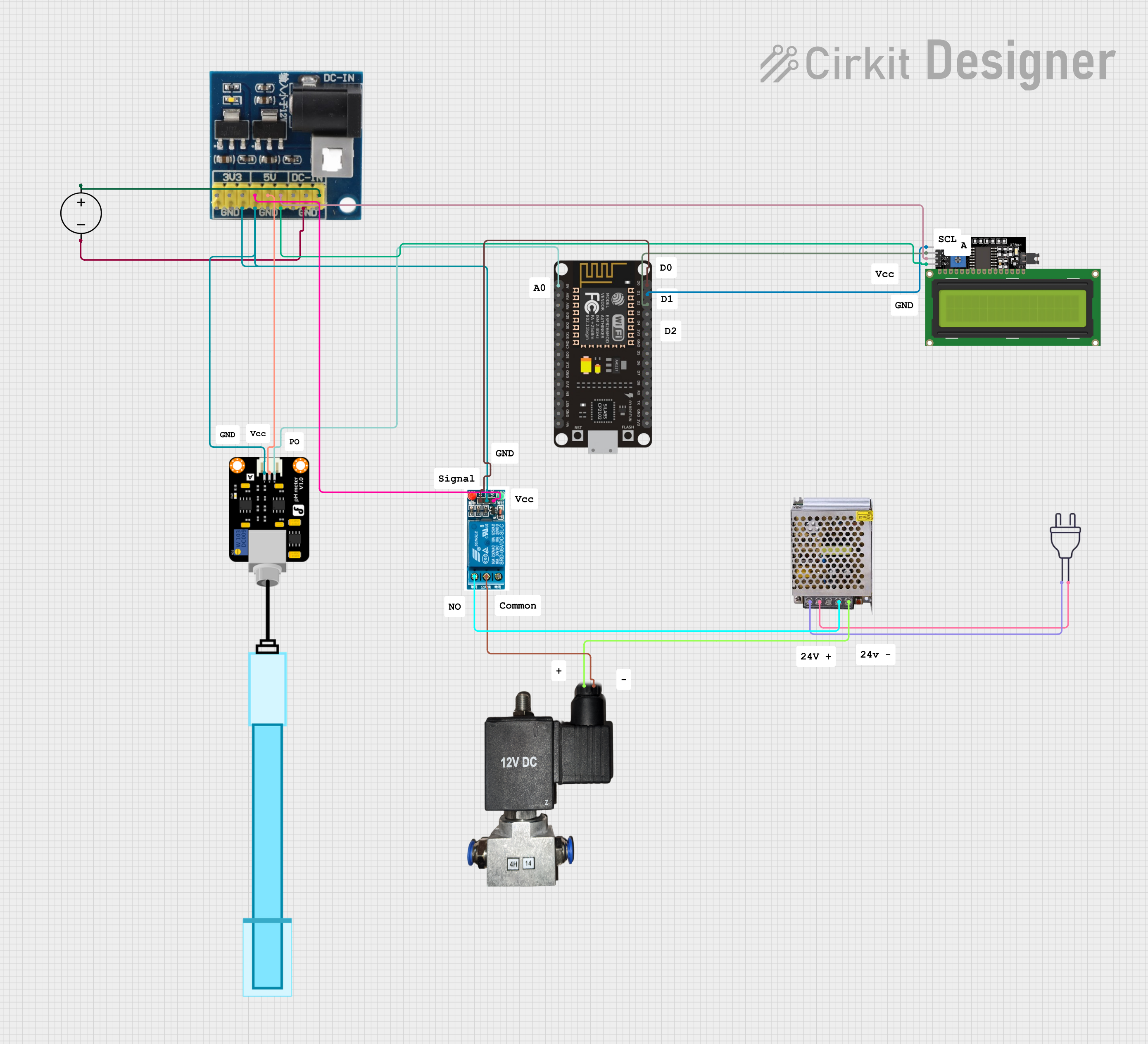
Circuit Documentation
Summary
This circuit is designed to monitor pH levels using a pH meter and display the readings on an LCD display. The ESP-8266 microcontroller is used to process the pH signal and control a 5V relay, which in turn controls a 12V pneumatic solenoid valve based on the pH readings. The circuit is powered by a 12V DC power source, which is regulated down to 5V and 3V to power the various components. The power supply also provides 12V to the solenoid valve. The system is designed to operate with a 220V AC input that is converted to 12V DC.
Component List
PH Meter
- Pins: Signal, VCC, GND
- Description: Measures the pH level of a solution.
ESP-8266 Controller
- Pins: A0, RSV, SD3, SD5, SD1, CMD, D0, D1, D2, D3, D4, 3V3, GND, D5, D6, SD0, CLK, RST, EN, D7, D8, RX, TX, Vin, 5V
- Description: Microcontroller used for processing sensor data and controlling the relay.
Voltage Regulator 12V to 5V 3V
- Pins: gnd, dc in1, dc in2, dc in3, v6 5v, v5 5v, v4 5v, v3 3v, v2 3v, v1 3v
- Description: Steps down the voltage from 12V to 5V and 3V to power the components.
DC Power Source
- Pins: Ground, Positive
- Description: Provides 12V DC power to the circuit.
12V Pneumatic Solenoid Valve
- Pins: VCC, GND
- Description: Actuates based on the control signal from the relay to control the flow of air or liquid.
5V Relay
- Pins: Normally Open, Common terminal, Normally Closed, In, GND, VCC
- Description: Electrically operated switch that controls the solenoid valve.
POWER SUPPLY 12V 5AMP
- Pins: 220V Positive Pole (AC), 220V Negative Pole (AC), GND, GND (DC), 12V-24V Output (DC)
- Description: Converts 220V AC to 12V DC to power the circuit.
LCD Display 16x4 I2C
- Pins: SCL, SDA, VCC, GND
- Description: Displays the pH readings and other information.
Power 220V
- Pins: hot wire, neutral wire
- Description: Provides 220V AC power to the power supply.
Wiring Details
PH Meter
- Signal connected to ESP-8266 Controller A0
- VCC connected to Voltage Regulator 12v to 5v 3v v5 5v
- GND connected to common ground net
ESP-8266 Controller
- A0 connected to PH Meter Signal
- D0 connected to 5v Relay In
- D1 connected to LCD Display 16x4 I2C SCL
- D2 connected to LCD Display 16x4 I2C SDA
- GND connected to common ground net
Voltage Regulator 12V to 5V 3V
- gnd connected to common ground net
- dc in1 connected to DC Power Source Positive
- v5 5v connected to PH Meter VCC
- v6 5v connected to LCD Display 16x4 I2C VCC
- v4 5v connected to 5v Relay VCC
DC Power Source
- Ground connected to common ground net
- Positive connected to Voltage Regulator 12v to 5v 3v dc in1
12V Pneumatic Solenoid Valve
- VCC connected to POWER SUPPLY 12V 5AMP 12V-24V Output (DC)
- GND connected to 5v Relay Common terminal
5V Relay
- Normally Open connected to POWER SUPPLY 12V 5AMP GND (DC)
- Common terminal connected to 12v Pneumatic Solenoid Valve GND
- In connected to ESP-8266 Controller D0
- GND connected to common ground net
- VCC connected to Voltage Regulator 12v to 5v 3v v4 5v
POWER SUPPLY 12V 5AMP
- 220V Positive Pole (AC) connected to power 220v hot wire
- 220V Negative Pole (AC) connected to power 220v neutral wire
- GND (DC) connected to 5v Relay Normally Open
- 12V-24V Output (DC) connected to 12v Pneumatic Solenoid Valve VCC
LCD Display 16x4 I2C
- SCL connected to ESP-8266 Controller D1
- SDA connected to ESP-8266 Controller D2
- VCC connected to Voltage Regulator 12v to 5v 3v v6 5v
- GND connected to common ground net
Power 220V
- hot wire connected to POWER SUPPLY 12V 5AMP 220V Positive Pole (AC)
- neutral wire connected to POWER SUPPLY 12V 5AMP 220V Negative Pole (AC)
Documented Code
No code has been provided for the microcontroller. The documentation of the code would include the setup and loop functions for the ESP-8266, detailing how it reads the pH level from the sensor, processes the data, and controls the relay based on the pH level. It would also include the initialization and update of the LCD display to show the pH readings.