
Arduino Nano-Based Flex Sensor System with Bluetooth Connectivity
View and Edit Project In Cirkit Designer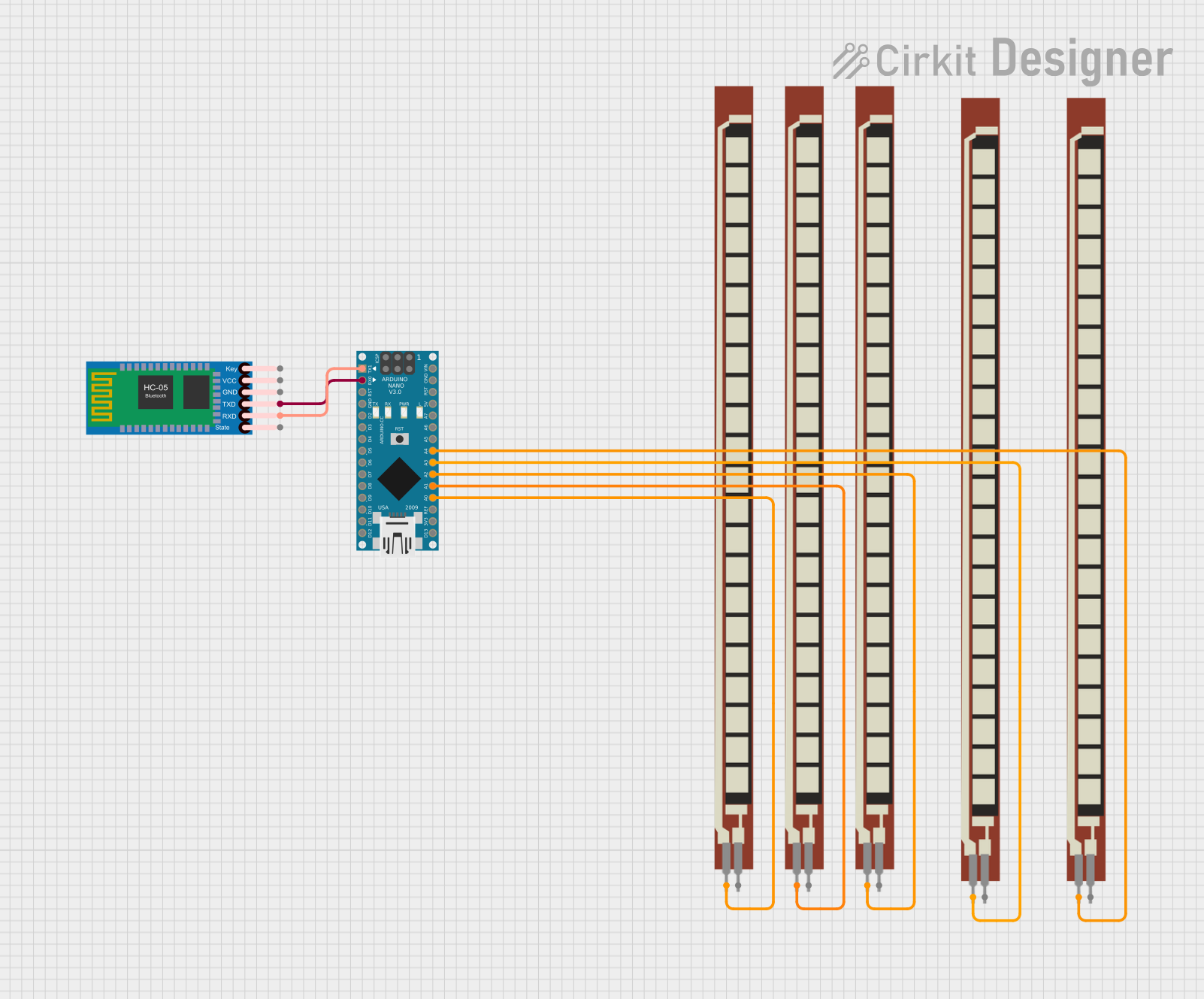
Circuit Documentation
Summary
This document provides a detailed overview of a circuit that includes an Arduino Nano, several Basic Flex Resistors, and an HC-05 Bluetooth Module. The circuit is designed to interface the Arduino Nano with multiple resistors and a Bluetooth module for communication. The document includes a component list, wiring details, and the embedded code used in the microcontroller.
Component List
Arduino Nano
- Description: A small, complete, and breadboard-friendly board based on the ATmega328P.
- Pins: D1/TX, D0/RX, RESET, GND, D2, D3, D4, D5, D6, D7, D8, D9, D10, D11/MOSI, D12/MISO, VIN, 5V, A7, A6, A5, A4, A3, A2, A1, A0, AREF, 3V3, D13/SCK
Basic Flex Resistor
- Description: A flexible resistor that changes resistance when bent.
- Pins: Pin 1, Pin 2
HC-05 Bluetooth Module
- Description: A Bluetooth module for wireless communication.
- Pins: Key, VCC, GND, TXD, RXD, State
Wiring Details
Arduino Nano
- A0 connected to Pin 1 of a Basic Flex Resistor
- A4 connected to Pin 1 of a Basic Flex Resistor
- A1 connected to Pin 1 of a Basic Flex Resistor
- A3 connected to Pin 1 of a Basic Flex Resistor
- A2 connected to Pin 1 of a Basic Flex Resistor
- D1/TX connected to RXD of the HC-05 Bluetooth Module
- D0/RX connected to TXD of the HC-05 Bluetooth Module
Basic Flex Resistor
- Pin 1 connected to A0 of the Arduino Nano
- Pin 1 connected to A4 of the Arduino Nano
- Pin 1 connected to A1 of the Arduino Nano
- Pin 1 connected to A3 of the Arduino Nano
- Pin 1 connected to A2 of the Arduino Nano
HC-05 Bluetooth Module
- RXD connected to D1/TX of the Arduino Nano
- TXD connected to D0/RX of the Arduino Nano
Code Documentation
Arduino Nano Code
void setup() {
  // put your setup code here, to run once:

}

void loop() {
  // put your main code here, to run repeatedly:

}
This code is a basic template for the Arduino Nano. The setup() function is used to initialize any settings or configurations, and the loop() function contains the main code that runs repeatedly.
This document provides a comprehensive overview of the circuit, including the components used, their wiring, and the embedded code. This should serve as a useful reference for understanding and replicating the circuit.