
Arduino UNO-Based Multi-Sensor Health and Environmental Monitoring System with Bluetooth Connectivity
View and Edit Project In Cirkit Designer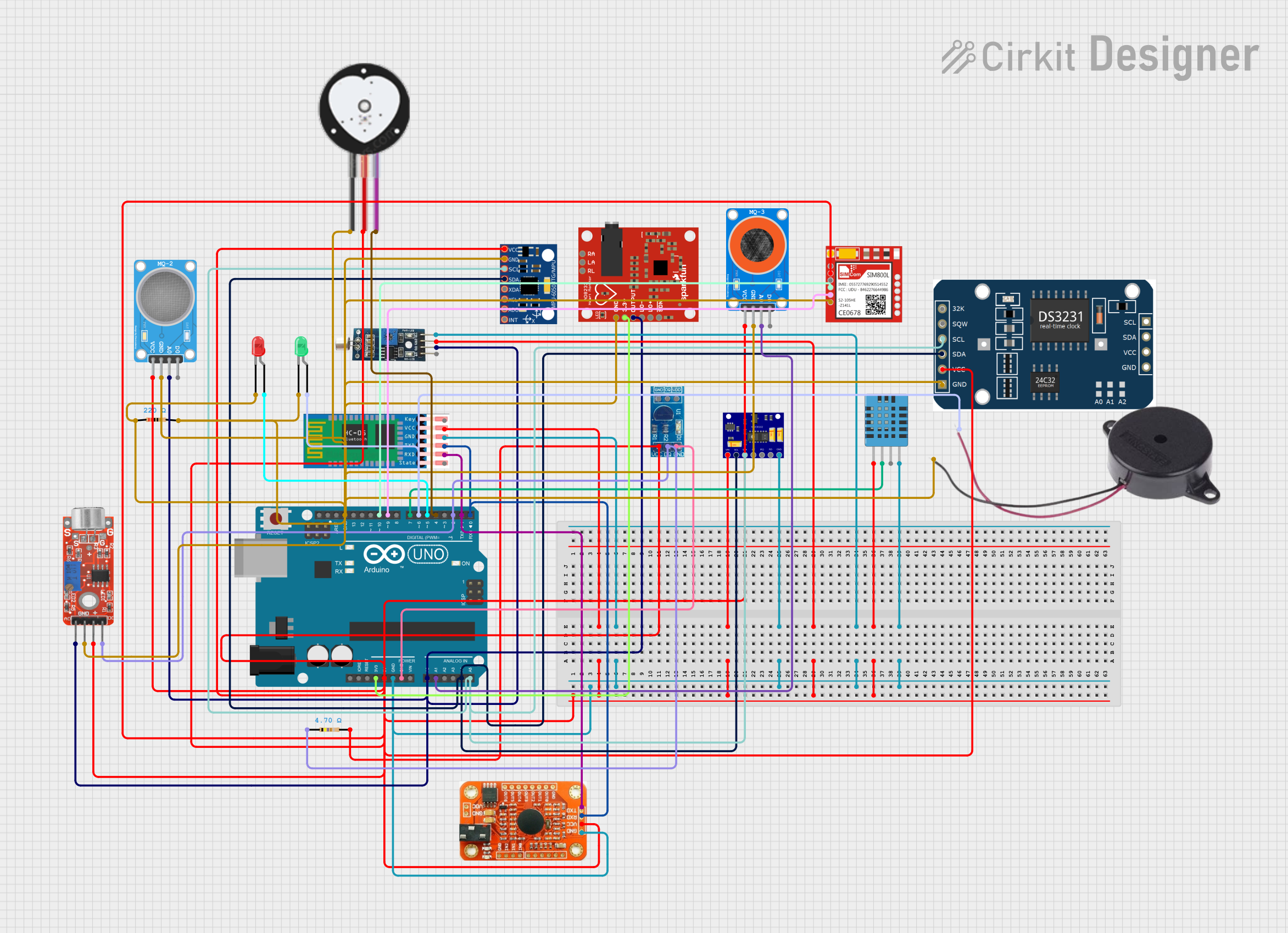
Circuit Documentation
Summary
This document provides a comprehensive overview of a circuit designed to interface with various sensors and modules, including temperature, humidity, heart rate, oxygen, sound, and alcohol sensors, as well as communication modules like HC-05 Bluetooth and SIM800L GSM. The central processing unit of the circuit is an Arduino UNO, which manages input from the sensors and communication with the modules. The circuit is powered by a 5V supply from the Arduino UNO, with some components also using the 3.3V supply. The sensors and modules are connected to the Arduino through various digital and analog pins, as well as I2C communication lines.
Component List
- Arduino UNO: A microcontroller board based on the ATmega328P, featuring digital and analog I/O pins.
- HC-05: A Bluetooth module for wireless communication.
- Sound Sensor: A module for detecting sound intensity.
- DHT11 Humidity and Temperature Sensor: A sensor for measuring ambient temperature and humidity.
- MAX30102 Heart Rate and Oxygen Sensor: A sensor for measuring heart rate and blood oxygen levels.
- DS18B20 Module: A digital temperature sensor.
- AD8232 Heart Rate Monitor: A single-lead heart rate monitor.
- MPU-6050: A 6-axis gyroscope and accelerometer module.
- LED (Red): A red light-emitting diode.
- LED (Green): A green light-emitting diode.
- Resistor (220 Ohms): A resistor with a resistance of 220 Ohms.
- Resistor (4.7 Ohms): A resistor with a resistance of 4.7 Ohms.
- MQ-3 Alcohol Sensor: A sensor for detecting alcohol levels.
- MQ-2 Sensor: A sensor for detecting flammable gases and smoke.
- SIM800L: A GSM/GPRS module for cellular communication.
- RTC Module: A real-time clock module for timekeeping.
- Heart Pulse Sensor: A sensor for detecting heartbeats.
- Buzzer: An electronic sounder.
- KY-037 Microphone: A microphone module with digital and analog outputs.
- Voice Recognition Module: A module for voice recognition.
Wiring Details
Arduino UNO
- 5V: Powers various sensors and modules.
- GND: Common ground for the circuit.
- 3.3V: Powers the AD8232 Heart Rate Monitor.
- A0: Connected to the KY-037 Microphone analog output, MQ-2 Sensor A0, Sound Sensor DO, and AD8232 Heart Rate Monitor OUTPUT.
- A1: Connected to the MQ-3 Alcohol Sensor A0.
- A4: I2C SDA line, connected to the MPU-6050 SDA, MAX30102 Heart Rate and Oxygen Sensor SCL, and RTC Module SDA.
- A5: I2C SCL line, connected to the MPU-6050 SCL, MAX30102 Heart Rate and Oxygen Sensor SDA, and RTC Module SCL.
- D2: Connected to the DS18B20 Module DQ, KY-037 Microphone digital output, and a 4.7 Ohm resistor.
- D4: Connected to the Heart Pulse Sensor SIGNAL.
- D5: Connected to the anode of the red LED.
- D6: Connected to the anode of the green LED and the positive terminal of the buzzer.
- D7: Connected to the DHT11 Humidity and Temperature Sensor DATA.
- D9: Connected to the SIM800L TXD.
- D10: Connected to the SIM800L RXD.
HC-05 Bluetooth Module
- VCC: Powered by 5V from the Arduino UNO.
- GND: Connected to the common ground.
- TXD: Connected to the Arduino UNO D0.
- RXD: Connected to the Arduino UNO D1.
Sound Sensor
- VCC: Powered by 5V from the Arduino UNO.
- GND: Connected to the common ground.
- DO: Connected to the Arduino UNO A0.
DHT11 Humidity and Temperature Sensor
- VDD: Powered by 5V from the Arduino UNO.
- GND: Connected to the common ground.
- DATA: Connected to the Arduino UNO D7.
MAX30102 Heart Rate and Oxygen Sensor
- VIN: Powered by 5V from the Arduino UNO.
- GND: Connected to the common ground.
- SCL: Connected to the Arduino UNO A5.
- SDA: Connected to the Arduino UNO A4.
DS18B20 Module
- VCC: Powered by 5V from the Arduino UNO.
- GND: Connected to the common ground.
- DQ: Connected to the Arduino UNO D2.
AD8232 Heart Rate Monitor
- 3.3v: Powered by 3.3V from the Arduino UNO.
- GND: Connected to the common ground.
- OUTPUT: Connected to the Arduino UNO A0.
MPU-6050
- VCC: Powered by 5V from the Arduino UNO.
- GND: Connected to the common ground.
- SCL: Connected to the Arduino UNO A5.
- SDA: Connected to the Arduino UNO A4.
LEDs
- Red LED: Anode connected to the Arduino UNO D5, cathode connected to the common ground.
- Green LED: Anode connected to the Arduino UNO D6, cathode connected to the common ground.
Resistors
- 220 Ohm: Connected between the common ground and the cathodes of the LEDs.
- 4.7 Ohm: Connected between the Arduino UNO D2 and the DS18B20 Module DQ.
MQ-3 Alcohol Sensor
- VCC: Powered by 5V from the Arduino UNO.
- GND: Connected to the common ground.
- A0: Connected to the Arduino UNO A1.
MQ-2 Sensor
- VCC: Powered by 5V from the Arduino UNO.
- GND: Connected to the common ground.
- A0: Connected to the Arduino UNO A0.
SIM800L GSM Module
- VCC: Powered by 5V from the Arduino UNO.
- GND: Connected to the common ground.
- RXD: Connected to the Arduino UNO D10.
- TXD: Connected to the Arduino UNO D9.
RTC Module
- VCC: Powered by 5V from the Arduino UNO.
- GND: Connected to the common ground.
- SDA: Connected to the Arduino UNO A4.
- SCL: Connected to the Arduino UNO A5.
Heart Pulse Sensor
- VCC: Powered by 5V from the Arduino UNO.
- GND: Connected to the common ground.
- SIGNAL: Connected to the Arduino UNO D4.
Buzzer
- POSITIVE: Connected to the Arduino UNO D6.
- NEGATIVE: Connected to the common ground.
KY-037 Microphone
- VCC: Powered by 5V from the Arduino UNO.
- Ground: Connected to the common ground.
- Analog output: Connected to the Arduino UNO A0.
- Digital output: Connected to the Arduino UNO D2.
Voice Recognition Module
- VCC: Powered by 5V from the Arduino UNO.
- GND: Connected to the common ground.
- RDX: Connected to the Arduino UNO D0.
- RTX: Connected to the Arduino UNO D1.
Documented Code
Arduino UNO Code (sketch.ino)
void setup() {
  // put your setup code here, to run once:

}

void loop() {
  // put your main code here, to run repeatedly:

}
Note: The provided code is a template and does not include specific functionality. It is expected that the user will add the necessary code to interact with the connected sensors and modules.