
Arduino UNO Based Temperature and Humidity Monitor with OLED Display
View and Edit Project In Cirkit Designer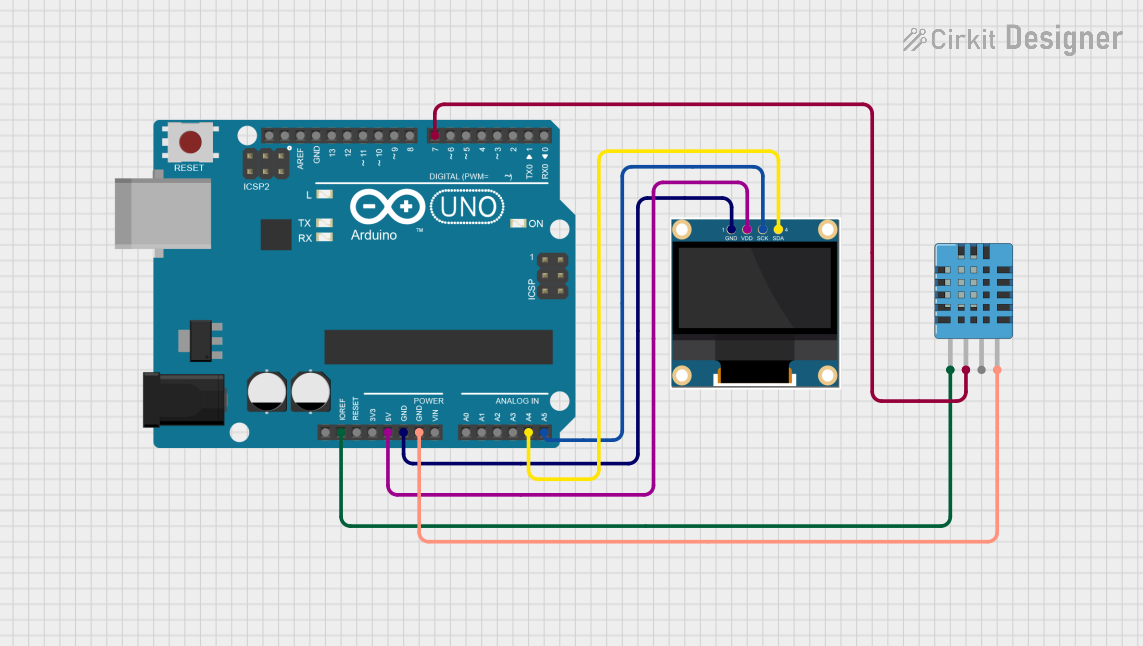
Circuit Documentation
Summary of the Circuit
This circuit consists of an Arduino UNO microcontroller, a 0.96" OLED display, and a DHT11 Humidity and Temperature Sensor. The Arduino UNO serves as the central processing unit, controlling the OLED display for visual output and interfacing with the DHT11 sensor to measure environmental conditions. The OLED display is connected to the Arduino via I2C communication, while the DHT11 sensor is connected to a digital input for data acquisition.
Component List
Arduino UNO
- Description: A microcontroller board based on the ATmega328P.
- Pins: UNUSED, IOREF, Reset, 3.3V, 5V, GND, Vin, A0-A5, SCL, SDA, AREF, D0-D13.
0.96" OLED
- Description: A small display for visual output.
- Pins: GND, VDD, SCK, SDA.
DHT11 Humidity and Temperature Sensor
- Description: A sensor for measuring ambient humidity and temperature.
- Pins: VDD, DATA, NULL, GND.
Wiring Details
Arduino UNO
- IOREF connected to DHT11 VDD (Power supply for the sensor).
- 5V connected to OLED VDD (Power supply for the display).
- GND connected to OLED GND and DHT11 GND (Common ground).
- A4 (SDA) connected to OLED SDA (I2C data line for the display).
- A5 (SCL) connected to OLED SCK (I2C clock line for the display).
- D7 connected to DHT11 DATA (Data line for the sensor).
0.96" OLED
- VDD connected to Arduino 5V (Power supply from the microcontroller).
- GND connected to Arduino GND (Common ground).
- SDA connected to Arduino A4 (I2C data line from the microcontroller).
- SCK connected to Arduino A5 (I2C clock line from the microcontroller).
DHT11 Humidity and Temperature Sensor
- VDD connected to Arduino IOREF (Power supply from the microcontroller).
- DATA connected to Arduino D7 (Data line to the microcontroller).
- GND connected to Arduino GND (Common ground).
Documented Code
Arduino UNO Code (sketch.ino)
void setup() {
  // put your setup code here, to run once:

}

void loop() {
  // put your main code here, to run repeatedly:

}
Additional Notes (documentation.txt)
No additional code documentation was provided.