
ESP8266 NodeMCU Controlled IR Sensor with Buzzer Alert System
View and Edit Project In Cirkit Designer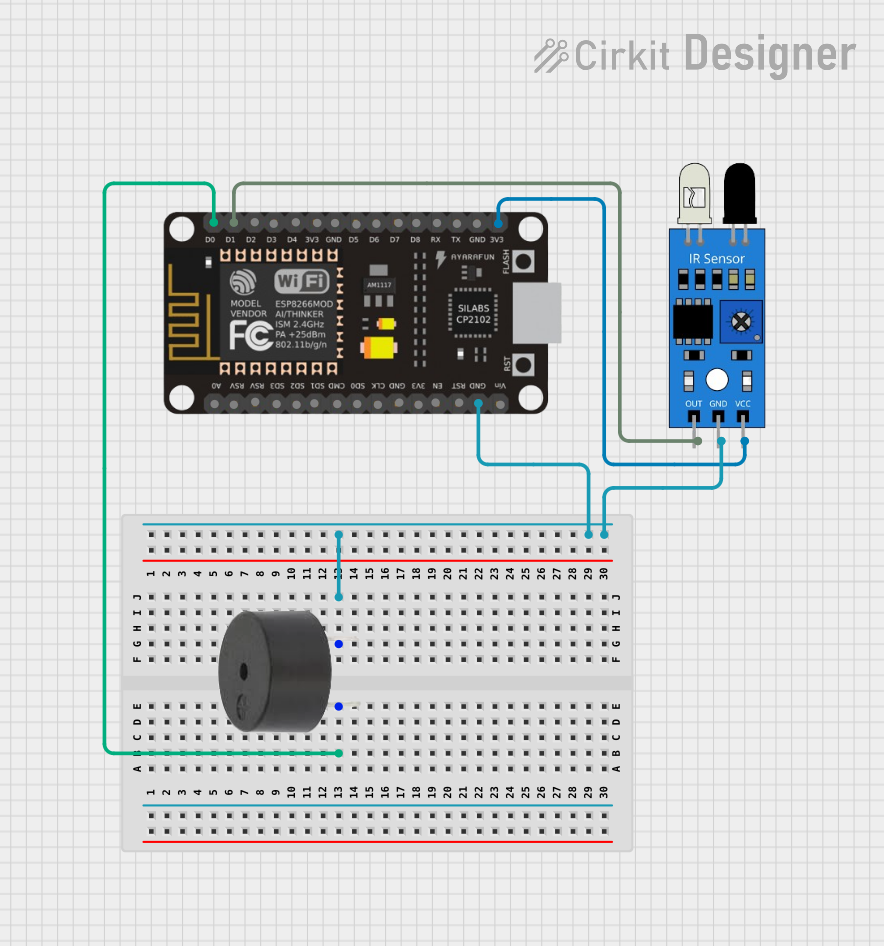
Circuit Documentation
Summary of the Circuit
This circuit comprises three main components: a buzzer, an ESP8266 NodeMCU microcontroller, and an IR sensor. The ESP8266 NodeMCU is the central processing unit of the circuit, controlling the buzzer and reading input from the IR sensor. The buzzer acts as an output device that can be triggered by the ESP8266 NodeMCU, while the IR sensor serves as an input device that detects infrared signals and sends the data to the microcontroller.
Component List
Buzzer
- Description: A buzzer is an audio signaling device, which may be mechanical, electromechanical, or piezoelectric.
- Pins:
- PIN: Signal input
- GND: Ground
ESP8266 NodeMCU
- Description: The ESP8266 NodeMCU is a low-cost Wi-Fi microchip with full TCP/IP stack and microcontroller capability.
- Pins:
- D0-D8: General purpose I/O pins
- RX/TX: UART communication pins
- A0: Analog input pin
- 3V3: 3.3V power supply pin
- GND: Ground
- RSV, SD3, SD2, SD1, CMD, SD0, CLK: SD card interface
- EN: Chip enable
- RST: Reset pin
- VIN: Voltage input for power supply
IR Sensor
- Description: An IR sensor is a device that detects infrared radiation to sense certain aspects of its surroundings.
- Pins:
- out: Output signal
- gnd: Ground
- vcc: Power supply input
Wiring Details
Buzzer
- PIN: Connected to ESP8266 NodeMCU D0
- GND: Shared ground with ESP8266 NodeMCU and IR Sensor
ESP8266 NodeMCU
- D0: Connected to Buzzer PIN
- D1: Connected to IR Sensor out
- 3V3: Power supply to IR Sensor vcc
- GND: Shared ground with Buzzer and IR Sensor
IR Sensor
- out: Connected to ESP8266 NodeMCU D1
- gnd: Shared ground with ESP8266 NodeMCU and Buzzer
- vcc: Connected to ESP8266 NodeMCU 3V3
Documented Code
There is no code provided for the microcontroller in this circuit. The code would typically be responsible for initializing the hardware peripherals, handling the logic for reading the IR sensor output, and controlling the buzzer based on the sensor input. Without the code, the functionality of the circuit cannot be fully described.