
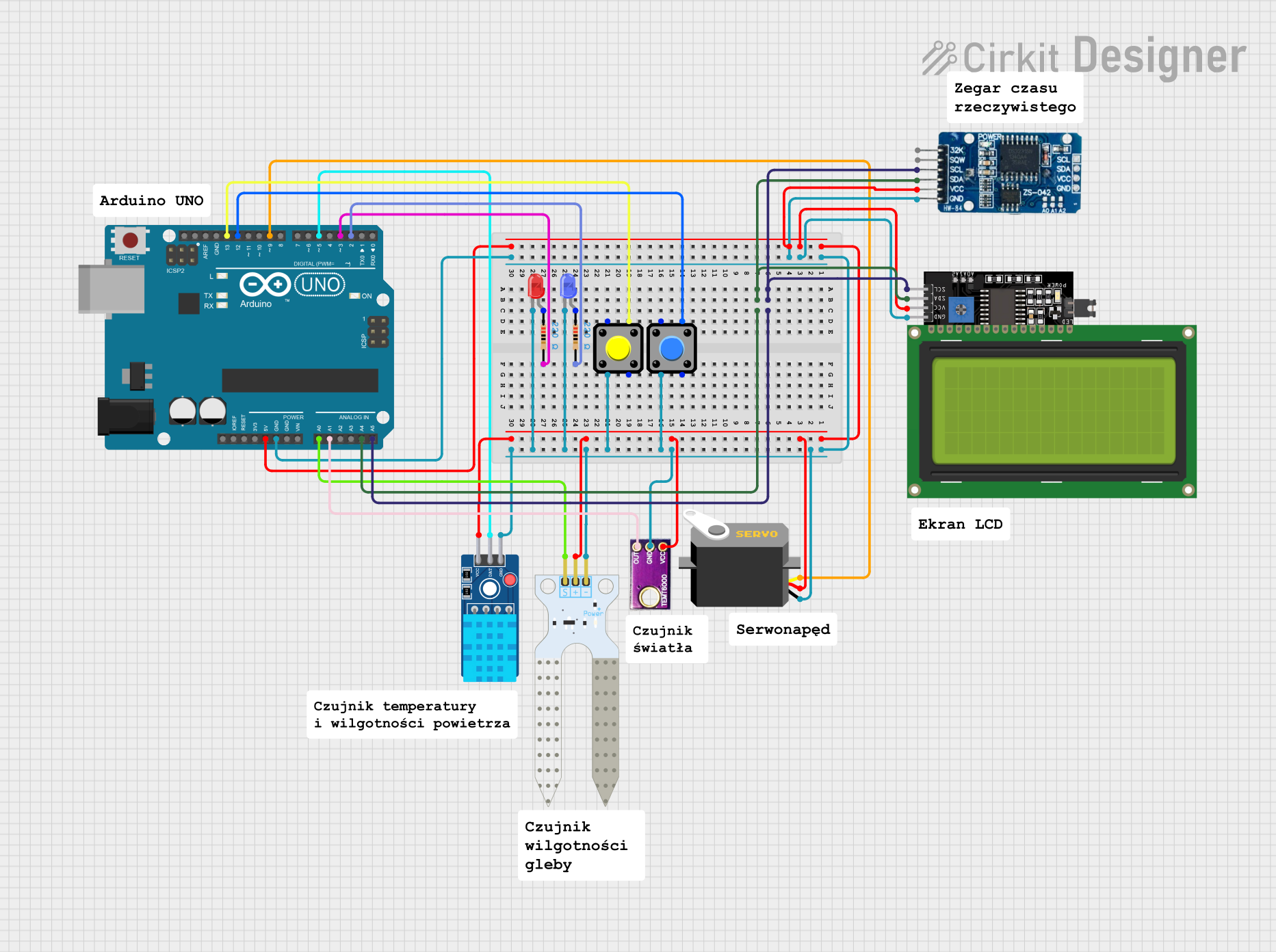
Circuit Documentation
Summary
This circuit integrates multiple components, including three Arduino UNO microcontrollers, various sensors (Soil Moisture Sensor, DHT11 Sensor V2, Ambient Light Sensor), actuators (Servo), human interface devices (Pushbuttons, LCD Display 20x4 I2C), and timing devices (RTC DS3231). The circuit is designed to interface with environmental sensors, display data, and control a servo motor. The Arduinos are programmed to handle input/output operations, and they communicate with I2C-enabled devices.
Component List
Microcontrollers
- Arduino UNO: A microcontroller board based on the ATmega328P, featuring digital and analog I/O pins.
Sensors
- Soil Moisture Sensor: Measures the volumetric content of water in soil.
- DHT11 Sensor V2: A basic, ultra low-cost digital temperature and humidity sensor.
- Ambient Light Sensor: Measures the light intensity in the environment.
Actuators
- Servo: A rotary actuator or linear actuator that allows for precise control of angular or linear position.
Human Interface Devices
- Pushbutton: A simple switch mechanism for controlling some aspect of a machine or a process.
- LCD Display 20x4 I2C: A liquid crystal display capable of displaying 4 lines of 20 characters, with an I2C interface.
Timing Devices
- RTC DS3231: A real-time clock (RTC) with an integrated temperature-compensated crystal oscillator (TCXO) and crystal.
Indicators
- LED: Two Pin (red): A red light-emitting diode.
- LED: Two Pin (blue): A blue light-emitting diode.
Passive Components
- Resistor: A passive two-terminal electrical component that implements electrical resistance as a circuit element.
Comments
- Comment: Used for annotations and notes within the circuit design.
Wiring Details
Arduino UNO
- Digital Pins:
- D2, D3: Connected to resistors and then to LEDs.
- D5: Connected to the DHT11 Sensor V2 (DAT pin).
- D9: Connected to the Servo (pulse pin).
- D12, D13: Connected to Pushbuttons.
- Analog Pins:
- A0: Connected to the Soil Moisture Sensor (SIG pin).
- A1: Connected to the Ambient Light Sensor (OUT pin).
- A4, A5: Connected to the I2C bus (SDA, SCL) shared with the RTC DS3231 and LCD Display 20x4 I2C.
- Power Pins:
- 5V: Power supply for various sensors and the LCD display.
- GND: Common ground for all components.
Sensors
- Soil Moisture Sensor: Powered by 5V, ground connected to common GND, and signal output to Arduino A0.
- DHT11 Sensor V2: Powered by 5V, ground connected to common GND, and data pin connected to Arduino D5.
- Ambient Light Sensor: Powered by 5V, ground connected to common GND, and output to Arduino A1.
Actuators
- Servo: Powered by 5V, ground connected to common GND, and control pulse connected to Arduino D9.
Human Interface Devices
- Pushbuttons: One side connected to Arduino digital pins (D12, D13), other side connected to common ground.
- LCD Display 20x4 I2C: Powered by 5V, ground connected to common GND, and I2C communication with Arduino (SDA, SCL).
Timing Devices
- RTC DS3231: Powered by 5V, ground connected to common GND, and I2C communication with Arduino (SDA, SCL).
Indicators
- LEDs: Anodes connected to resistors, which are then connected to Arduino digital pins (D2, D3). Cathodes connected to common ground.
Passive Components
- Resistors: Connected in series with LEDs and Arduino digital pins (D2, D3).
Documented Code
Arduino UNO (Primary Controller)
void setup() {
  // put your setup code here, to run once:

}

void loop() {
  // put your main code here, to run repeatedly:

}
Arduino UNO (Secondary Controllers)
void setup() {
  // put your setup code here, to run once:

}

void loop() {
  // put your main code here, to run repeatedly:

}
(Note: The code provided for the secondary Arduino UNOs is identical to the primary controller. This may be intentional for synchronization purposes or may require further customization based on the specific roles of each microcontroller in the circuit.)