
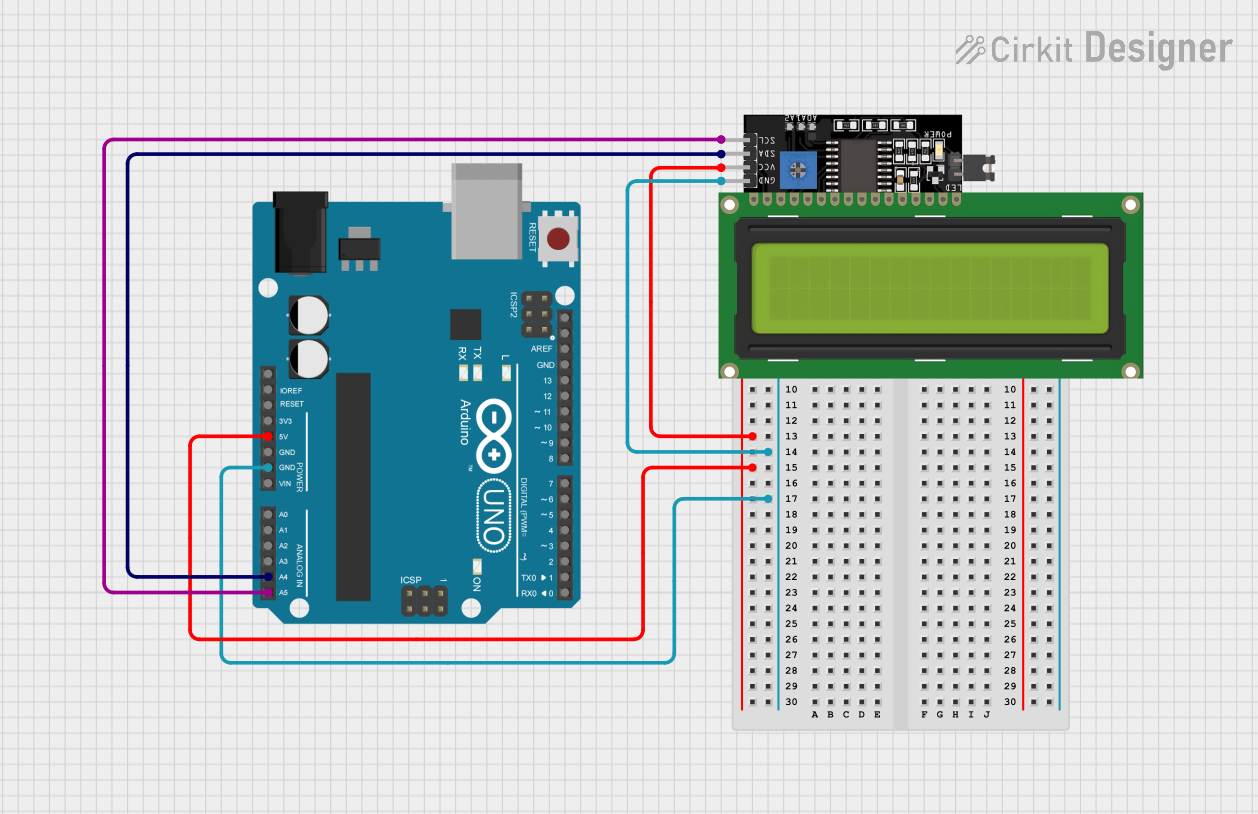
Circuit Documentation
Summary of the Circuit
This circuit consists of an Arduino UNO microcontroller board interfaced with a 16x4 LCD display that uses an I2C communication interface. The Arduino UNO provides power to the LCD display and facilitates data communication via the I2C protocol, using its analog input pins A4 and A5 as SDA (Serial Data Line) and SCL (Serial Clock Line), respectively.
Component List
Arduino UNO
- Description: A microcontroller board based on the ATmega328P.
- Purpose: Acts as the central processing unit of the circuit, controlling the LCD display and executing the embedded code.
- Pins: UNUSED, IOREF, Reset, 3.3V, 5V, GND, Vin, A0-A5, SCL, SDA, AREF, D0-D13.
LCD Display 16x4 I2C
- Description: A 16x4 character LCD display with an I2C communication interface.
- Purpose: Displays information as directed by the Arduino UNO.
- Pins: SCL, SDA, VCC, GND.
Wiring Details
Arduino UNO
- 5V to LCD Display VCC
- GND to LCD Display GND
- A4 (SDA) to LCD Display SDA
- A5 (SCL) to LCD Display SCL
LCD Display 16x4 I2C
- VCC connected to Arduino UNO 5V
- GND connected to Arduino UNO GND
- SDA connected to Arduino UNO A4 (SDA)
- SCL connected to Arduino UNO A5 (SCL)
Documented Code
Arduino UNO Code (sketch.ino)
void setup() {
  // put your setup code here, to run once:

}

void loop() {
  // put your main code here, to run repeatedly:

}
Additional Notes
- The code provided is a template and does not contain any specific functionality. It needs to be populated with the setup and loop functions to initialize the I2C communication and control the LCD display.
- The
setup()function is intended to contain initialization code that runs once when the microcontroller is powered on or reset. - The
loop()function is intended to contain the main code that will run repeatedly, allowing the microcontroller to perform its tasks continuously.
This documentation provides an overview of the circuit, including the components used, their wiring, and the initial code structure for the Arduino UNO. Further development of the code is required to achieve the desired functionality of the circuit.