
Circuit Documentation
Summary of the Circuit
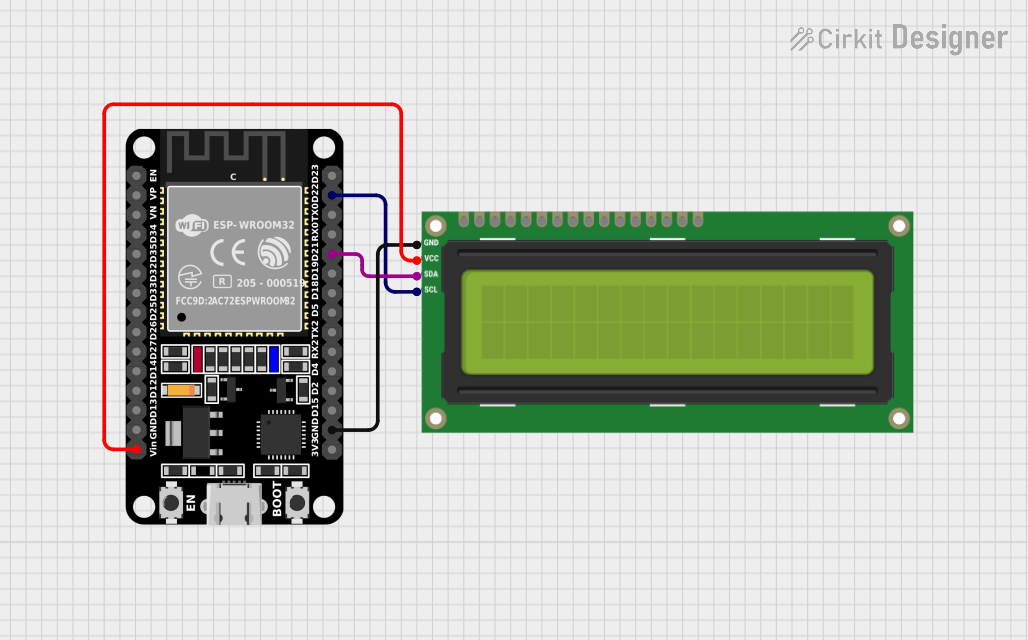
This circuit consists of an ESP32 microcontroller and an I2C LCD 16x2 screen. The ESP32 is a versatile microcontroller with Wi-Fi and Bluetooth capabilities, and it is used here to interface with the LCD screen over the I2C protocol. The LCD screen is a 16x2 character display that can show text or custom characters. The ESP32 powers the LCD screen and communicates with it using the I2C data (SDA) and clock (SCL) lines. Ground (GND) connections are shared between the two components to complete the circuit.
Component List
ESP32 (30 pin)
- Description: A 30-pin microcontroller with Wi-Fi and Bluetooth capabilities.
- Purpose: Acts as the central processing unit of the circuit, controlling the LCD screen and handling data processing and connectivity.
- Pins: EN, VP, VN, D34, D35, D32, D33, D25, D26, D27, D14, D12, D13, GND, Vin, D23, D22, TX0, RX0, D21, D19, D18, D5, TX2, RX2, D4, D2, D15, 3V3
I2C LCD 16x2 Screen
- Description: A 16x2 character LCD display with an I2C interface.
- Purpose: Displays information and data processed by the ESP32.
- Pins: SCL, SDA, VCC (5V), GND, VDD, VO, RS, RW, E, D0, D1, D2, D3, D4, D5, D6, D7, BLA, BLK
Wiring Details
ESP32 (30 pin)
- Vin connected to LCD VCC (5V) for power supply.
- D22 connected to LCD SCL for I2C clock signal.
- D21 connected to LCD SDA for I2C data signal.
- GND connected to LCD GND to provide a common ground reference.
I2C LCD 16x2 Screen
- VCC (5V) connected to ESP32 Vin for power supply.
- SCL connected to ESP32 D22 for I2C clock signal.
- SDA connected to ESP32 D21 for I2C data signal.
- GND connected to ESP32 GND to provide a common ground reference.
Documented Code
Since no code was provided for the microcontroller, this section is currently empty. When code is available, it should be documented here with explanations of its functionality, including setup, main loop, and any functions or libraries used to control the I2C LCD screen and other features of the ESP32.
Please note that the actual implementation of the code would be necessary to fully document the software aspect of this circuit. The code would typically include initialization of the I2C interface, functions to send data to the LCD to display text, and possibly additional features such as Wi-Fi or Bluetooth functions provided by the ESP32.