
PLC-Controlled Power Window System with Infrared Sensing and Relay Module
View and Edit Project In Cirkit Designer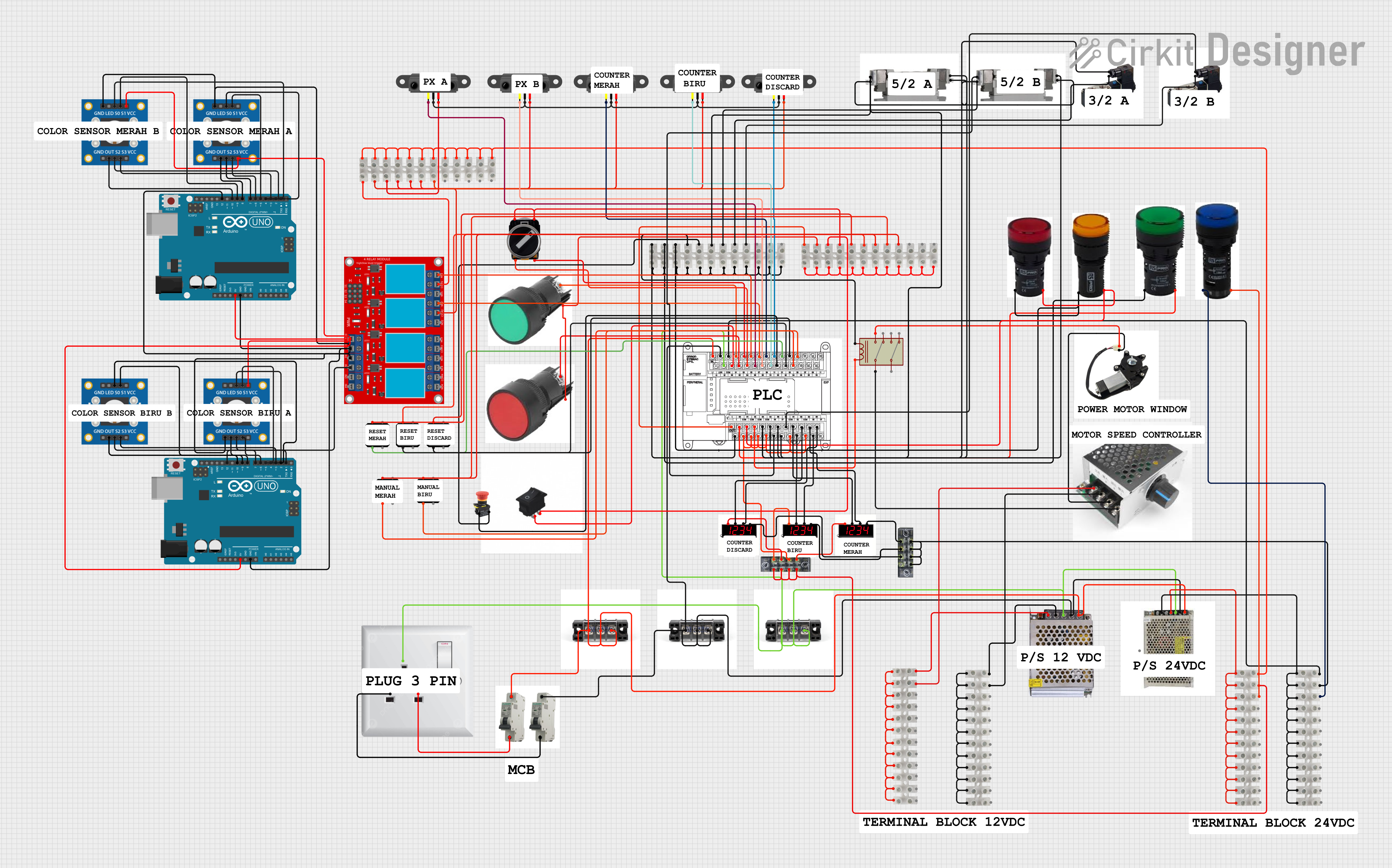
Circuit Documentation
Summary
The circuit in question appears to be a control system that includes a power supply section, a control unit (PLC), input/output devices such as pushbuttons and lamps, a motor with a speed controller, and a set of sensors interfaced with microcontrollers (Arduino UNO). The system is designed to operate on AC power, with safety mechanisms like MCBs in place, and it includes a DC power supply for low-voltage components. The microcontrollers are programmed to interact with various sensors and control elements within the circuit.
Component List
Power Supply Components
- AC Wall Plug Point: Provides the main AC power input to the circuit.
- MCBs (Miniature Circuit Breakers): Provide overcurrent protection for the circuit.
- Power Supply 12V 5A: Converts AC to 12V DC power for low-voltage components.
- Power Supply 24VDC: Provides 24V DC power for specific components requiring this voltage level.
Control Unit
- PLC OMRON CP1L: Acts as the central control unit for the circuit, processing inputs and controlling outputs.
Actuators
- Motor Power Window: An actuator that is likely used for movement or positioning tasks.
- Motor Speed Controller: Controls the speed of the motor based on input signals.
Input Devices
- Pushbuttons (Green, Red): Provide user input to the control system.
- 3 Position Switch: Allows for multi-position input, likely for mode selection or control.
- Emergency STOP: A safety device that can immediately halt the system's operation.
- Rocker Switch: A simple on/off control input.
Output Devices
- Lamps (Green, Yellow, Blue, Red): Visual indicators for system status or alerts.
- Relay: An electrically operated switch that controls the motor power window.
- 4 Channel Relay Module: Provides multiple channels for controlling various devices.
Sensors
- Infrared Proximity Sensors: Detect the presence or absence of objects within their sensing range.
- TCS3200 Color Sensors: Detect color information from objects.
Microcontrollers
- Arduino UNO: Programmable microcontroller boards used for interfacing with sensors and other components.
Miscellaneous
- Terminal Blocks: Used for organizing and connecting different wires in the circuit.
- Counters: Likely used for counting events or objects.
Wiring Details
Power Supply Wiring
- AC Wall Plug Point is connected to MCBs for protection.
- MCBs are connected to the Power Supply 12V 5A and Power Supply 24VDC to distribute power.
- Power Supply 12V 5A provides ground and 12V-24V DC output to various components.
- Power Supply 24VDC provides V+ and V- to components requiring 24V.
Control Unit Wiring
- PLC OMRON CP1L is connected to power supplies, input devices, output devices, and sensors.
Actuator Wiring
- Motor Power Window is controlled by the Relay, which is in turn controlled by the PLC.
- Motor Speed Controller receives input from the PLC and controls the motor accordingly.
Input Device Wiring
- Pushbuttons, 3 Position Switch, Emergency STOP, and Rocker Switch are all wired to the PLC for user input.
Output Device Wiring
- Lamps are connected to the PLC and are used to indicate system status.
- Relay and 4 Channel Relay Module are connected to the PLC for controlling various devices.
Sensor Wiring
- Infrared Proximity Sensors and TCS3200 Color Sensors are connected to the Arduino UNOs for data acquisition.
Microcontroller Wiring
- Arduino UNOs are connected to sensors and receive power from the power supplies.
Documented Code
Arduino UNO Code (Instance 1)
void setup() {
  // put your setup code here, to run once:

}

void loop() {
  // put your main code here, to run repeatedly:

}
This code is a template and does not contain any functional instructions. It needs to be programmed with specific tasks based on the circuit's requirements.
Arduino UNO Code (Instance 2)
void setup() {
  // put your setup code here, to run once:

}

void loop() {
  // put your main code here, to run repeatedly:

}
Similar to the first instance, this code is also a template and requires specific programming to fulfill the circuit's intended functions.