
Arduino UNO-Based Turbidity Sensor Module for Water Quality Monitoring
View and Edit Project In Cirkit Designer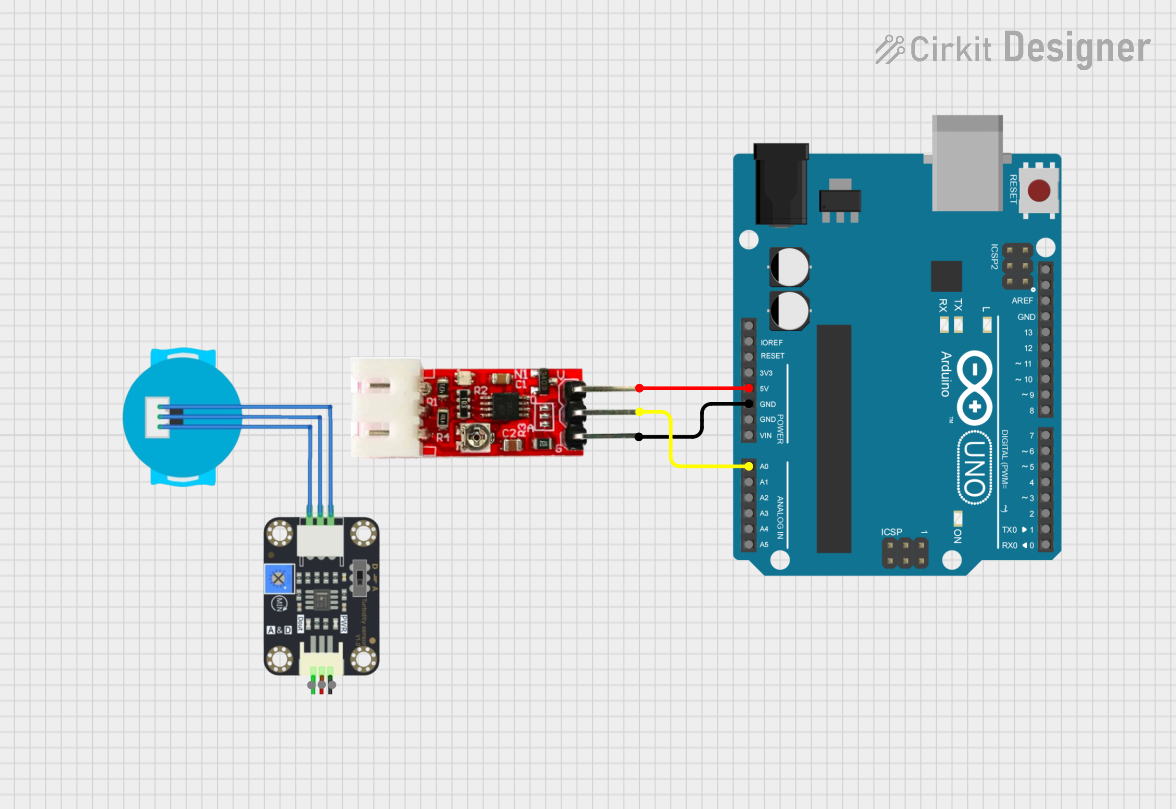
Circuit Documentation
Summary
This circuit involves an Arduino UNO microcontroller interfacing with a Turbidity Module and a Turbidity Sensor. The Arduino UNO provides power to the Turbidity Module and reads the turbidity data through its analog input pin.
Component List
Arduino UNO
- Description: A microcontroller board based on the ATmega328P.
- Pins: UNUSED, IOREF, Reset, 3.3V, 5V, GND, Vin, A0, A1, A2, A3, A4, A5, SCL, SDA, AREF, D13, D12, D11, D10, D9, D8, D7, D6, D5, D4, D3, D2, D1, D0
Turbidity Module
- Description: A module used to measure the turbidity (cloudiness) of water.
- Pins: VCC, GND, OUT
Turbidity Sensor
- Description: A sensor that detects the turbidity of water.
- Pins: OUT, VCC, GND
Wiring Details
Arduino UNO
- 5V: Connected to VCC of the Turbidity Module
- GND: Connected to GND of the Turbidity Module
- A0: Connected to OUT of the Turbidity Module
Turbidity Module
- VCC: Connected to 5V of the Arduino UNO
- GND: Connected to GND of the Arduino UNO
- OUT: Connected to A0 of the Arduino UNO
Turbidity Sensor
- OUT: Not connected
- VCC: Not connected
- GND: Not connected
Code Documentation
Arduino UNO Code
void setup() {
  // put your setup code here, to run once:

}

void loop() {
  // put your main code here, to run repeatedly:

}
Turbidity Sensor Code
void setup() {
  // put your setup code here, to run once:

}

void loop() {
  // put your main code here, to run repeatedly:

}
This documentation provides a comprehensive overview of the circuit, including the components used, their wiring details, and the code for the microcontrollers.