
Circuit Documentation
Summary of the Circuit
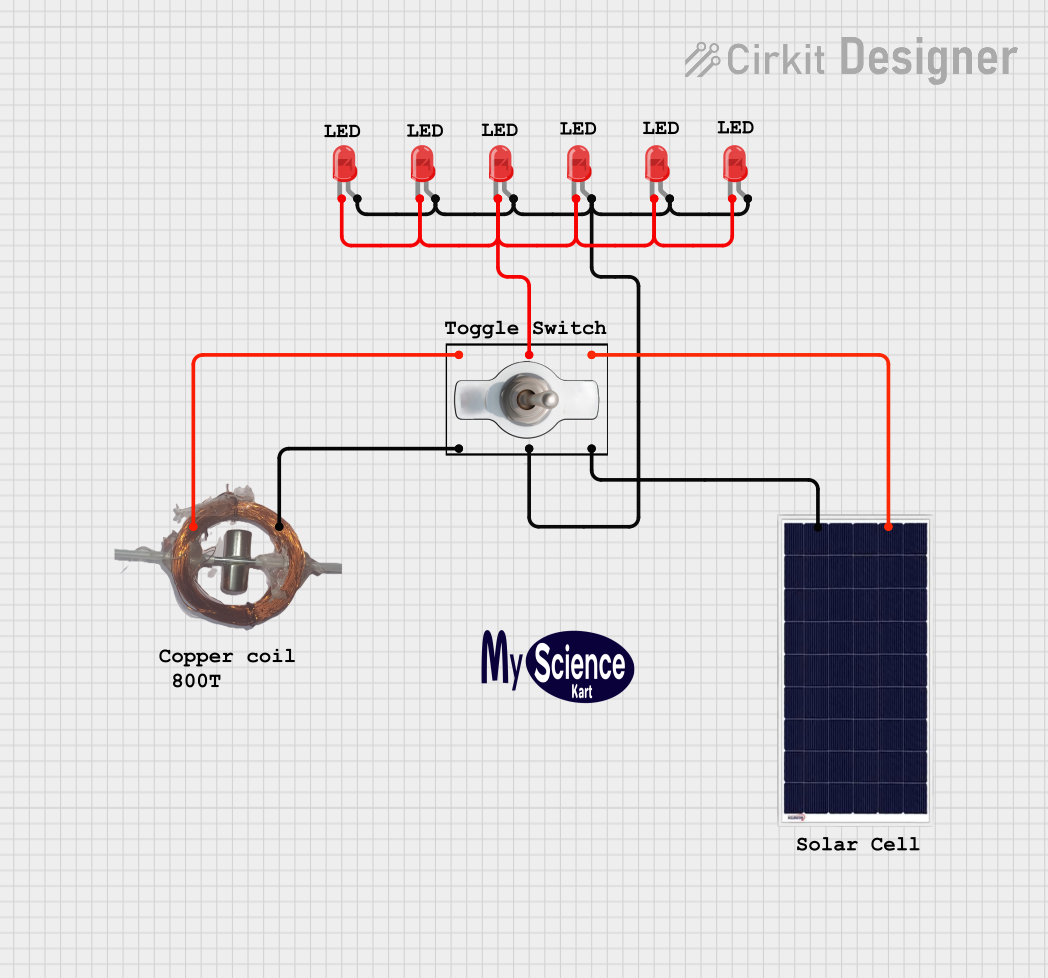
The circuit appears to be a simple solar-powered LED array with a toggle switch. The solar cell provides power to the LEDs, which can be turned on or off using the toggle switch. A copper coil is included in the circuit, but without further context, its purpose is unclear. It may be part of a charging circuit or used for electromagnetic purposes. There is no embedded code provided, indicating that the circuit functions without a microcontroller.
Component List
LEDs: Two Pin (red)
- Description: These are red LEDs with two pins: an anode and a cathode.
- Purpose: To emit light when powered.
Solar Cell
- Description: A photovoltaic cell that converts sunlight into electrical energy.
- Purpose: To provide power to the LEDs.
Toggle Switch 6L
- Description: A switch with an unspecified number of positions (assumed to be a single-pole, single-throw switch based on the wiring).
- Purpose: To allow the user to turn the LED array on or off.
Copper Coil
- Description: A coil of copper wire.
- Purpose: The exact purpose is not specified in the provided information.
Comments
- Description: Placeholder components that may represent annotations or notes in the circuit design.
Logo
- Description: A graphical representation, possibly for branding or identification.
Wiring Details
LEDs: Two Pin (red)
- Cathode: Connected to the toggle switch.
- Anode: Connected to the toggle switch.
Solar Cell
- Positive: Connected to the toggle switch.
- Negative: Connected to the toggle switch.
Toggle Switch 6L
- Pin: Connected to the copper coil, solar cell, and all LED cathodes and anodes.
Copper Coil
- Connection: Wired to the toggle switch.
Documented Code
No code has been provided for this circuit. This is consistent with a simple circuit that does not require a microcontroller or any form of programmable logic to operate.
Please note that the documentation is based on the provided information and assumptions made due to the lack of certain details. For a more accurate and detailed document, additional context and specifications would be required.