
Circuit Documentation
Summary
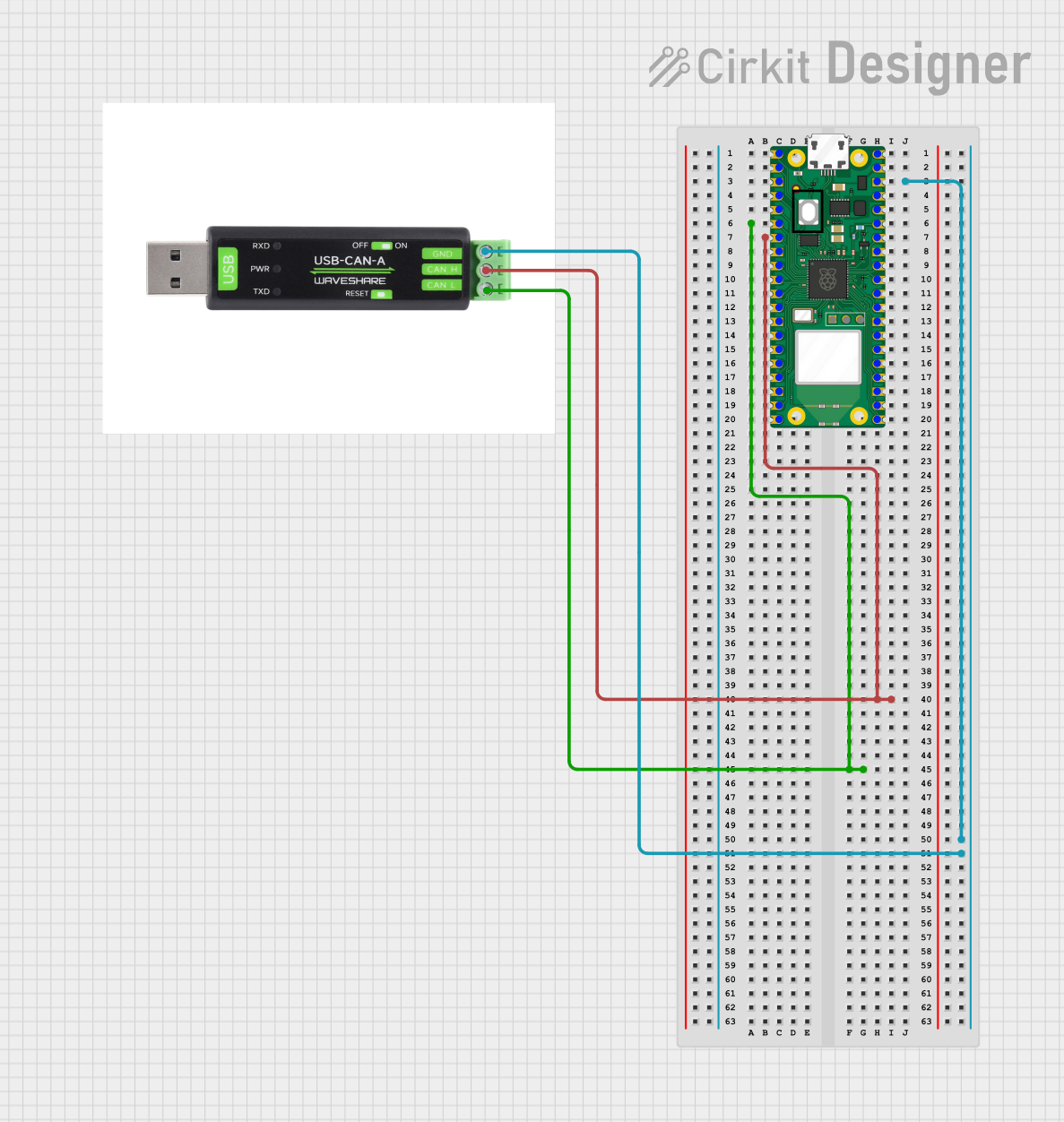
This document provides a detailed overview of a circuit involving a Raspberry Pi Pico W microcontroller and a USB-CAN-A module. The circuit is designed to interface the Raspberry Pi Pico W with a CAN bus through the USB-CAN-A module. The document includes a list of components, wiring details, and the embedded code used in the microcontroller.
Component List
Raspberry Pi Pico W
- Description: A low-cost, high-performance microcontroller board with flexible digital interfaces.
- Pins: pin 1, pin 2, pin 3, pin 4, pin 5, pin 6, pin 7, pin 8, pin 9, pin 10, pin 11, pin 12, pin 13, pin 14, pin 15, pin 16, pin 17, pin 18, pin 19, pin 20, pin 21, pin 22, pin 23, pin 24, pin 25, pin 26, pin 27, pin 28, pin 29, pin 30, pin 31, pin 32, pin 33, pin 34, pin 35, pin 36, pin 37, pin 38, pin 39, pin 40, SWCLK, GND, SWDIO
- Purpose in Circuit: Acts as the main controller, processing data and interfacing with the CAN bus through the USB-CAN-A module.
USB-CAN-A
- Description: A module that provides a USB interface to a CAN bus.
- Pins: GND, CAN_H, CAN_L
- Purpose in Circuit: Facilitates communication between the Raspberry Pi Pico W and the CAN bus.
Wiring Details
Raspberry Pi Pico W
- pin 38 is connected to GND of the USB-CAN-A.
- pin 6 is connected to CAN_L of the USB-CAN-A.
- pin 7 is connected to CAN_H of the USB-CAN-A.
USB-CAN-A
- GND is connected to pin 38 of the Raspberry Pi Pico W.
- CAN_L is connected to pin 6 of the Raspberry Pi Pico W.
- CAN_H is connected to pin 7 of the Raspberry Pi Pico W.
Embedded Code
Raspberry Pi Pico W Code
void setup() {
  // put your setup code here, to run once:

}

void loop() {
  // put your main code here, to run repeatedly:

}
This code is a basic template for the Raspberry Pi Pico W. The setup function is intended for initialization code that runs once, while the loop function contains the main code that runs repeatedly.
This document provides a comprehensive overview of the circuit, including the components used, their connections, and the embedded code. This should serve as a useful reference for understanding and replicating the circuit.