
Circuit Documentation
Summary of the Circuit
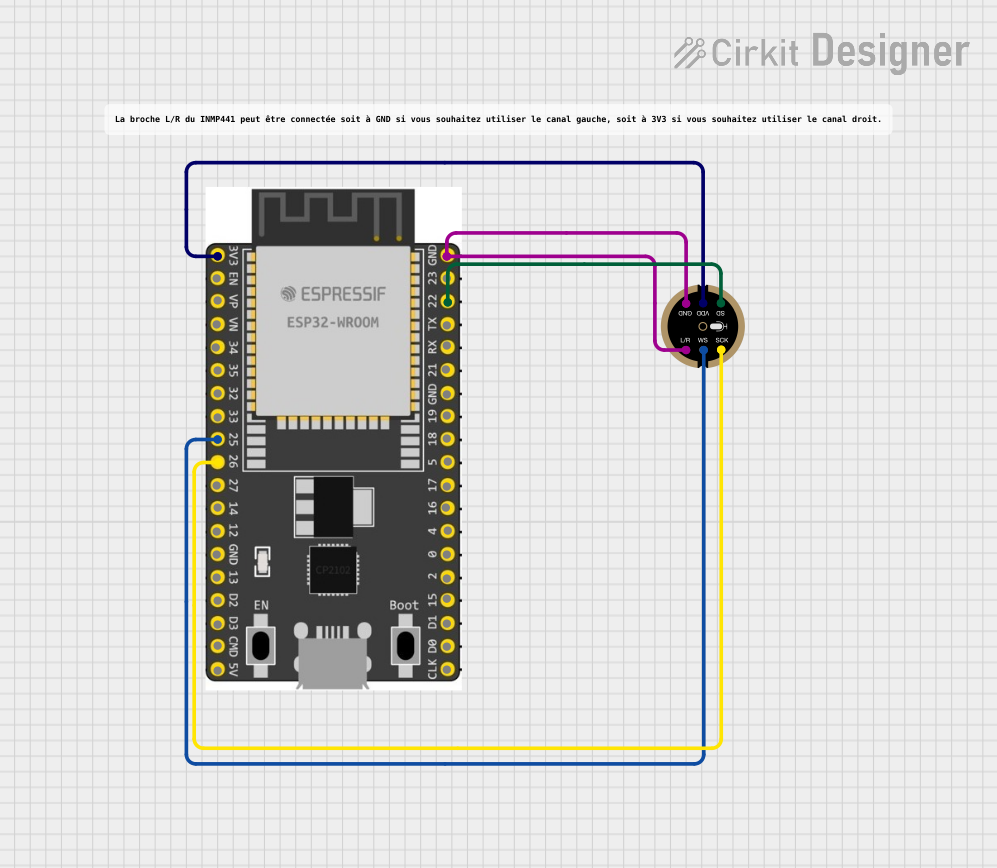
This circuit integrates an ESP32 Wroom Dev Kit microcontroller with an INMP441 MEMS microphone. The ESP32 is responsible for controlling the microphone and processing its data. The INMP441 is a high-quality microphone that outputs a digital signal, which the ESP32 can capture and process. The circuit is designed to provide power to the microphone, establish a digital communication interface, and ground connections for stable operation.
Component List
ESP 32 Wroom Dev Kit
- Description: A powerful microcontroller with Wi-Fi and Bluetooth capabilities, suitable for a wide range of IoT applications.
- Pins: 3V3, EN, VP, VN, GPIO 34, GPIO 35, GPIO 32, GPIO 33, GPIO 25, GPIO 26, GPIO 27, GPIO 14, GND, GPIO 13, SD2, SD3, CMD, V5, GPIO 23, GPIO 22, TXD, RXD, GPIO 21, GPIO 19, GPIO 18, GPIO 5, GPIO 17, GPIO 16, GPIO 4, GPIO 0, GPIO 2, GPIO 15, SD1, SD0, CLK
INMP441 FRONT MIC
- Description: A digital I2S output microphone compatible with many microcontrollers for audio input applications.
- Pins: L/R, WS, SCK, SD, VDD, GND
Wiring Details
ESP 32 Wroom Dev Kit
- 3V3: Provides power to the INMP441 microphone.
- GPIO 25: Connected to the WS (Word Select) pin of the INMP441 for I2S data transfer.
- GPIO 26: Connected to the SCK (Serial Clock) pin of the INMP441 for I2S data transfer.
- GPIO 22: Connected to the SD (Serial Data) pin of the INMP441 for I2S data transfer.
- GND: Common ground with the INMP441 microphone.
INMP441 FRONT MIC
- VDD: Receives power from the 3V3 pin of the ESP32.
- WS: Connected to GPIO 25 of the ESP32 for I2S data transfer.
- SCK: Connected to GPIO 26 of the ESP32 for I2S data transfer.
- SD: Connected to GPIO 22 of the ESP32 for I2S data transfer.
- GND: Common ground with the ESP32.
Documented Code
sketch.ino
void setup() {
  // put your setup code here, to run once:

}

void loop() {
  // put your main code here, to run repeatedly:

}
documentation.txt
(No additional documentation provided)
This concludes the documentation for the given circuit. The code provided is a template and does not include specific functionality. It should be expanded to initialize the I2S interface, read data from the microphone, and process or transmit the audio data as required by the application.