
Circuit Documentation
Summary of the Circuit
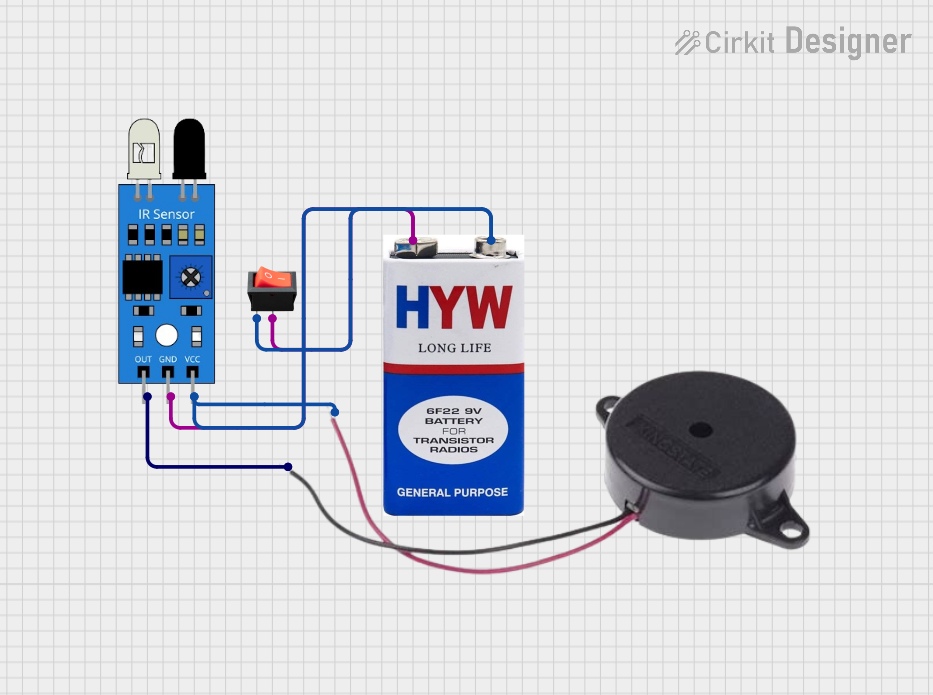
This circuit is designed to detect the presence of an object using an infrared (IR) sensor and signal its detection through a buzzer. The circuit is powered by a 9V battery and includes a rocker switch to control the power flow to the circuit components.
Component List
IR Sensor
- Pins: out, gnd, vcc
- Description: An IR sensor used to detect objects within its range. It has an output pin that goes high when an object is detected.
Buzzer
- Pins: POSITIVE, NEGATIVE
- Description: An electromechanical component that emits an audible sound when powered.
9V Battery
- Pins: +, -
- Description: A standard 9V battery that provides power to the circuit.
Rocker Switch
- Pins: output, input
- Description: A switch that can toggle the connection between two points, controlling the power flow in the circuit.
Wiring Details
IR Sensor
- out: Connected to the NEGATIVE pin of the Buzzer.
- gnd: Connected to the output pin of the Rocker Switch and the + pin of the 9V Battery.
- vcc: Connected to the input pin of the Rocker Switch and the - pin of the 9V Battery.
Buzzer
- POSITIVE: Connected to the vcc pin of the IR Sensor.
- NEGATIVE: Connected to the out pin of the IR Sensor.
9V Battery
- +: Connected to the gnd pin of the IR Sensor.
- -: Connected to the vcc pin of the IR Sensor.
Rocker Switch
- output: Connected to the gnd pin of the IR Sensor.
- input: Connected to the vcc pin of the IR Sensor.
Documented Code
There is no microcontroller or embedded code associated with this circuit as per the provided inputs. The circuit functions purely on the basis of direct electrical connections and does not involve any programmable components.
This documentation provides an overview of the circuit's components, their purpose, and how they are wired together. The absence of a microcontroller simplifies the circuit, making it a straightforward electrical design.