
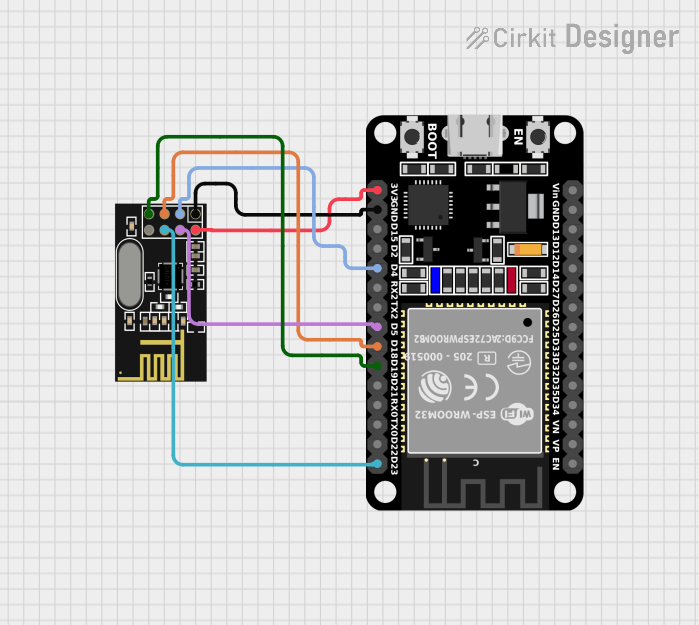
Circuit Documentation
Summary of the Circuit
This circuit integrates an NRF24L01 transceiver module with an ESP32 microcontroller. The NRF24L01 is a 2.4GHz wireless transceiver that enables wireless communication between devices. The ESP32 is a versatile microcontroller with Wi-Fi and Bluetooth capabilities, which is used here to control the NRF24L01 module and manage data communication.
The circuit is designed to establish a wireless communication link, with the ESP32 microcontroller acting as the host controller for the NRF24L01 transceiver. The ESP32 is responsible for initializing the NRF24L01, sending and receiving data, and handling any necessary data processing.
Component List
NRF24L01 Transceiver Module
- Description: A 2.4GHz wireless transceiver module.
- Pins:
- IRQ (not used)
- MOSI
- CSN
- VCC (3V)
- GND
- CE
- SCK
- MISO
ESP32 Microcontroller (30 pin)
- Description: A microcontroller with Wi-Fi and Bluetooth capabilities.
- Pins:
- EN
- VP
- VN
- D34
- D35
- D32
- D33
- D25
- D26
- D27
- D14
- D12
- D13
- GND
- Vin
- D23
- D22
- TX0
- RX0
- D21
- D19
- D18
- D5
- TX2
- RX2
- D4
- D2
- D15
- 3V3
Wiring Details
NRF24L01 Transceiver Module
- MOSI connected to ESP32 pin D23
- CSN connected to ESP32 pin D5
- VCC (3V) connected to ESP32 pin 3V3
- GND connected to ESP32 pin GND
- CE connected to ESP32 pin D4
- SCK connected to ESP32 pin D18
- MISO connected to ESP32 pin D19
ESP32 Microcontroller (30 pin)
- D23 connected to NRF24L01 pin MOSI
- D5 connected to NRF24L01 pin CSN
- 3V3 connected to NRF24L01 pin VCC (3V)
- GND connected to NRF24L01 pin GND
- D4 connected to NRF24L01 pin CE
- D18 connected to NRF24L01 pin SCK
- D19 connected to NRF24L01 pin MISO
Documented Code
No code has been provided for the microcontrollers in the circuit. The ESP32 microcontroller would typically be programmed to initialize and control the NRF24L01 transceiver module, handle the data communication, and manage any other application-specific functionalities. The code would be written in a suitable programming language, such as C or C++, and uploaded to the ESP32 using an integrated development environment (IDE) like Arduino IDE or Espressif IDF.