
Raspberry Pi Zero W Fire Detection System with SIM900A and Buzzer Alert
View and Edit Project In Cirkit Designer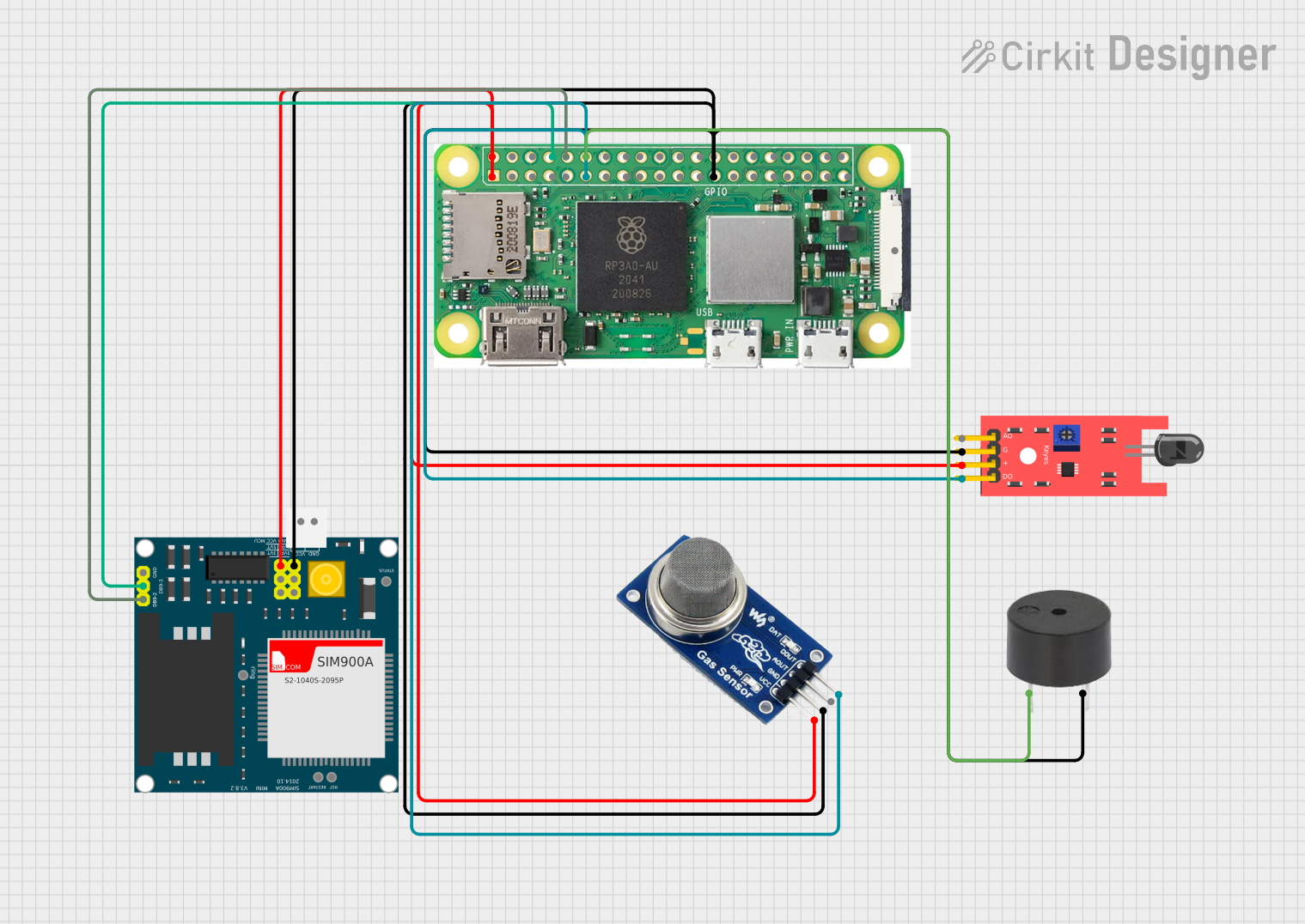
Circuit Documentation
Summary
This circuit is designed to detect fire using a flame sensor and a gas sensor. When a fire is detected, the system activates a buzzer and sends an SMS alert using the SIM900A GSM module. The entire system is controlled by a Raspberry Pi Zero W.
Component List
SIM900A
- Description: GSM/GPRS module used for sending SMS and making calls.
- Pins: GND, DB9-3 (RXD), DB9-2 (TXD), 5V, 3VR, 5VR, 3VT, 5VT, VCC, Ring, RESTART, RESET, STATUS
Buzzer
- Description: An audio signaling device used to alert when a fire is detected.
- Pins: PIN, GND
MQ2
- Description: Gas sensor used to detect the presence of gas.
- Pins: VCC, GND, AOUT, DOUT
KY-026 Flame Sensor
- Description: Sensor used to detect the presence of fire.
- Pins: A0, GND, VCC, D0
Raspberry Pi Zero W
- Description: A small, affordable computer used to control the entire system.
- Pins: 5V, 3V3, GPIO2 (SDA), GPIO 3, GROUND, GPIO 14, GPIO15, GPIO 18, GND, GPIO 23, GPIO24, GPIO 25, GPIO 8, GPIO 7, GPIO 1, GPIO 12, GPIO 16, GPIO 20, GPIO 21, GPIO 04, GPIO 17, GPIO 27, GPIO 22, GPIO 10, GPIO 9, GPIO 11, GPIO 0, GPIO 5, GPIO 6, GPIO 13, GPIO 19, GPIO 26, CSI (CAMERA)
Wiring Details
SIM900A
- DB9-3 (RXD) connected to Raspberry Pi Zero W GPIO 14
- DB9-2 (TXD) connected to Raspberry Pi Zero W GPIO 15
- GND connected to Raspberry Pi Zero W GND
- VCC connected to Raspberry Pi Zero W 5V
Buzzer
- PIN connected to Raspberry Pi Zero W GPIO 18
- GND connected to Raspberry Pi Zero W GND
MQ2
- VCC connected to Raspberry Pi Zero W 3V3
- GND connected to Raspberry Pi Zero W GND
- DOUT connected to Raspberry Pi Zero W GPIO 17
KY-026 Flame Sensor
- VCC connected to Raspberry Pi Zero W 3V3
- GND connected to Raspberry Pi Zero W GND
- D0 connected to Raspberry Pi Zero W GPIO 17
Raspberry Pi Zero W
- GPIO 14 connected to SIM900A DB9-3 (RXD)
- GPIO 15 connected to SIM900A DB9-2 (TXD)
- GPIO 18 connected to Buzzer PIN
- GND connected to SIM900A GND, Buzzer GND, MQ2 GND, KY-026 Flame Sensor GND
- 5V connected to SIM900A VCC
- 3V3 connected to MQ2 VCC, KY-026 Flame Sensor VCC
- GPIO 17 connected to MQ2 DOUT, KY-026 Flame Sensor D0
Code Documentation
import RPi.GPIO as GPIO
import serial
import time

# Phone numbers
PHONE_1 = "+9647704215880"
PHONE_2 = ""  # optional
PHONE_3 = ""  # optional

# GPIO pin definitions
FLAME_SENSOR_PIN = 17
BUZZER_PIN = 18

# Setup GPIO
GPIO.setmode(GPIO.BCM)
GPIO.setup(FLAME_SENSOR_PIN, GPIO.IN)
GPIO.setup(BUZZER_PIN, GPIO.OUT)
GPIO.output(BUZZER_PIN, GPIO.LOW)

# Setup serial communication with SIM800C
sim800L = serial.Serial('/dev/serial0', baudrate=9600, timeout=1)

def send_sms(text, phone):
    print("Sending SMS...")
    sim800L.write(b'AT+CMGF=1\r')
    time.sleep(1)
    sim800L.write(b'AT+CMGS="' + phone.encode() + b'"\r')
    time.sleep(1)
    sim800L.write(text.encode() + b'\r')
    time.sleep(1)
    sim800L.write(bytes([26]))  # ASCII code for Ctrl+Z
    time.sleep(5)

def make_call(phone):
    print("Calling...")
    sim800L.write(b'ATD' + phone.encode() + b';\r')
    time.sleep(20)
    sim800L.write(b'ATH\r')
    time.sleep(1)

def send_multi_sms():
    if PHONE_1:
        print("Phone 1: ")
        send_sms("Fire is Detected", PHONE_1)
    if PHONE_2:
        print("Phone 2: ")
        send_sms("Fire is Detected", PHONE_2)
    if PHONE_3:
        print("Phone 3: ")
        send_sms("Fire is Detected", PHONE_3)

def make_multi_call():
    if PHONE_1:
        print("Phone 1: ")
        make_call(PHONE_1)
    if PHONE_2:
        print("Phone 2: ")
        make_call(PHONE_2)
    if PHONE_3:
        print("Phone 3: ")
        make_call(PHONE_3)

def main():
    fire_flag = False
    print("Initializing...")
    sim800L.write(b'AT\r')
    time.sleep(1)
    sim800L.write(b'AT+CMGF=1\r')
    time.sleep(1)

    while True:
        flame_value = GPIO.input(FLAME_SENSOR_PIN)
        if flame_value == GPIO.LOW:
            GPIO.output(BUZZER_PIN, GPIO.HIGH)
            if not fire_flag:
                print("Fire Detected.")
                fire_flag = True
                send_multi_sms()
                make_multi_call()
        else:
            GPIO.output(BUZZER_PIN, GPIO.LOW)
            fire_flag = False
        time.sleep(1)

if __name__ == "__main__":
    try:
        main()
    except KeyboardInterrupt:
        GPIO.cleanup()
This code initializes the GPIO pins and sets up serial communication with the SIM900A module. It continuously monitors the flame sensor, and if a fire is detected, it activates the buzzer, sends SMS alerts, and makes phone calls to predefined numbers.