
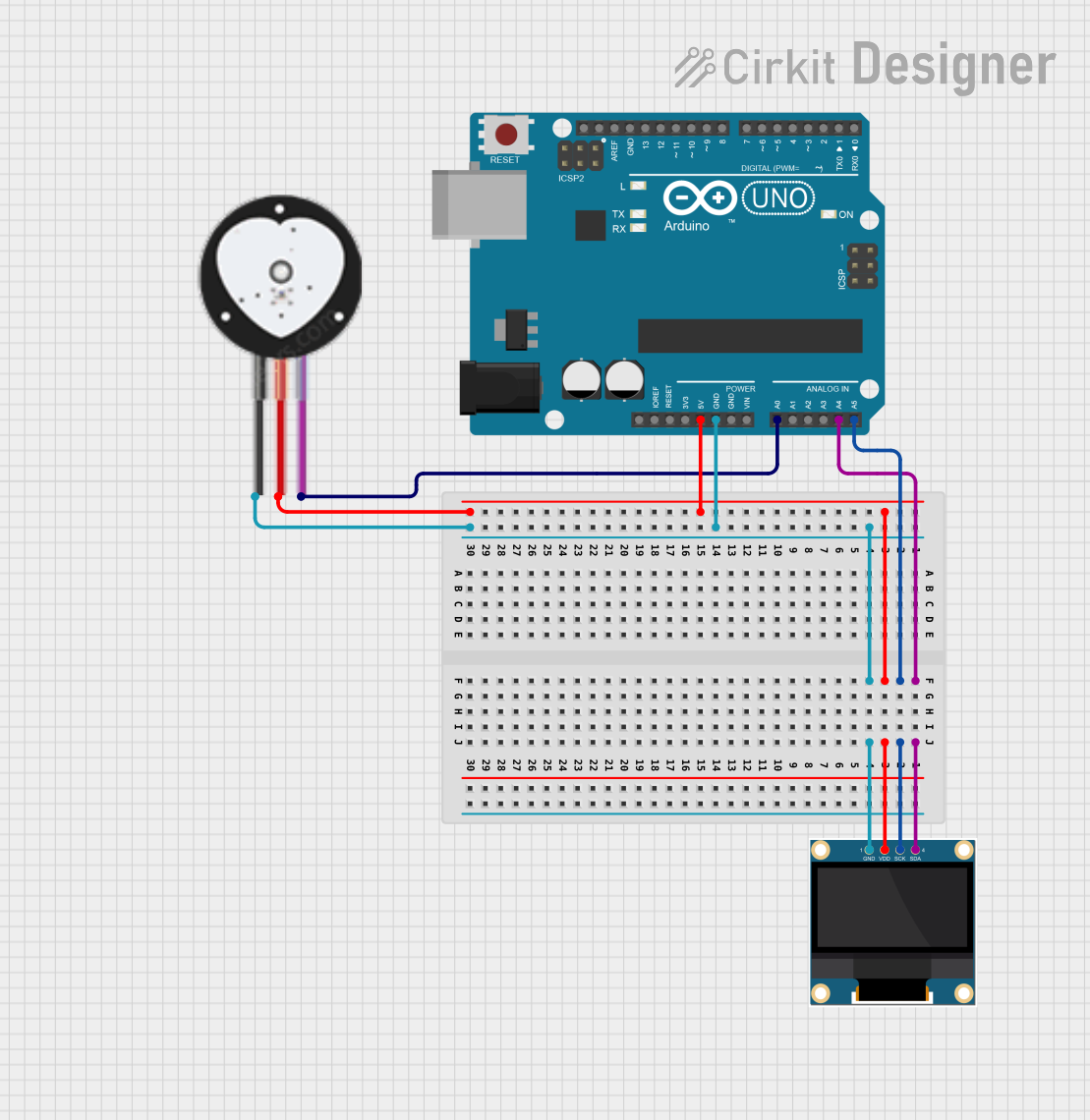
Circuit Documentation
Summary
The circuit in question is designed to monitor heart rate using a pulse sensor and display the readings on an OLED screen. The core of the circuit is an Arduino UNO microcontroller, which processes the signal from the heart pulse sensor and controls the OLED display to provide a user interface.
Component List
Arduino UNO
- Description: A microcontroller board based on the ATmega328P.
- Purpose: Acts as the central processing unit of the circuit, reading sensor data, running the heart rate detection algorithm, and controlling the OLED display.
Heart Pulse Sensor
- Description: A sensor that detects heart pulses through light modulation.
- Purpose: To measure the blood volume changes in the fingertip and provide a signal that correlates with the heartbeats.
0.96" OLED
- Description: A small display that uses organic light-emitting diodes.
- Purpose: To visually display the heart rate readings and other relevant information to the user.
Wiring Details
Arduino UNO
- 5V: Provides power to the OLED display and the Heart Pulse Sensor.
- GND: Common ground for the circuit.
- A0: Receives the analog signal from the Heart Pulse Sensor.
- A4 (SDA): Data line for I2C communication with the OLED display.
- A5 (SCL): Clock line for I2C communication with the OLED display.
Heart Pulse Sensor
- VCC: Connected to the 5V output from the Arduino UNO.
- GND: Connected to the ground on the Arduino UNO.
- SIGNAL: Connected to the A0 analog input on the Arduino UNO.
0.96" OLED
- VDD: Connected to the 5V output from the Arduino UNO.
- GND: Connected to the ground on the Arduino UNO.
- SCK: Connected to the A5 (SCL) on the Arduino UNO for I2C clock.
- SDA: Connected to the A4 (SDA) on the Arduino UNO for I2C data.
Documented Code
#include <Wire.h>
#include <Adafruit_GFX.h>
#include <Adafruit_SSD1306.h>

#define SCREEN_WIDTH 128
#define SCREEN_HEIGHT 64
#define OLED_RESET    -1
#define SMOOTHING_WINDOW_SIZE 4
Adafruit_SSD1306 display(SCREEN_WIDTH, SCREEN_HEIGHT, &Wire, OLED_RESET);

const int PULSE_SENSOR_PIN = A0;
const int LED_PIN = 13;

const int SAMPLE_INTERVAL = 100;  // Time between samples in milliseconds
const int BEAT_THRESHOLD = 550;  // Adjust based on your sensor's characteristics
const int NO_OBJECT_THRESHOLD = 400;

const unsigned long MIN_BEAT_INTERVAL = 600;  // Minimum time between beats (200 BPM)
const unsigned long MAX_BEAT_INTERVAL = 1500; // Maximum time between beats (40 BPM)

unsigned long lastBeatTime = 0;
int lastReading = 0;
bool rising = false;
float beatsPerMinute = 0;
bool objectPresent = false;

int readings[SMOOTHING_WINDOW_SIZE] = {0};  // Array for smoothing
int readIndex = 0;
int total = 0;

int getSmoothedReading(int reading) {
  total = total - readings[readIndex];        // Subtract the oldest reading
  readings[readIndex] = reading;              // Store new reading
  total = total + readings[readIndex];        // Add the new reading
  readIndex = (readIndex + 1) % SMOOTHING_WINDOW_SIZE;
  return total / SMOOTHING_WINDOW_SIZE;       // Return the average
}

// Heart icon (7x7 pixels)
const unsigned char PROGMEM heart_bmp[] = {
  B00100100,
  B01111110,
  B11111111,
  B11111111,
  B01111110,
  B00111100,
  B00011000
};

// Smaller heart for "beating" effect
const unsigned char PROGMEM heart_small_bmp[] = {
  B00000000,
  B00100100,
  B01111110,
  B01111110,
  B00111100,
  B00011000,
  B00000000
};

void setup() {
  Serial.begin(9600);
  pinMode(LED_PIN, OUTPUT);

  if (!display.begin(SSD1306_SWITCHCAPVCC, 0x3C)) {
    Serial.println(F("SSD1306 allocation failed"));
    for (;;);
  }

  display.clearDisplay();
  display.setTextSize(2);
  display.setTextColor(SSD1306_WHITE);
  display.setCursor(0, 0);
  display.println("Heart Rate Monitor");
  display.setTextSize(1);
  display.println("\n~~shibjyoti");
  display.display();
  delay(2000);
  display.clearDisplay();
}

void loop() {
  display.clearDisplay();
  static unsigned long lastSampleTime = 0;
  unsigned long currentTime = millis();
  int reading = getSmoothedReading(analogRead(PULSE_SENSOR_PIN)); // Smoothed reading

  if (currentTime - lastSampleTime >= SAMPLE_INTERVAL) {
    lastSampleTime = currentTime;
    int reading = analogRead(PULSE_SENSOR_PIN);

    if (reading < NO_OBJECT_THRESHOLD) {
      if (objectPresent) {
        objectPresent = false;
        display.clearDisplay();
        display.setTextSize(2);
        display.setCursor(0, 0);
        display.println("No object");
        display.println("Place finger on sensor");
        display.display();
      }
    } else {
      objectPresent = true;
      bool beatDetected = detectBeat(reading, currentTime);

      if (beatDetected) {
        unsigned long beatInterval = currentTime - lastBeatTime;
        if (beatInterval >= MIN_BEAT_INTERVAL && beatInterval <= MAX_BEAT_INTERVAL) {
          beatsPerMinute = 60000.0 / beatInterval;
          Serial.println(beatsPerMinute);
          display.clearDisplay();
          displayHeartRate(beatsPerMinute, true);
          getHealthAdvisory(beatsPerMinute);
          digitalWrite(LED_PIN, HIGH);
        }
        lastBeatTime = currentTime;
      } else {
        displayHeartRate(beatsPerMinute, false);
        digitalWrite(LED_PIN, LOW);
      }
    }
  }
  delay(100);
}

bool detectBeat(int reading, unsigned long currentTime) {
  static unsigned long lastDebounceTime = 0;
  bool beat = false;

  if (reading > BEAT_THRESHOLD && reading > lastReading && !rising) {
    rising = true;
  } else if (reading < lastReading && rising) {
    unsigned long debounceDelay = 200;
    if (currentTime - lastDebounceTime > debounceDelay) {
      rising = false;
      beat = true;
      lastDebounceTime = currentTime;
    }
  }
  lastReading = reading;
  return beat;
}

void displayHeartRate(float bpm, bool beating) {
  display.setTextSize(2);
  display.setCursor(0, 16);
  display.print(bpm, 1);   // Print BPM value without clearing the whole display
  display.println(" BPM");
  display.setTextSize(1);
  display.println(getHealthAdvisory(bpm));

  // Display the heart icon (update only if beating status changes)
  if (beating) {
    display.drawBitmap(110, 0, heart_bmp, 8, 7, SSD1306_WHITE);
  } else {
    display.drawBitmap(110, 0, heart_small_bmp, 8, 7, SSD1306_WHITE);
  }

  display.display();
}

const char* getHealthAdvisory(float bpm) {
  if (bpm < 60) {
    return "Low. Consult doctor if symptomatic";
  } else if (bpm >= 60 && bpm <= 100) {
    return "Normal resting adult heart rate.";
  } else if (bpm > 100 && bpm <= 140) {
    return "Elevated. Normal during exercise or nervousness";
  } else {
    return "Very high. Seek medical attention if persistent";
  }
}

/* Bibliography:
1. American Heart Association. (2021). All About Heart Rate (Pulse).
   https://www.heart.org/en/health-topics/high-blood-pressure/the-facts-about-high-blood-pressure/all-about-heart-rate-pulse
2. Mayo Clinic. (2020). Heart rate: What's normal?
   https://www.mayoclinic.org/healthy-lifestyle/fitness/expert-answers/heart-rate/faq-20057979
3. Cleveland Clinic. (2022). Pulse & Heart Rate.
   https://my.clevelandclinic.org/health/diagnostics/17402-pulse--heart-rate
*/
This code is responsible for initializing the OLED display, reading the heart pulse sensor data, smoothing the readings, detecting heartbeats, calculating the beats per minute (BPM), and displaying the BPM along with a heart icon on the OLED. It also provides health advisories based on the BPM readings.