
USB-Powered DC Gear Motor with LED Indicator
Circuit Documentation
Summary
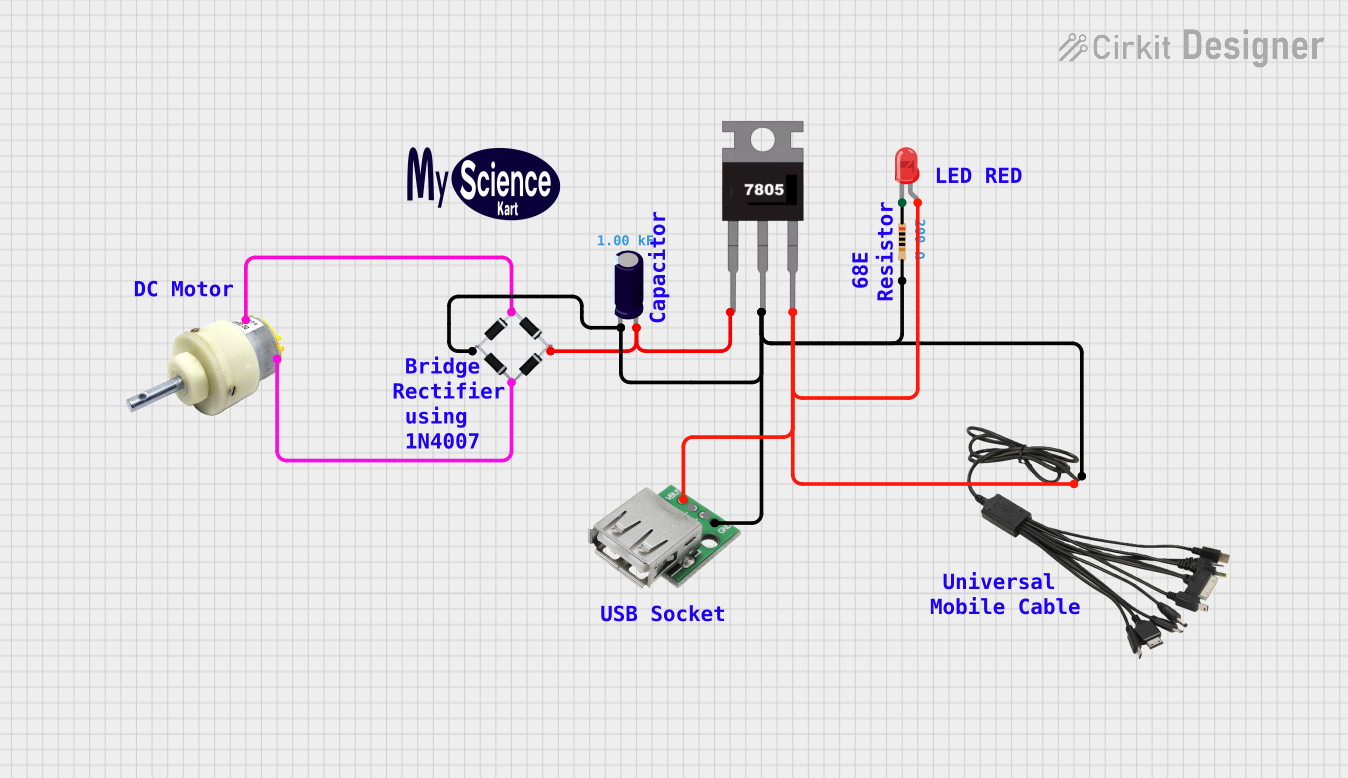
The circuit in question appears to be a simple power supply and indicator circuit. It takes input from a USB source, rectifies and regulates the voltage, and then powers a DC gear motor and an LED indicator. The LED is connected through a resistor to limit the current. The circuit uses a bridge rectifier to convert the incoming AC to DC, an electrolytic capacitor to smooth out the ripples in the DC supply, a 7805 voltage regulator to provide a stable 5V output, and a resistor to limit the current through the LED.
Component List
DC Gear Motor
- Description: A motor that converts electrical energy into mechanical energy with a gearbox to reduce speed and increase torque.
- Pins: Positive, Negative
Bridge Rectifier
- Description: A component that converts alternating current (AC) to direct current (DC).
- Pins: Source_in-, source_out-, source_out+, source_in+
Electrolytic Capacitor
- Description: A capacitor that uses an electrolyte to achieve a larger capacitance per unit volume.
- Properties: Capacitance: 1000 Farads
- Pins: -, +
7805 Voltage Regulator
- Description: A fixed linear voltage regulator that outputs a constant 5V.
- Pins: Vin, Gnd, Vout
LED: Two Pin (red)
- Description: A red light-emitting diode used as an indicator.
- Pins: cathode, anode
Resistor
- Description: A passive two-terminal electrical component that implements electrical resistance as a circuit element.
- Properties: Resistance: 200 Ohms
- Pins: pin1, pin2
USB Female
- Description: A female USB connector used as the power input for the circuit.
- Pins: VCC, GND, -D, +D
Multi Charging Cable Universal
- Description: A cable that provides power to the circuit.
- Pins: + Positive, - Negative
Logo
- Description: A graphical representation or symbol of a company name, trademark, abbreviation, etc.
- Pins: None
Comment
- Description: A text note or annotation in the circuit.
- Pins: None
Wiring Details
DC Gear Motor
- Positive connected to Bridge rectifier source_in+
- Negative connected to Bridge rectifier Source_in-
Bridge Rectifier
- Source_in- connected to DC Gear Motor Negative
- source_out- connected to Electrolytic Capacitor -, USB Female GND, 7805 Gnd, Resistor pin2, and Multi Charging Cable Universal - Negative
- source_out+ connected to Electrolytic Capacitor +
- source_in+ connected to DC Gear Motor Positive
Electrolytic Capacitor
- - connected to USB Female GND, 7805 Gnd, Bridge rectifier source_out-, Resistor pin2, and Multi Charging Cable Universal - Negative
- + connected to 7805 Vin and Bridge rectifier source_out+
7805 Voltage Regulator
- Vin connected to Electrolytic Capacitor +
- Gnd connected to Electrolytic Capacitor -, USB Female GND, Bridge rectifier source_out-, Resistor pin2, and Multi Charging Cable Universal - Negative
- Vout connected to USB Female VCC, LED: Two Pin (red) anode, and Multi Charging Cable Universal + Positive
LED: Two Pin (red)
- cathode connected to Resistor pin1
- anode connected to USB Female VCC, 7805 Vout, and Multi Charging Cable Universal + Positive
Resistor
- pin1 connected to LED: Two Pin (red) cathode
- pin2 connected to Electrolytic Capacitor -, USB Female GND, 7805 Gnd, Bridge rectifier source_out-, and Multi Charging Cable Universal - Negative
USB Female
- VCC connected to LED: Two Pin (red) anode, 7805 Vout, and Multi Charging Cable Universal + Positive
- GND connected to Electrolytic Capacitor -, 7805 Gnd, Bridge rectifier source_out-, Resistor pin2, and Multi Charging Cable Universal - Negative
Multi Charging Cable Universal
- + Positive connected to USB Female VCC, LED: Two Pin (red) anode, and 7805 Vout
- - Negative connected to Electrolytic Capacitor -, USB Female GND, 7805 Gnd, Bridge rectifier source_out-, and Resistor pin2
Documented Code
There is no embedded code provided for any microcontrollers in this circuit. If there were microcontrollers and associated code, this section would detail the functionality and implementation of the code within the context of the circuit.