
Circuit Documentation
Summary of the Circuit
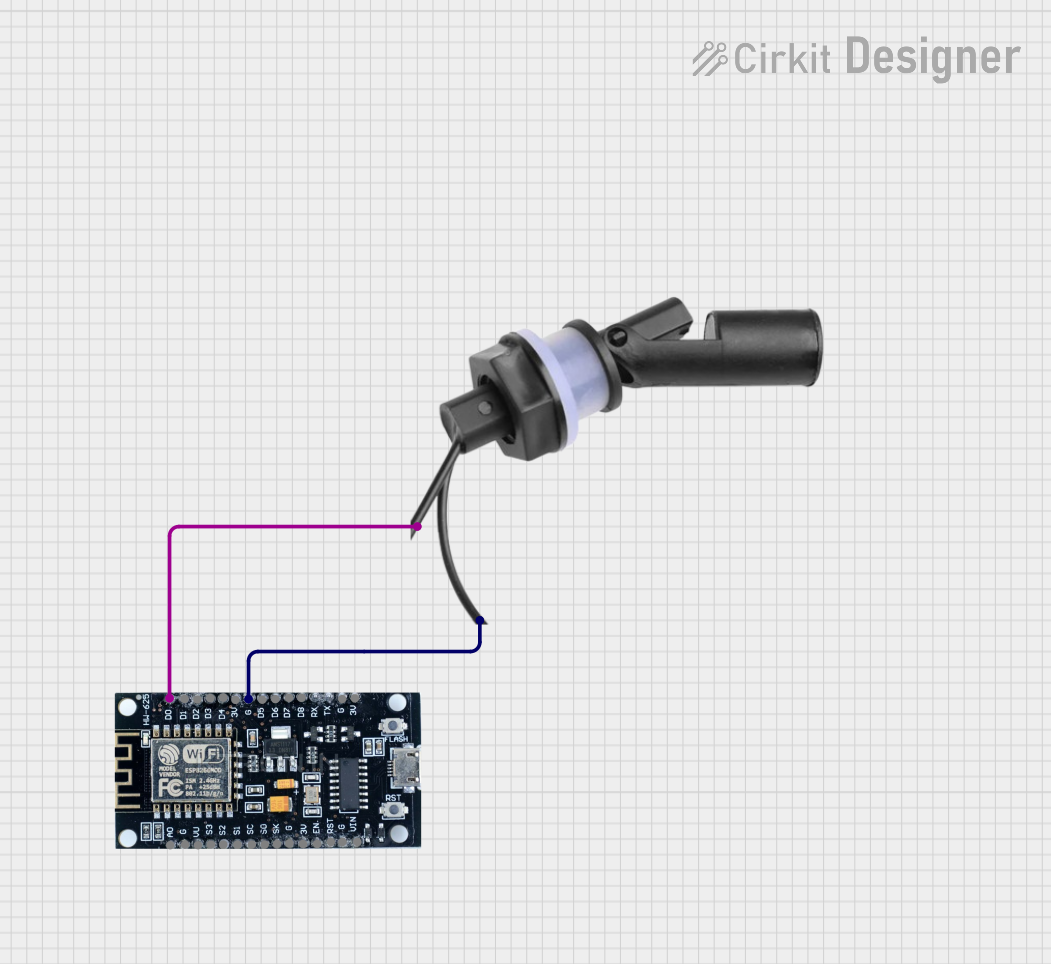
This circuit consists of an ESP8266 microcontroller unit (MCU) and a Water Level Float Switch Sensor. The ESP8266 is a popular Wi-Fi-enabled MCU that is widely used for IoT projects. The Water Level Float Switch Sensor is a simple device that can detect the presence or absence of water at a certain level. In this circuit, the sensor is connected to the ESP8266, which can process the signal from the sensor and perform actions such as sending alerts or data to a remote server.
Component List
ESP8266
- Description: A Wi-Fi-enabled microcontroller unit used for IoT applications.
- Pins: 3V, G, D8, D7, D6, D5, D4, D3, D2, D1, D0, A0, S3, S2, S1, SC, S0, SK, EN, VIN, RST, VU
- Purpose in Circuit: Acts as the main controller and Wi-Fi communication module.
Water Level Float Switch Sensor
- Description: A sensor that detects the presence of water at a certain level.
- Pins: Wire1, Wire2
- Purpose in Circuit: Provides water level status to the ESP8266.
Wiring Details
ESP8266
- Ground (G): Connected to the Water Level Float Switch Sensor (Wire2).
- D0: Connected to the Water Level Float Switch Sensor (Wire1).
Water Level Float Switch Sensor
- Wire1: Connected to the ESP8266 (D0).
- Wire2: Connected to the ESP8266 (Ground).
Documented Code
There is no code provided for the microcontroller in this circuit. If code were provided, it would typically be used to read the state of the Water Level Float Switch Sensor from the ESP8266's D0 pin and take action based on the sensor's status, such as sending a notification or logging the data.
Please note that the actual functionality of the circuit would depend on the embedded code running on the ESP8266, which is not included in the provided inputs. The code would be responsible for initializing the MCU's Wi-Fi capabilities, setting up the GPIO pin connected to the sensor (D0) as an input, and reading the sensor's state to determine the presence of water.