
Circuit Documentation
Summary of the Circuit
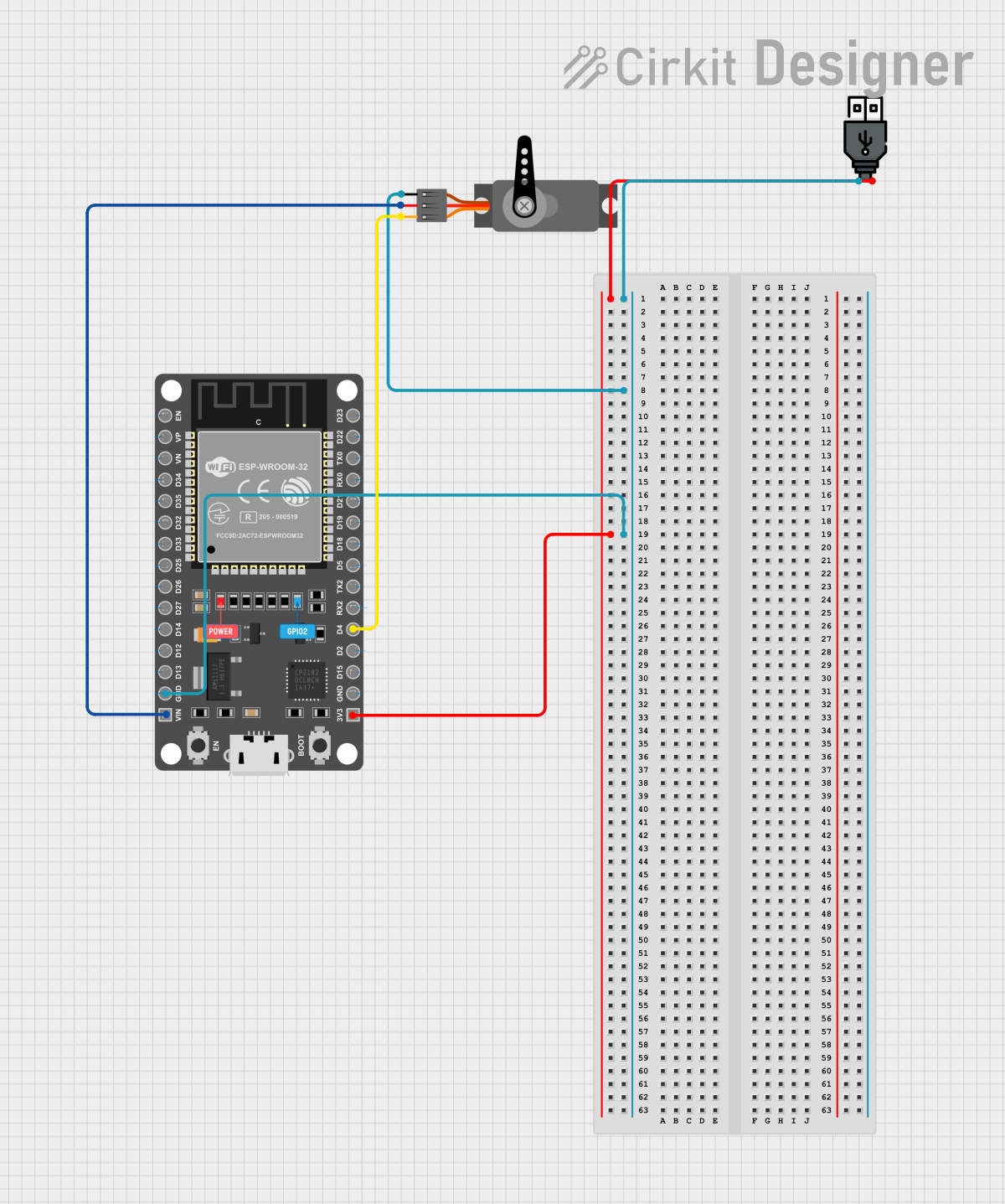
This circuit consists of an ESP32 DEVKIT V1 microcontroller, a servo motor, and a USB power supply. The ESP32 is a versatile microcontroller with Wi-Fi and Bluetooth capabilities, which is used to control the servo motor in this setup. The servo motor is an actuator that can be precisely controlled to move to different positions. The USB power supply provides the necessary power to the circuit.
Component List
ESP 32 DEVKIT V1 (30 pins)
- Description: A microcontroller with Wi-Fi and Bluetooth capabilities, featuring a wide range of GPIO pins.
- Purpose: Acts as the central processing unit of the circuit, controlling the servo motor and managing power distribution.
Servo
- Description: An electromechanical device that can be controlled to move to a specific position.
- Purpose: To perform physical movements or actions as instructed by the ESP32 microcontroller.
USB Power
- Description: A power supply module that provides power through a USB connection.
- Purpose: To supply electrical power to the circuit components.
Wiring Details
ESP 32 DEVKIT V1 (30 pins)
- 3V3: Connected to the positive (+) terminal of the USB power supply.
- GND: Connected to the negative (-) terminal of the USB power supply and the GND pin of the Servo.
- VIN: Connected to the VCC pin of the Servo.
- D4: Connected to the PWM pin of the Servo.
Servo
- GND: Connected to the GND pin of the ESP 32 DEVKIT V1 and the negative (-) terminal of the USB power supply.
- VCC: Connected to the VIN pin of the ESP 32 DEVKIT V1.
- PWM: Connected to the D4 pin of the ESP 32 DEVKIT V1.
USB Power
- +: Connected to the 3V3 pin of the ESP 32 DEVKIT V1.
- -: Connected to the GND pin of the ESP 32 DEVKIT V1 and the GND pin of the Servo.
Documented Code
There is no code provided for the microcontroller in this circuit. To fully utilize the ESP32 DEVKIT V1 and the servo motor, embedded code is required to control the servo's position through the PWM signal on pin D4. The user should develop and upload appropriate firmware to the ESP32 for the intended application.