
WiFi-Enabled Environmental Monitoring System with Alert Notifications
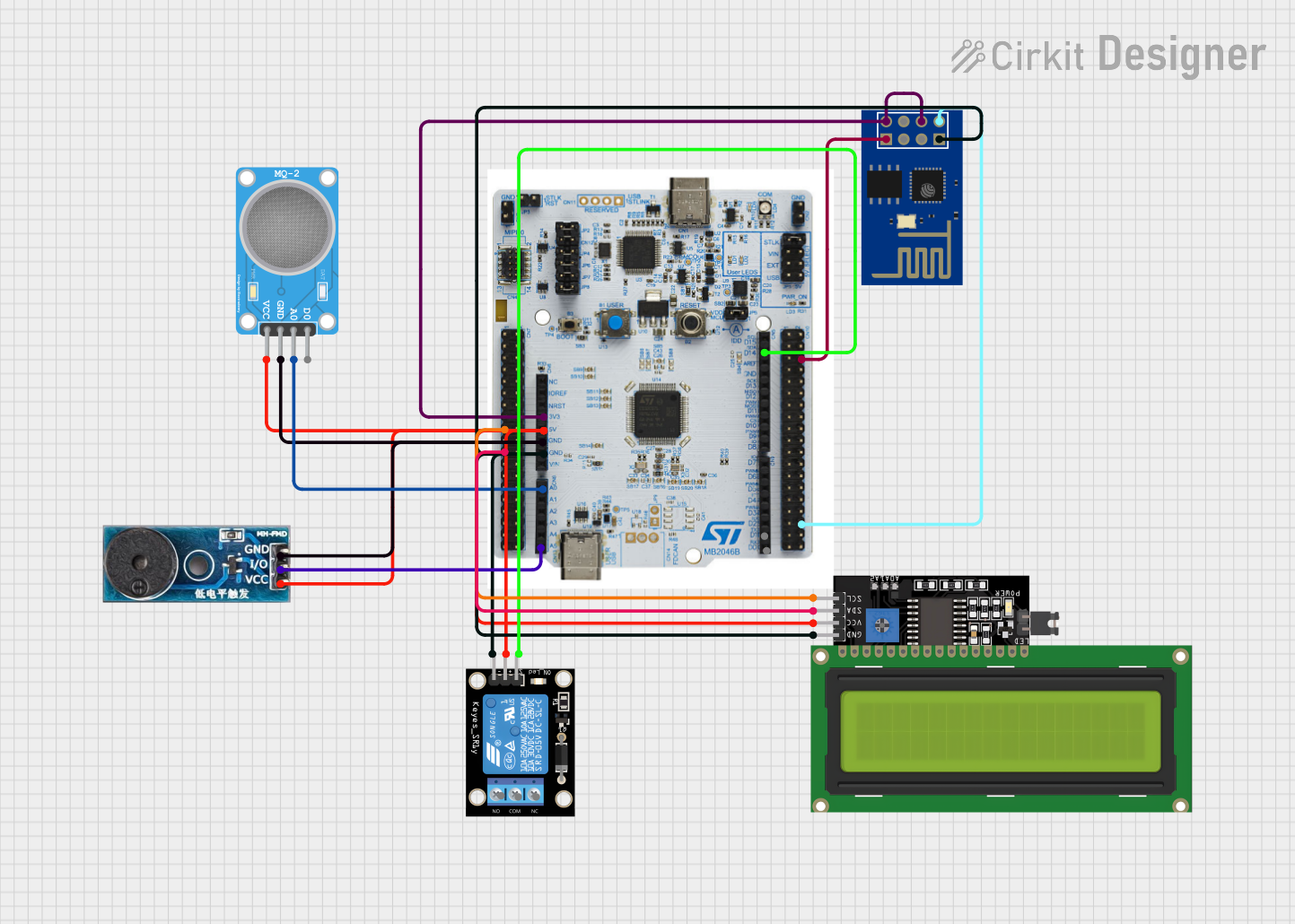
Circuit Documentation
Summary
The circuit in question is designed to interface a NUCLEO-F303RE development board with various peripheral modules, including an LCD display, a WiFi module, a buzzer, a relay module, and a gas sensor. The NUCLEO-F303RE board serves as the central processing unit, controlling the peripherals through various communication protocols and GPIO connections. The LCD display is connected via I2C, the ESP8266 WiFi module via UART, the buzzer through a timer pin, the MQ-2 gas sensor through an ADC pin, and the relay module through a GPIO pin. Power distribution is managed with +3V and +5V lines from the NUCLEO board to the respective components, and a common ground is shared among all components.
Component List
Buzzer Module
- Pins: GND, Vcc, I/O
- Description: An audio signaling device that can be triggered by a digital signal.
KY-019 Relay Module 1 Channel
- Pins: S, 5V, GND, NC, COM, NO
- Description: A relay module capable of switching higher power loads using a low power signal.
NUCLEO-F303RE BOARD
- Pins: SCL_I2C, SDA_I2C, USART_1 TX, USART1_RX, USART_2 RX, USART_2 TX, TIM1, ADC1, RELAY_IN, +3V, +5V, GND
- Description: A development board featuring an STM32F303RE microcontroller, suitable for rapid prototyping.
ESP8266 ESP-01 WiFi Module
- Pins: TXD, CH_PD, RST, VCC, GND, GPIO_2, GPIO_0, RXD
- Description: A WiFi module that enables wireless communication and Internet connectivity.
MQ-2 SENSOR
- Pins: VCC, GND, A0, D0
- Description: A gas sensor used for detecting a variety of gases including LPG, smoke, and alcohol vapor.
LCD Display 16x4 I2C
- Pins: SCL, SDA, VCC, GND
- Description: A 16x4 character LCD display with an I2C interface for displaying text and characters.
Wiring Details
Buzzer Module
- GND: Connected to the common ground.
- Vcc: Connected to the +5V power supply from the NUCLEO-F303RE BOARD.
- I/O: Connected to the TIM1(PC0) pin on the NUCLEO-F303RE BOARD.
KY-019 Relay Module 1 Channel
- S: Connected to the RELAY_IN(PB9) pin on the NUCLEO-F303RE BOARD.
- 5V: Connected to the +5V power supply from the NUCLEO-F303RE BOARD.
- GND: Connected to the common ground.
NUCLEO-F303RE BOARD
- SCL_I2C, SDA_I2C: Connected to the corresponding SCL and SDA pins on the LCD Display 16x4 I2C.
- USART_1 TX, USART1_RX: Connected to the RXD and TXD pins on the ESP8266 ESP-01 WiFi Module.
- TIM1: Connected to the I/O pin on the Buzzer Module.
- ADC1: Connected to the A0 pin on the MQ-2 SENSOR.
- RELAY_IN: Connected to the S pin on the KY-019 Relay Module 1 Channel.
- +3V: Connected to the CH_PD and VCC pins on the ESP8266 ESP-01 WiFi Module.
- +5V: Connected to the 5V pins on the KY-019 Relay Module 1 Channel, Buzzer Module, MQ-2 SENSOR, and LCD Display 16x4 I2C.
- GND: Common ground for all components.
ESP8266 ESP-01 WiFi Module
- TXD: Connected to the USART_1 TX pin on the NUCLEO-F303RE BOARD.
- CH_PD, VCC: Connected to the +3V power supply from the NUCLEO-F303RE BOARD.
- GND: Connected to the common ground.
- RXD: Connected to the USART1_RX pin on the NUCLEO-F303RE BOARD.
MQ-2 SENSOR
- VCC: Connected to the +5V power supply from the NUCLEO-F303RE BOARD.
- GND: Connected to the common ground.
- A0: Connected to the ADC1(PA0) pin on the NUCLEO-F303RE BOARD.
LCD Display 16x4 I2C
- SCL, SDA: Connected to the corresponding SCL_I2C and SDA_I2C pins on the NUCLEO-F303RE BOARD.
- VCC: Connected to the +5V power supply from the NUCLEO-F303RE BOARD.
- GND: Connected to the common ground.
Documented Code
No code has been provided for the microcontrollers in the circuit. When code is available, it should be documented here with explanations for each function and routine, including setup and loop functions, interrupt service routines, and any communication protocol implementations.