
ESP8266 NodeMCU with DHT11 Sensor for Temperature and Humidity Monitoring
View and Edit Project In Cirkit Designer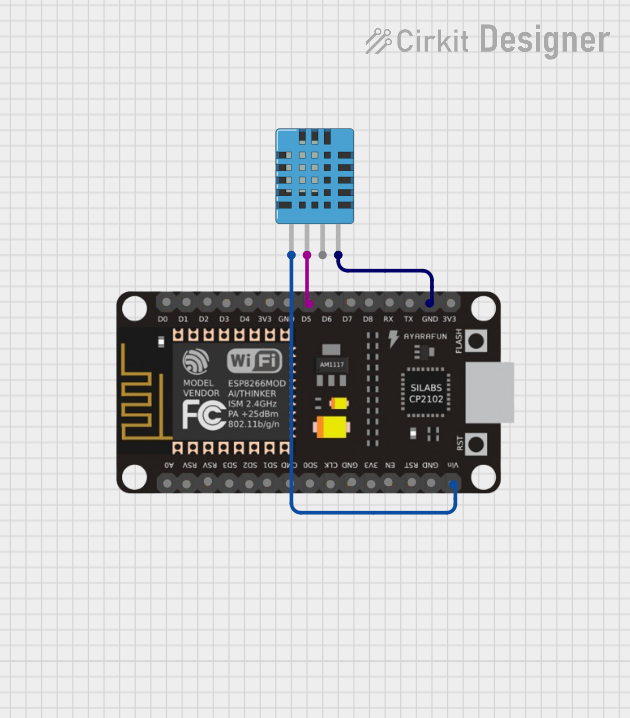
Circuit Documentation
Summary of the Circuit
This circuit integrates a DHT11 Humidity and Temperature Sensor with an ESP8266 NodeMCU microcontroller. The purpose of the circuit is to measure ambient temperature and humidity levels and process this data using the ESP8266 NodeMCU. The DHT11 sensor provides digital temperature and humidity readings, which are then read by one of the digital pins on the ESP8266. The ESP8266 is capable of wireless data communication, which allows the sensor data to be transmitted to a remote server or displayed on a user interface.
Component List
DHT11 Humidity and Temperature Sensor
- Description: A digital sensor for measuring temperature and humidity.
- Pins:
- VDD: Power supply
- DATA: Digital output
- NULL: No connection
- GND: Ground
ESP8266 NodeMCU
- Description: A Wi-Fi enabled microcontroller board based on the ESP8266 SoC.
- Pins:
- D0-D8: Digital I/O pins
- RX, TX: UART communication pins
- A0: Analog input pin
- 3V3: 3.3V power supply
- GND: Ground
- RSV, SD3, SD2, SD1, CMD, SD0, CLK: SD card interface
- EN: Chip enable
- RST: Reset
- VIN: Voltage input for power supply
Wiring Details
DHT11 Humidity and Temperature Sensor
- VDD connected to VIN of ESP8266 NodeMCU
- DATA connected to D5 of ESP8266 NodeMCU
- GND connected to GND of ESP8266 NodeMCU
ESP8266 NodeMCU
- VIN connected to VDD of DHT11 Humidity and Temperature Sensor
- D5 connected to DATA of DHT11 Humidity and Temperature Sensor
- GND connected to GND of DHT11 Humidity and Temperature Sensor
Documented Code
No code has been provided for the microcontroller. To fully utilize the circuit, embedded code for the ESP8266 NodeMCU is required to initialize the sensor, read data from it, and handle the wireless communication for data transmission. The code would typically be written in C or C++ using the Arduino IDE or a similar development environment that supports the ESP8266 SDK.