
ESP32-Based Temperature Monitoring System with I2C LCD Display
View and Edit Project In Cirkit Designer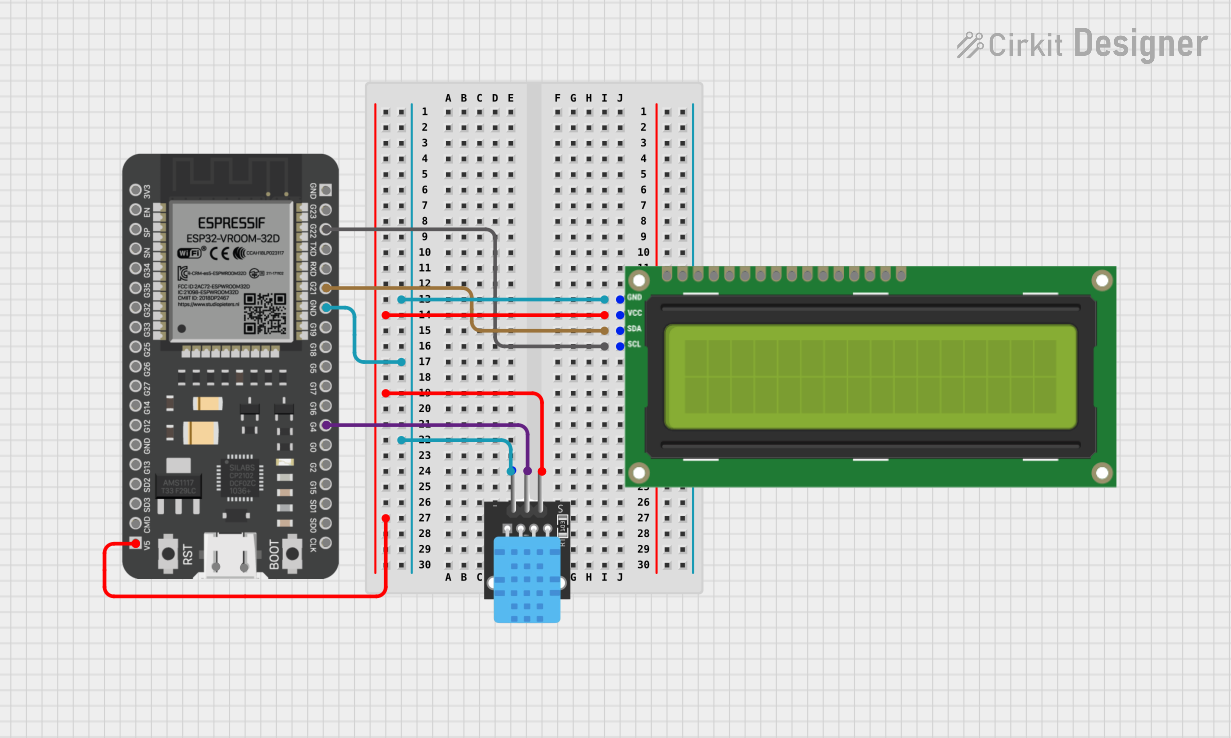
Circuit Documentation
Summary of the Circuit
This circuit integrates an ESP32 microcontroller with a 16x2 I2C LCD screen and a DHT11 temperature and humidity sensor. The ESP32 serves as the central processing unit, controlling the display on the LCD screen via the I2C protocol and reading environmental data from the DHT11 sensor. The circuit is designed to share a common ground and power supply across all components, ensuring that the components operate at compatible voltage levels.
Component List
ESP32 - 38 pins
- Description: A microcontroller with Wi-Fi and Bluetooth capabilities, featuring a wide range of GPIO pins.
- Purpose: Acts as the central processing unit for the circuit, managing I/O and communication with the LCD screen and DHT11 sensor.
I2C LCD 16x2 Screen
- Description: A liquid crystal display capable of showing 16 characters in 2 rows, with an I2C interface for communication.
- Purpose: Displays information processed by the ESP32, such as temperature and humidity readings.
DHT11
- Description: A basic, low-cost digital temperature and humidity sensor.
- Purpose: Provides environmental data to the ESP32 for processing and display on the LCD screen.
Wiring Details
ESP32 - 38 pins
- GND connected to the common ground net.
- 5V connected to the common power supply net.
- G21 (SDA) connected to the SDA pin of the I2C LCD 16x2 Screen.
- G22 (SCL) connected to the SCL pin of the I2C LCD 16x2 Screen.
- G4 connected to the signal pin (S) of the DHT11 sensor.
I2C LCD 16x2 Screen
- GND connected to the common ground net.
- VCC (5V) connected to the common power supply net.
- SDA connected to the G21 pin of the ESP32.
- SCL connected to the G22 pin of the ESP32.
DHT11
- GND connected to the common ground net.
- 5V connected to the common power supply net.
- S connected to the G4 pin of the ESP32.
Documented Code
No code has been provided for the microcontroller. Typically, the code would initialize the I2C communication with the LCD screen, read data from the DHT11 sensor, and display the readings on the LCD. Since no code is available, it is recommended to develop firmware that includes the following functionalities:
- Initialization of the I2C interface.
- Periodic reading of temperature and humidity data from the DHT11 sensor.
- Displaying the sensor data on the LCD screen.
- Handling errors and exceptions.
Please provide the code for the microcontroller to complete the documentation process.