
Arduino UNO Solar-Powered Motion-Activated Security System with GSM Module
View and Edit Project In Cirkit Designer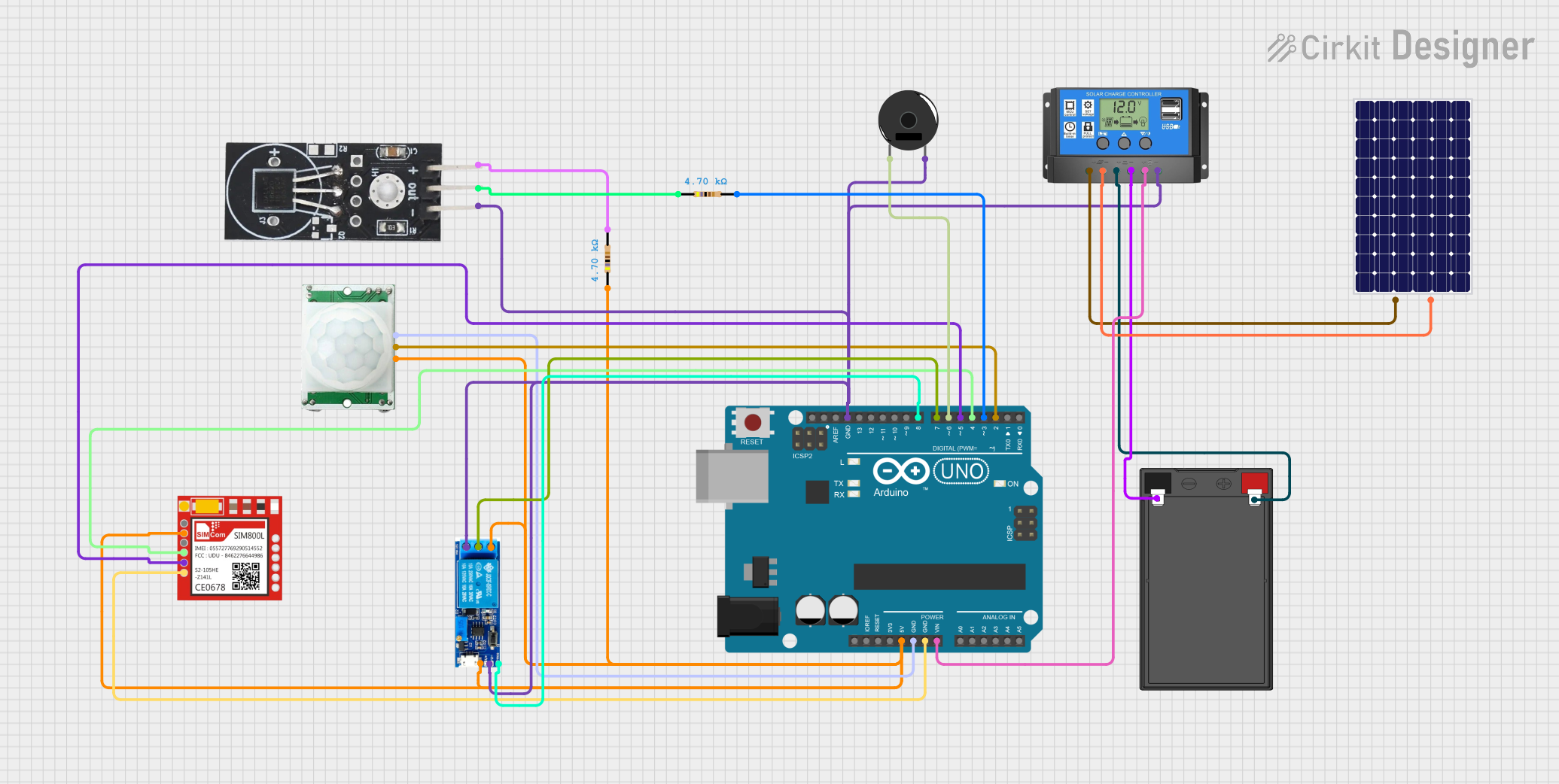
Circuit Documentation
Summary
This circuit is designed to integrate various sensors and modules with an Arduino UNO microcontroller. The system includes a PIR motion sensor, a DS18B20 temperature sensor, a piezo buzzer, a Sim800l GSM module, a solar panel, a solar charge controller, a 12V 7Ah battery, and a relay module. The circuit is powered by a solar panel and battery setup, ensuring sustainable energy usage.
Component List
Arduino UNO
- Description: Microcontroller board based on the ATmega328P.
- Pins: UNUSED, IOREF, Reset, 3.3V, 5V, GND, Vin, A0, A1, A2, A3, A4, A5, SCL, SDA, AREF, D13, D12, D11, D10, D9, D8, D7, D6, D5, D4, D3, D2, D1, D0
PIR/Motion Sensor
- Description: Sensor to detect motion.
- Pins: GND, OUTPUT, VCC
DS18B20 Temperature Sensor
- Description: Digital temperature sensor.
- Pins: GND, VCC, OUT
Piezo Buzzer
- Description: Sound-producing device.
- Pins: pin 1, pin 2
Sim800l
- Description: GSM module for communication.
- Pins: NET, RST, VCC, RXD, TXD, GND
Solar Panel
- Description: Converts sunlight into electrical energy.
- Pins: +, -
Solar Charge Controller
- Description: Manages the power from the solar panel to the battery and load.
- Pins: Solar Cell +, Solar Cell -, Battery +, Battery -, Load +, Load -
12V 7Ah Battery
- Description: Rechargeable battery for energy storage.
- Pins: 12v +, 12v -
Resistor (4700 Ohms)
- Description: Limits current flow.
- Pins: pin1, pin2
Relay Module (5V-30V)
- Description: Electrically operated switch.
- Pins: common contact, normally open, normally closed, trigger, V-, V+
Wiring Details
Arduino UNO
- 5V: Connected to VCC of PIR/Motion Sensor, VCC of Sim800l, V+ and normally open of Relay Module, pin1 of Resistor (4700 Ohms).
- GND: Connected to GND of PIR/Motion Sensor, GND of Sim800l, Load - of Solar Charge Controller, pin 2 of Piezo Buzzer, GND of DS18B20 Temperature Sensor.
- Vin: Connected to Load + of Solar Charge Controller.
- D8: Connected to trigger of Relay Module.
- D7: Connected to common contact of Relay Module.
- D6: Connected to pin 1 of Piezo Buzzer.
- D5: Connected to TXD of Sim800l.
- D4: Connected to RXD of Sim800l.
- D3: Connected to pin2 of Resistor (4700 Ohms).
- D2: Connected to OUTPUT of PIR/Motion Sensor.
PIR/Motion Sensor
- VCC: Connected to 5V of Arduino UNO.
- GND: Connected to GND of Arduino UNO.
- OUTPUT: Connected to D2 of Arduino UNO.
DS18B20 Temperature Sensor
- GND: Connected to GND of Arduino UNO.
- VCC: Connected to pin2 of Resistor (4700 Ohms).
- OUT: Connected to pin1 of Resistor (4700 Ohms).
Piezo Buzzer
- pin 1: Connected to D6 of Arduino UNO.
- pin 2: Connected to Load - of Solar Charge Controller.
Sim800l
- VCC: Connected to 5V of Arduino UNO.
- GND: Connected to GND of Arduino UNO.
- TXD: Connected to D5 of Arduino UNO.
- RXD: Connected to D4 of Arduino UNO.
Solar Panel
- +: Connected to Solar Cell + of Solar Charge Controller.
- -: Connected to Solar Cell - of Solar Charge Controller.
Solar Charge Controller
- Solar Cell +: Connected to + of Solar Panel.
- Solar Cell -: Connected to - of Solar Panel.
- Battery +: Connected to 12v + of 12V 7Ah Battery.
- Battery -: Connected to 12v - of 12V 7Ah Battery.
- Load +: Connected to Vin of Arduino UNO.
- Load -: Connected to GND of Arduino UNO, pin 2 of Piezo Buzzer.
12V 7Ah Battery
- 12v +: Connected to Battery + of Solar Charge Controller.
- 12v -: Connected to Battery - of Solar Charge Controller.
Resistor (4700 Ohms)
- pin1: Connected to OUT of DS18B20 Temperature Sensor.
- pin2: Connected to D3 of Arduino UNO, VCC of DS18B20 Temperature Sensor.
Relay Module (5V-30V)
- common contact: Connected to D7 of Arduino UNO.
- normally open: Connected to 5V of Arduino UNO.
- normally closed: Connected to V- of Relay Module, Load - of Solar Charge Controller.
- trigger: Connected to D8 of Arduino UNO.
- V-: Connected to normally closed of Relay Module.
- V+: Connected to 5V of Arduino UNO.
Documented Code
Arduino UNO Code (sketch.ino)
void setup() {
  // put your setup code here, to run once:

}

void loop() {
  // put your main code here, to run repeatedly:

}
Additional Documentation (documentation.txt)