
ESP32-CAM Based Environmental Monitoring System with Gas Detection and Infrared Temperature Sensing
View and Edit Project In Cirkit Designer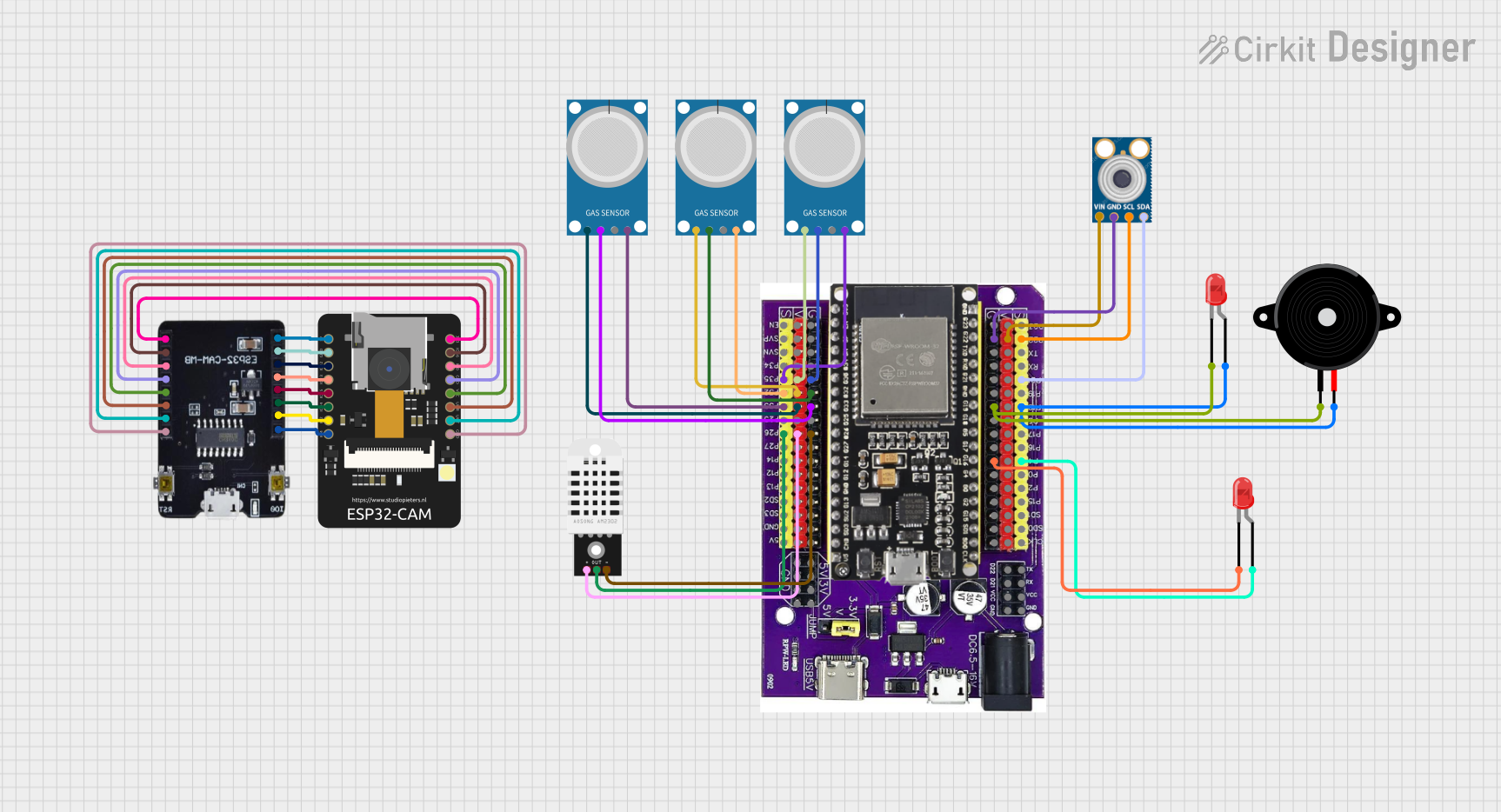
Circuit Documentation
Summary
This document provides a detailed overview of a circuit designed to interface various sensors and modules with an ESP32 microcontroller. The circuit includes sensor modules for gas detection (MQ-4), temperature measurement (mlx90614), and humidity sensing (DHT22). Additionally, it incorporates an ESP32-CAM module with a camera interface board (ESP32-CAM MB FLIP), LEDs for indication, and a piezo speaker for audio feedback. The circuit is powered through the ESP32 on a baseboard, which also provides the necessary GPIO connections for interfacing with the various components.
Component List
ESP32 - CAM
- A microcontroller module with camera support.
- Pins: 5V, GND, IO12, IO13, IO15, IO14, IO2, IO4, VOT, VOR, VCC, IO0, IO16, 3V3
ESP32-CAM MB FLIP
- A camera interface board designed to work with the ESP32-CAM module.
- Pins: 3.3V, IO16, IO0, GND, VCC, IO3RX, IO1TX, 5V, IO12, IO13, IO15, IO14, IO2, IO4
MQ-4 Gas Sensor
- A gas sensor module for detecting methane and natural gas in the air.
- Pins: A0, D0, GND, VCC
Esp32 on Baseboard
- A development board that provides easy access to the ESP32's pins.
- Pins: GPIO23, GPIO22, GPIO1/TX, GPIO3/RX, GPIO21, GPIO19, GPIO18, GPIO5, GPIO17, GPIO16, GPIO4, GPIO0, GPIO2, GPIO15, SD1, SD0, CLK, V, G, GPIO36, GPIO39, GPIO34, GPIO35, GPIO32, GPIO33, GPIO25, GPIO26, GPIO27, GPIO14, GPIO12, GPIO13, SD2, SD3, GND, 5V, 3V, TX, RX, VCC, D22, D21
DHT22 Temperature and Humidity Sensor
- A sensor for measuring ambient temperature and humidity.
- Pins: VCC, OUT, GND
LED: Two Pin (red)
- A basic red LED for indication purposes.
- Pins: cathode, anode
mlx90614 Infrared Temperature Sensor
- A non-contact infrared temperature sensor.
- Pins: SDA, SCL, GND, VIN
Piezo Speaker
- An electronic component that can be used to produce sound.
- Pins: pin1, pin2
Wiring Details
ESP32 - CAM
- 5V connected to ESP32-CAM MB FLIP 5V
- GND connected to ESP32-CAM MB FLIP GND
- IO12 connected to ESP32-CAM MB FLIP IO12
- IO13 connected to ESP32-CAM MB FLIP IO13
- IO15 connected to ESP32-CAM MB FLIP IO15
- IO14 connected to ESP32-CAM MB FLIP IO14
- IO2 connected to ESP32-CAM MB FLIP IO2
- IO4 connected to ESP32-CAM MB FLIP IO4
- VOT connected to ESP32-CAM MB FLIP IO1TX
- VOR connected to ESP32-CAM MB FLIP IO3RX
- VCC connected to ESP32-CAM MB FLIP VCC
- IO0 connected to ESP32-CAM MB FLIP IO0
- IO16 connected to ESP32-CAM MB FLIP IO16
- 3V3 connected to ESP32-CAM MB FLIP 3.3V
MQ-4 Gas Sensor (Multiple Instances)
- A0 connected to Esp32 on Baseboard GPIO32, GPIO33, GPIO35 (one sensor per GPIO)
- GND connected to Esp32 on Baseboard G
- VCC connected to Esp32 on Baseboard V
Esp32 on Baseboard
- GPIO22 connected to mlx90614 SCL
- GPIO21 connected to mlx90614 SDA
- GPIO18 connected to LED anode and Piezo Speaker pin2
- GPIO4 connected to LED anode
- GPIO26 connected to DHT22 OUT
- GND connected to mlx90614 GND, LED cathode, Piezo Speaker pin1, and DHT22 GND
- VCC connected to mlx90614 VIN and DHT22 VCC
DHT22 Temperature and Humidity Sensor
- OUT connected to Esp32 on Baseboard GPIO26
- VCC connected to Esp32 on Baseboard VCC
- GND connected to Esp32 on Baseboard GND
LED: Two Pin (red) (Multiple Instances)
- Anode connected to Esp32 on Baseboard GPIO18, GPIO4
- Cathode connected to Esp32 on Baseboard GND
mlx90614 Infrared Temperature Sensor
- SDA connected to Esp32 on Baseboard GPIO21
- SCL connected to Esp32 on Baseboard GPIO22
- GND connected to Esp32 on Baseboard GND
- VIN connected to Esp32 on Baseboard VCC
Piezo Speaker
- Pin1 connected to Esp32 on Baseboard GND
- Pin2 connected to Esp32 on Baseboard GPIO18
Documented Code
No code has been provided for the microcontrollers in the circuit. The functionality of the circuit will depend on the embedded code that controls the ESP32 microcontroller, which is responsible for interfacing with the sensors and modules, processing their data, and performing actions such as activating the LEDs or piezo speaker. Without the code, the behavior of the circuit cannot be documented.