
Arduino Nano-Based Wearable Gesture Control Interface with Bluetooth Connectivity
View and Edit Project In Cirkit Designer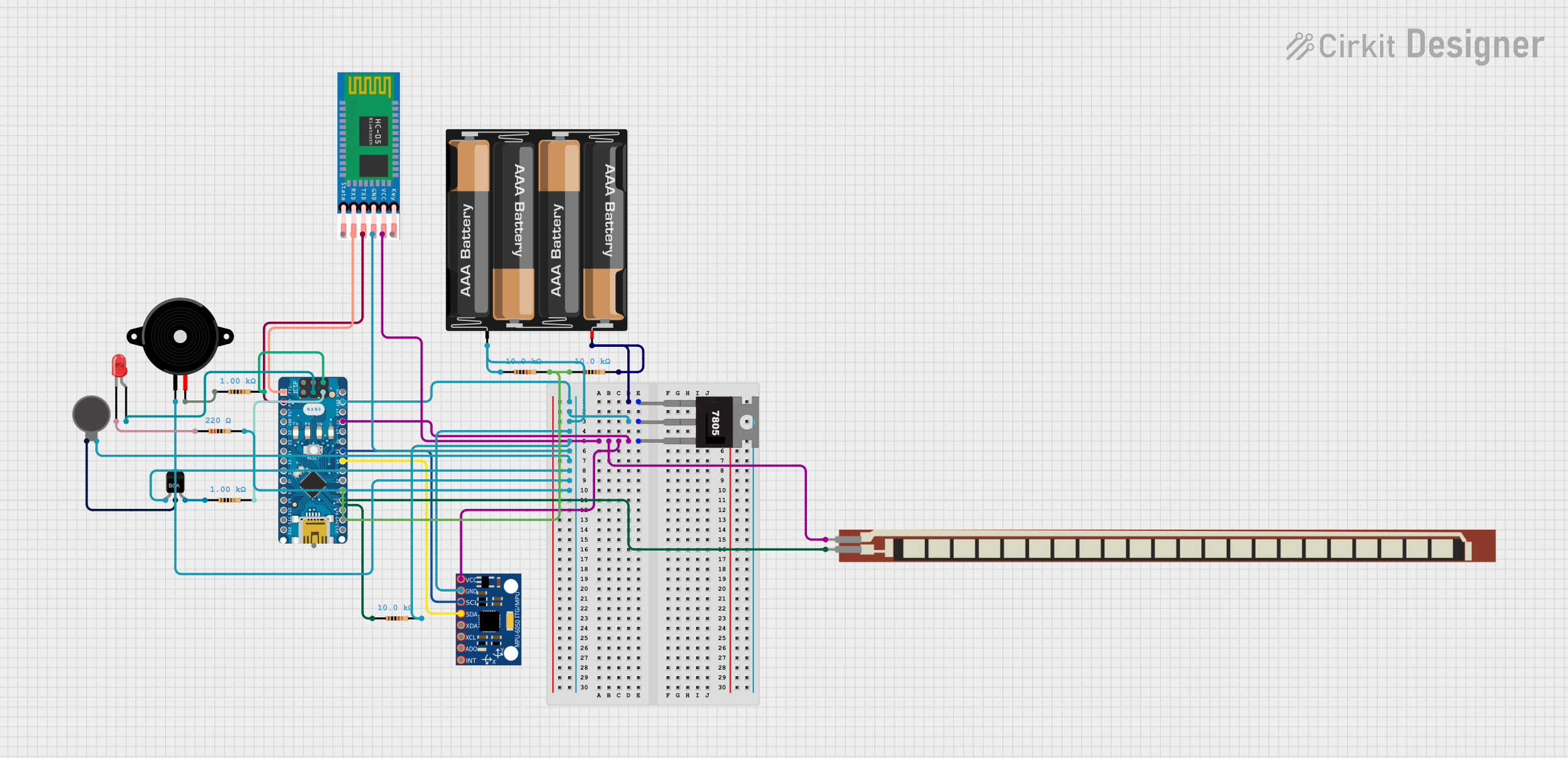
Circuit Documentation
Summary
This document provides a detailed overview of a circuit designed to interface various components with an Arduino Nano microcontroller. The circuit includes a voltage regulator, a battery mount, sensors, a Bluetooth module, actuators, and supporting passive components. The Arduino Nano serves as the central processing unit, managing data from the MPU-6050 sensor and communicating via the HC-05 Bluetooth module. Actuators in the circuit include a vibration motor and a piezo speaker, and there is also an LED for visual output. The circuit is powered by a 4 x AAA battery mount, with voltage regulation provided by a 7805 voltage regulator.
Component List
Voltage Regulator
- 7805: A voltage regulator that outputs a steady 5V from a higher input voltage.
Power Source
- 4 x AAA Battery Mount: Holds four AAA batteries to provide power to the circuit.
Sensors
- MPU-6050: A motion processing unit that includes a gyroscope and an accelerometer.
- Basic Flex Resistor: A flexible resistor that changes resistance when bent.
Communication Module
- HC-05: A Bluetooth module for wireless communication.
Actuators
- Vibration Motor: An actuator that provides haptic feedback.
- Piezo Speaker: An electronic component that can produce sound.
Transistor
- NPN-Transistor: A bipolar junction transistor used for switching or amplification.
Microcontroller
- Arduino Nano: A small, complete, and breadboard-friendly board based on the ATmega328P.
Passive Components
- Resistors: Various resistors with different resistance values used for current limiting and voltage division.
- LED: A red two-pin light-emitting diode for visual indication.
Wiring Details
7805 Voltage Regulator
- Vin connected to the positive terminal of the 4 x AAA Battery Mount.
- Gnd connected to the ground net, which includes the Arduino Nano GND, battery mount negative terminal, and various other ground connections.
- Vout connected to the 5V net, which powers the HC-05, Arduino Nano 5V, Basic Flex Resistor, and MPU-6050 VCC.
4 x AAA Battery Mount
- + connected to the 7805 Vin.
- - connected to the ground net.
MPU-6050
- VCC connected to the 5V net.
- GND connected to the ground net.
- SCL connected to Arduino Nano A5.
- SDA connected to Arduino Nano A4.
Basic Flex Resistor
- One pin connected to the 5V net.
- The other pin connected to Arduino Nano A0.
HC-05 Bluetooth Module
- EN not connected in this circuit.
- VCC connected to the 5V net.
- GND connected to the ground net.
- TXD connected to Arduino Nano D0/RX.
- RXD connected to Arduino Nano D1/TX.
- STATE not connected in this circuit.
Vibration Motor
- + connected to the collector of the NPN-Transistor.
- - connected to the ground net.
NPN-Transistor
- E connected to the ground net.
- C connected to the Vibration Motor +.
- B connected to a 1kΩ resistor, which is then connected to the 5V net.
Arduino Nano
- D1/TX connected to HC-05 RXD.
- D0/RX connected to HC-05 TXD.
- RESET, D2-D10, D13/SCK, VIN, A7-A2, AREF, 3V3 not connected in this circuit.
- GND connected to the ground net.
- 5V connected to the 5V net.
- A5 connected to MPU-6050 SCL.
- A4 connected to MPU-6050 SDA.
- A1 connected to a voltage divider network involving two 10kΩ resistors.
- A0 connected to the Basic Flex Resistor.
Piezo Speaker
- One pin connected to a 1kΩ resistor, which is then connected to Arduino Nano D12/MISO.
- The other pin connected to the ground net.
LED: Two Pin (red)
- Anode connected to Arduino Nano D11/MOSI.
- Cathode connected to a 220Ω resistor, which is then connected to the ground net.
Documented Code
Arduino Nano - sketch.ino
void setup() {
  // put your setup code here, to run once:

}

void loop() {
  // put your main code here, to run repeatedly:

}
Arduino Nano - documentation.txt
(No additional documentation provided for the code)
This concludes the documentation for the provided circuit. The circuit is designed for sensor data acquisition, wireless communication, and providing feedback through actuators. The Arduino Nano's code is currently a template and should be further developed to handle the sensor data, control the actuators, and manage Bluetooth communication.