
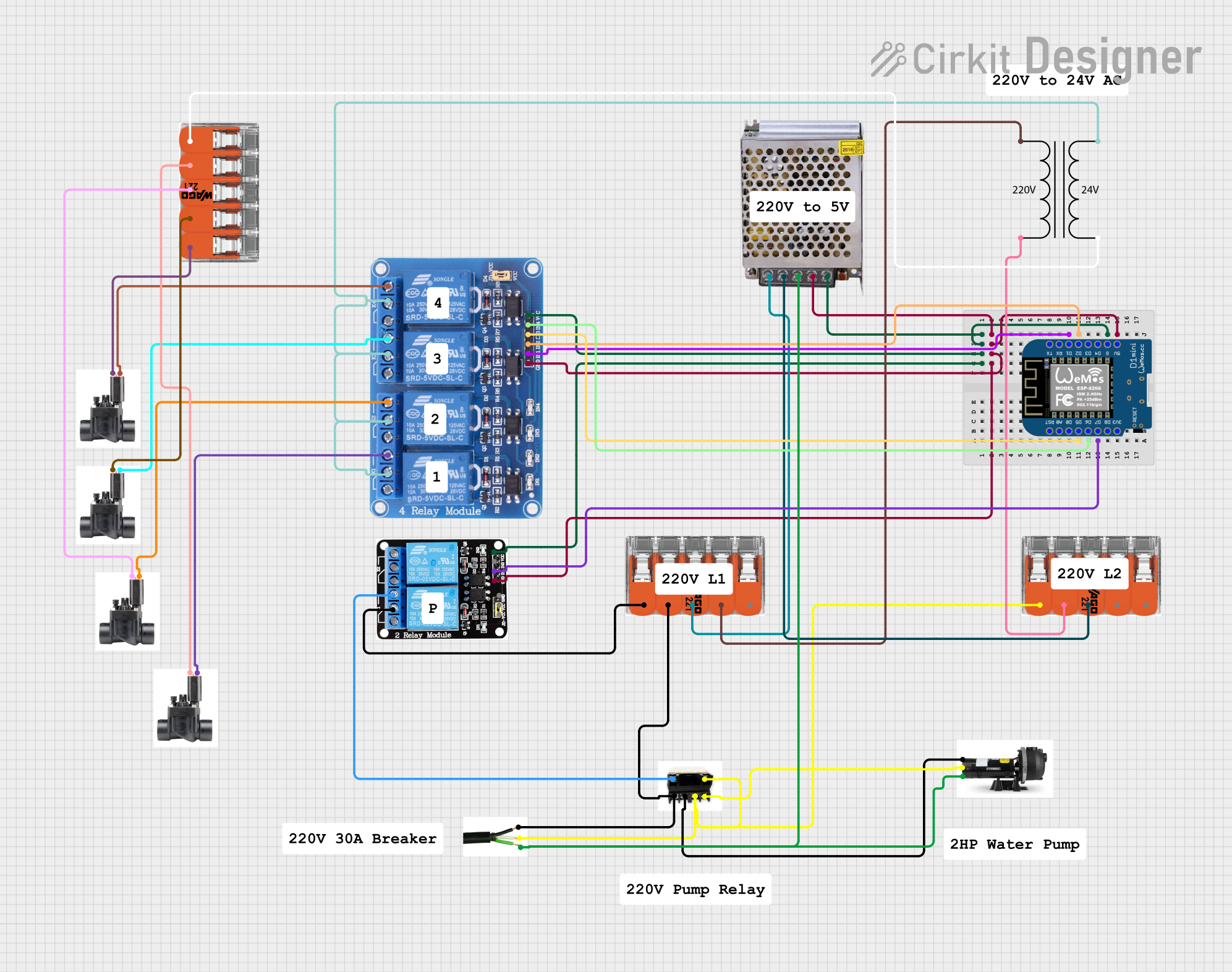
Circuit Documentation
Summary of the Circuit
This circuit is designed to control a 2HP well pump and multiple 24V irrigation valves using a Wemos D1 Mini microcontroller. The Wemos D1 Mini interfaces with a 4-channel 5V relay module to switch the irrigation valves on and off. A separate 5V 2-relay module is used to control the well pump via a 220V well pump relay. The power supply for the circuit is a 5V, 5A unit that powers the microcontroller and the relay modules. A power transformer steps down 220V AC to 24V AC to supply the irrigation valves. Splicing connectors are used to manage the wiring connections throughout the circuit.
Component List
Microcontroller
- Wemos D1 Mini: A compact microcontroller board based on the ESP8266, featuring WiFi capabilities and multiple digital I/O pins.
Power Supply
- POWER SUPPLY 5V 5AMP: Provides a 5V DC output with up to 5A of current, suitable for powering the microcontroller and relay modules.
Transformer
- Power Transformer (220V to 24V): Steps down 220V AC to 24V AC, used to power the 24V irrigation valves.
Relay Modules
- 5v 2-Relay JD-VCC: A relay module with two channels, used for controlling high-power devices like the well pump.
- Relay 4 Channel 5v: A 4-channel relay module controlled by the Wemos D1 Mini, used to control the 24V irrigation valves.
Pump and Valves
- 2HP Well Pump: A high-power well pump that operates at 220V.
- 24V Irrigation Valve: Solenoid valves used to control the flow of water in an irrigation system.
Connectors and Cables
- Splicing connector WAGO 221: A connector used for joining multiple wires together securely.
- 6/3 Cable: Heavy-duty cable used for carrying 220V power to the well pump.
Miscellaneous
- 220V Well Pump Relay: A high-power relay used to control the 2HP well pump.
Wiring Details
Wemos D1 Mini
- GND: Connected to the ground of the power supply and relay modules.
- 5V: Connected to the 5V output of the power supply.
- D1, D2, D5, D6, D7: Digital outputs connected to the input pins of the 4-channel relay module and the 5V 2-relay module.
POWER SUPPLY 5V 5AMP
- 220V Positive Pole (AC): Connected to the AC power source.
- 220V Negative Pole (AC): Connected to the AC power source.
- GND (DC): Connected to the ground of the microcontroller and relay modules.
- 12V-24V Output (DC): Connected to the VCC of the microcontroller and relay modules.
Power Transformer (220V to 24V)
- Primary: Connected to the AC power source.
- Secondary: Connected to the common (COM) terminals of the 4-channel relay module and to the WAGO connectors for the irrigation valves.
5v 2-Relay JD-VCC
- VCC: Connected to the 5V output of the power supply.
- GND: Connected to the ground of the power supply.
- IN1: Controlled by the Wemos D1 Mini.
- NO, COM: Connected to the 220V well pump relay for controlling the well pump.
Relay 4 Channel 5v
- VCC: Connected to the 5V output of the power supply.
- GND: Connected to the ground of the power supply.
- IN1, IN2, IN3, IN4: Controlled by the Wemos D1 Mini.
- COM1, COM2, COM3, COM4: Connected to the 24V AC from the transformer.
- NO1, NO2, NO3, NO4: Connected to the 24V irrigation valves.
24V Irrigation Valves
- 24V COM (No Polarity): Connected to the 24V AC from the transformer via WAGO connectors.
- 24V Control (No Polarity): Connected to the normally open (NO) terminals of the 4-channel relay module.
Splicing connector WAGO 221
- Used to connect various components such as the power supply, transformer, and irrigation valves.
6/3 Cable
- Used to connect the 220V power source to the well pump and the 220V well pump relay.
220V Well Pump Relay
- 220V Coil: Controlled by the 5V 2-relay module.
- 220V COM, NO: Connected to the 2HP well pump and the 220V power source.
Documented Code
No code was provided for the microcontroller. The operation of the circuit is dependent on the embedded code that would be running on the Wemos D1 Mini. The code would typically initialize the digital pins connected to the relay modules as outputs and then control them to switch the relays on and off, thereby controlling the well pump and irrigation valves. Without the code, the specific logic and timing for controlling the devices cannot be documented.