
Arduino and ESP8266 Environmental Monitoring System with Sensors and LCD Display
View and Edit Project In Cirkit Designer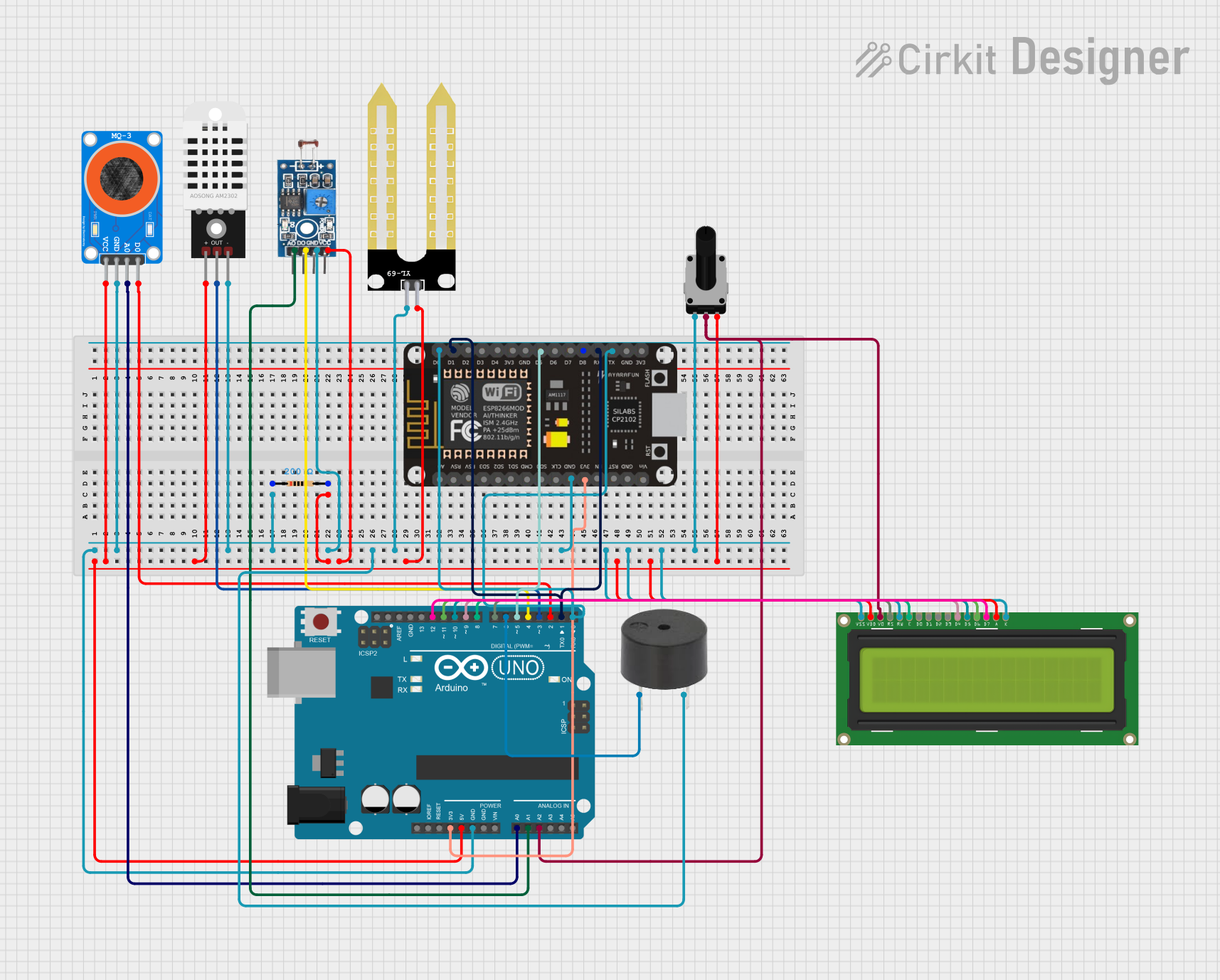
Circuit Documentation
Summary
This document provides a detailed overview of a circuit designed to interface various sensors and modules with an Arduino UNO and an ESP8266 NodeMCU microcontroller. The circuit includes sensors for detecting alcohol levels, temperature and humidity, soil moisture, and light intensity. Additionally, it features a rotary potentiometer for analog input, a buzzer for audio output, and an LCD display for visual output. The circuit is powered by a 5V supply from the Arduino UNO, which also serves as the ground reference for all components. Communication between the Arduino UNO and the ESP8266 NodeMCU is established through serial connections.
Component List
- MQ-3 Alcohol Sensor: A sensor for detecting alcohol levels in the air.
- DHT22: A sensor for measuring ambient temperature and humidity.
- YL-69 Soil Moisture Sensor (Sonda): A probe for detecting the moisture content in soil.
- Photosensitive Sensor Module: A light intensity detection module with both analog and digital outputs.
- Arduino UNO: A microcontroller board based on the ATmega328P, with digital and analog I/O pins.
- Rotary Potentiometer: A variable resistor with a knob that provides a variable voltage output.
- ESP8266 NodeMCU: A microcontroller with Wi-Fi capabilities, compatible with the Arduino IDE.
- Resistor: A passive two-terminal electrical component that implements electrical resistance.
- LCD Display 16x2: A liquid crystal display capable of displaying 16 characters per line across 2 lines.
- Buzzer: An audio signaling device.
Wiring Details
MQ-3 Alcohol Sensor
- VCC: Connected to 5V supply.
- GND: Connected to ground.
- A0: Analog output connected to Arduino UNO's A0 pin.
- D0: Digital output connected to Arduino UNO's D2 pin.
DHT22
- +: Connected to 5V supply.
- Out: Data output connected to Arduino UNO's D3 pin.
- -: Connected to ground.
YL-69 Soil Moisture Sensor (Sonda)
- +: Connected to 5V supply.
- -: Connected to ground.
Photosensitive Sensor Module
- Analog Output: Connected to Arduino UNO's A1 pin.
- Digital Output: Connected to Arduino UNO's D4 pin.
- Ground: Connected to ground.
- VCC: Connected to 5V supply.
Arduino UNO
- 3.3V: Connected to ESP8266 NodeMCU's 3V3 pin.
- 5V: Connected to 5V supply rail.
- GND: Connected to ground rail.
- A0 - A5: Analog input pins.
- D0 - D13: Digital I/O pins.
Rotary Potentiometer
- leg1: Connected to ground.
- wiper: Connected to Arduino UNO's A2 pin.
- leg2: Connected to 5V supply.
ESP8266 NodeMCU
- 3V3: Connected to Arduino UNO's 3.3V pin.
- GND: Connected to ground.
- D0 - D8, RX, TX: Digital I/O pins.
Resistor
- pin1: Connected to ground.
- pin2: Connected to 5V supply.
LCD Display 16x2
- VSS: Connected to ground.
- VDD: Connected to 5V supply.
- RS: Connected to Arduino UNO's D7 pin.
- RW: Connected to ground.
- E: Connected to Arduino UNO's D8 pin.
- DB4 - DB7: Connected to Arduino UNO's D9 - D12 pins.
- LEDA: Connected to 5V supply.
- LEDK: Connected to ground.
- VO: Connected to the wiper of the rotary potentiometer.
Buzzer
- PIN: Connected to Arduino UNO's D6 pin.
- GND: Connected to ground.
Documented Code
Arduino UNO Code (sketch.ino)
void setup() {
  // put your setup code here, to run once:

}

void loop() {
  // put your main code here, to run repeatedly:

}
ESP8266 NodeMCU Code
No code provided for the ESP8266 NodeMCU.
This documentation provides a basic framework for understanding the circuit's components, wiring, and code. Further details may be added to describe the functionality of each component within the circuit, the logic of the code, and the interaction between the microcontrollers and the sensors/modules.