
ESP32-Based Weather Monitoring System with Rain and Temperature Sensing
View and Edit Project In Cirkit Designer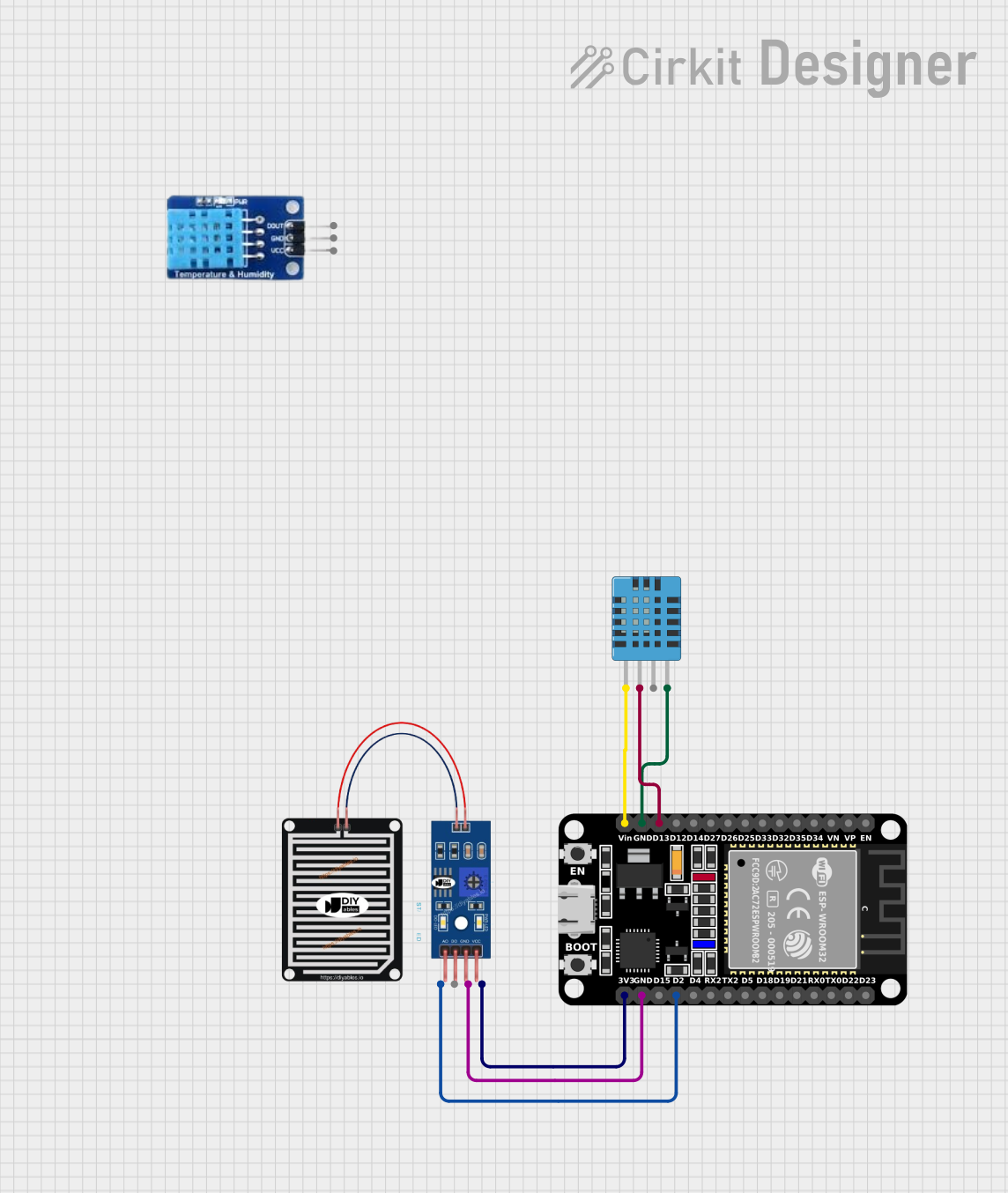
Circuit Documentation
Summary
The circuit in question is designed to interface an ESP32 microcontroller with a DHT11 Humidity and Temperature Sensor and a Rain Sensor. The ESP32 is a versatile microcontroller with a wide range of GPIO pins suitable for various applications, including IoT devices. The DHT11 sensor provides ambient temperature and humidity readings, while the Rain Sensor can detect rainwater.
Component List
ESP32 (30 pin)
- Description: A microcontroller with Wi-Fi and Bluetooth capabilities, featuring a wide range of GPIO pins.
- Purpose: Acts as the central processing unit of the circuit, reading sensor data and controlling the flow of the program.
RAIN SENSOR
- Description: A sensor that detects the presence of water, indicating rainfall.
- Purpose: To provide real-time data on weather conditions, specifically the presence of rain.
DHT11
- Description: A basic, ultra low-cost digital temperature and humidity sensor.
- Purpose: To measure the ambient temperature and humidity.
DHT11 Humidity and Temperature Sensor
- Description: A sensor for measuring the ambient humidity and temperature.
- Purpose: To provide environmental readings to the ESP32 for processing.
Wiring Details
ESP32 (30 pin)
- D13: Connected to the DATA pin of the DHT11 Humidity and Temperature Sensor.
- GND: Common ground shared with the DHT11 Humidity and Temperature Sensor and the Rain Sensor.
- Vin: Connected to the VDD pin of the DHT11 Humidity and Temperature Sensor to provide power.
- D2: Connected to the AO pin of the Rain Sensor to read analog data.
- 3V3: Powers the Rain Sensor by connecting to its VCC pin.
RAIN SENSOR
- AO: Analog output connected to the D2 pin of the ESP32 for rain detection data.
- GRD: Ground connection shared with the ESP32.
- VCC: Power input connected to the 3V3 pin of the ESP32.
DHT11 Humidity and Temperature Sensor
- DATA: Sends temperature and humidity data to the D13 pin of the ESP32.
- GND: Ground connection shared with the ESP32.
- VDD: Power input connected to the Vin pin of the ESP32.
Code Documentation
No code has been provided for the microcontrollers in the circuit. To fully utilize the circuit, embedded code for the ESP32 is required to initialize the sensors, read data from them, and perform any necessary data processing or communication tasks. The code would typically include initialization routines, data acquisition loops, and possibly communication protocols if the data needs to be sent to a remote server or another device.