
Arduino-Based Automated Dosing System with Keypad, LCD, Servo, and RTC
View and Edit Project In Cirkit Designer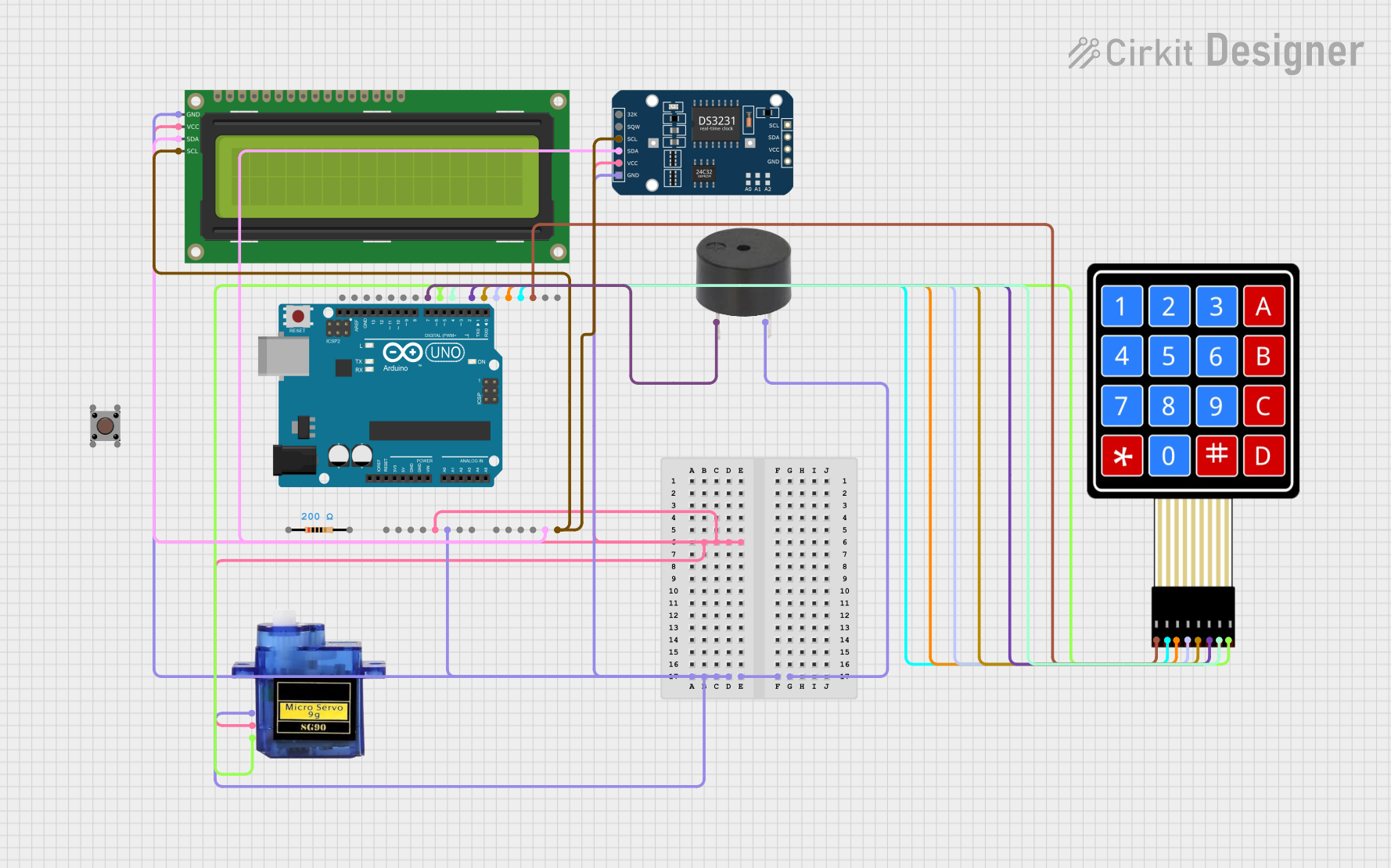
Circuit Documentation
Summary
This circuit integrates a 4x4 membrane keypad, a 16x2 I2C LCD, a micro servo, a DS3231 RTC, and a buzzer with an Arduino UNO. The user inputs a dose and time using the keypad, which is displayed on the LCD. The servo motor operates for the specified time, and the buzzer sounds when the time elapses.
Component List
Arduino UNO
- Description: A microcontroller board based on the ATmega328P.
- Pins: UNUSED, IOREF, Reset, 3.3V, 5V, GND, Vin, A0, A1, A2, A3, A4, A5, SCL, SDA, AREF, D13, D12, D11, D10, D9, D8, D7, D6, D5, D4, D3, D2, D1, D0
Micro servo 9G
- Description: A small servo motor used for precise control of angular position.
- Pins: GND, +5V, PWM
4X4 Membrane Matrix Keypad
- Description: A keypad with 16 buttons arranged in a 4x4 matrix.
- Pins: R1, R2, R3, R4, C1, C2, C3, C4
16x2 I2C LCD
- Description: A 16x2 character LCD display with I2C interface.
- Pins: GND, VCC, SDA, SCL
Buzzer
- Description: An electronic device that emits sound.
- Pins: PIN, GND
DS3231 RTC
- Description: A real-time clock module with I2C interface.
- Pins: 32K, SQW, SCL, SDA, VCC, GND
Pushbutton
- Description: A simple pushbutton switch.
- Pins: Pin 3 (out), Pin 4 (out), Pin 1 (in), Pin 2 (in)
Resistor
- Description: A 200 Ohms resistor.
- Pins: pin1, pin2
- Properties: Resistance: 200 Ohms
Wiring Details
Arduino UNO
- 5V: Connected to +5V of Micro servo 9G, VCC of 16x2 I2C LCD, VCC of DS3231 RTC
- GND: Connected to GND of Micro servo 9G, GND of 16x2 I2C LCD, GND of DS3231 RTC, GND of Buzzer
- A4: Connected to SDA of 16x2 I2C LCD, SDA of DS3231 RTC
- A5: Connected to SCL of 16x2 I2C LCD, SCL of DS3231 RTC
- D10: Connected to PIN of Buzzer
- D9: Connected to PWM of Micro servo 9G, C4 of 4X4 Membrane Matrix Keypad
- D8: Connected to C3 of 4X4 Membrane Matrix Keypad
- D7: Connected to C2 of 4X4 Membrane Matrix Keypad
- D6: Connected to C1 of 4X4 Membrane Matrix Keypad
- D5: Connected to R4 of 4X4 Membrane Matrix Keypad
- D4: Connected to R3 of 4X4 Membrane Matrix Keypad
- D3: Connected to R2 of 4X4 Membrane Matrix Keypad
- D2: Connected to R1 of 4X4 Membrane Matrix Keypad
Micro servo 9G
- +5V: Connected to 5V of Arduino UNO
- GND: Connected to GND of Arduino UNO
- PWM: Connected to D9 of Arduino UNO
4X4 Membrane Matrix Keypad
- R1: Connected to D2 of Arduino UNO
- R2: Connected to D3 of Arduino UNO
- R3: Connected to D4 of Arduino UNO
- R4: Connected to D5 of Arduino UNO
- C1: Connected to D6 of Arduino UNO
- C2: Connected to D7 of Arduino UNO
- C3: Connected to D8 of Arduino UNO
- C4: Connected to D9 of Arduino UNO
16x2 I2C LCD
- GND: Connected to GND of Arduino UNO
- VCC: Connected to 5V of Arduino UNO
- SDA: Connected to A4 of Arduino UNO
- SCL: Connected to A5 of Arduino UNO
Buzzer
- PIN: Connected to D10 of Arduino UNO
- GND: Connected to GND of Arduino UNO
DS3231 RTC
- VCC: Connected to 5V of Arduino UNO
- GND: Connected to GND of Arduino UNO
- SDA: Connected to A4 of Arduino UNO
- SCL: Connected to A5 of Arduino UNO
Pushbutton
- Pin 1 (in): Not connected
- Pin 2 (in): Not connected
- Pin 3 (out): Not connected
- Pin 4 (out): Not connected
Resistor
- pin1: Not connected
- pin2: Not connected
Code Documentation
Arduino UNO Code
/*
 * This Arduino Sketch integrates a 4x4 membrane keypad, a 16x2 I2C LCD, a
 * micro servo, a DS3231 RTC, and a buzzer. The user inputs a dose and time
 * using the keypad, which is displayed on the LCD. The servo motor operates
 * for the specified time, and the buzzer sounds when the time elapses.
 */

#include <Wire.h>
#include <LiquidCrystal_I2C.h>
#include <Keypad.h>
#include <Servo.h>
#include <RTClib.h>

LiquidCrystal_I2C lcd(0x27, 16, 2);
RTC_DS3231 rtc;
Servo myservo;

const byte ROWS = 4; // four rows
const byte COLS = 4; // four columns
char keys[ROWS][COLS] = {
  {'1','2','3','A'},
  {'4','5','6','B'},
  {'7','8','9','C'},
  {'*','0','#','D'}
};
byte rowPins[ROWS] = {2, 3, 4, 5}; // connect to the row pinouts of the keypad
byte colPins[COLS] = {6, 7, 8, 9}; // connect to the column pinouts of the keypad

Keypad keypad = Keypad(makeKeymap(keys), rowPins, colPins, ROWS, COLS);

int buzzerPin = 10;
int buttonPin = 11;
int servoPin = 9;

void setup() {
  lcd.begin();
  lcd.backlight();
  myservo.attach(servoPin);
  pinMode(buzzerPin, OUTPUT);
  pinMode(buttonPin, INPUT_PULLUP);
  if (!rtc.begin()) {
    lcd.print("Couldn't find RTC");
    while (1);
  }
  if (rtc.lostPower()) {
    rtc.adjust(DateTime(F(__DATE__), F(__TIME__)));
  }
  lcd.print("Enter dose (ml):");
}

void loop() {
  static String dose = "";
  static String time = "";
  static bool doseEntered = false;
  static bool timeEntered = false;
  static bool pumpStarted = false;
  static DateTime startTime;

  char key = keypad.getKey();
  if (key) {
    if (!doseEntered) {
      if (key == '#') {
        doseEntered = true;
        lcd.clear();
        lcd.print("Enter time (s):");
      } else {
        dose += key;
        lcd.setCursor(dose.length() - 1, 1);
        lcd.print(key);
      }
    } else if (!timeEntered) {
      if (key == '#') {
        timeEntered = true;
        lcd.clear();
        lcd.print("Press button to start");
      } else {
        time += key;
        lcd.setCursor(time.length() - 1, 1);
        lcd.print(key);
      }
    }
  }

  if (timeEntered && digitalRead(buttonPin) == LOW && !pumpStarted) {
    pumpStarted = true;
    startTime = rtc.now();
    myservo.write(90); // Start the servo
    lcd.clear();
    lcd.print("Pumping...");
  }

  if (pumpStarted) {
    DateTime currentTime = rtc.now();
    int elapsedTime = currentTime.secondstime() - startTime.secondstime();
    if (elapsedTime >= time.toInt()) {
      myservo.write(0); // Stop the servo
      digitalWrite(buzzerPin, HIGH); // Trigger the alarm
      lcd.clear();