
Circuit Documentation
Summary
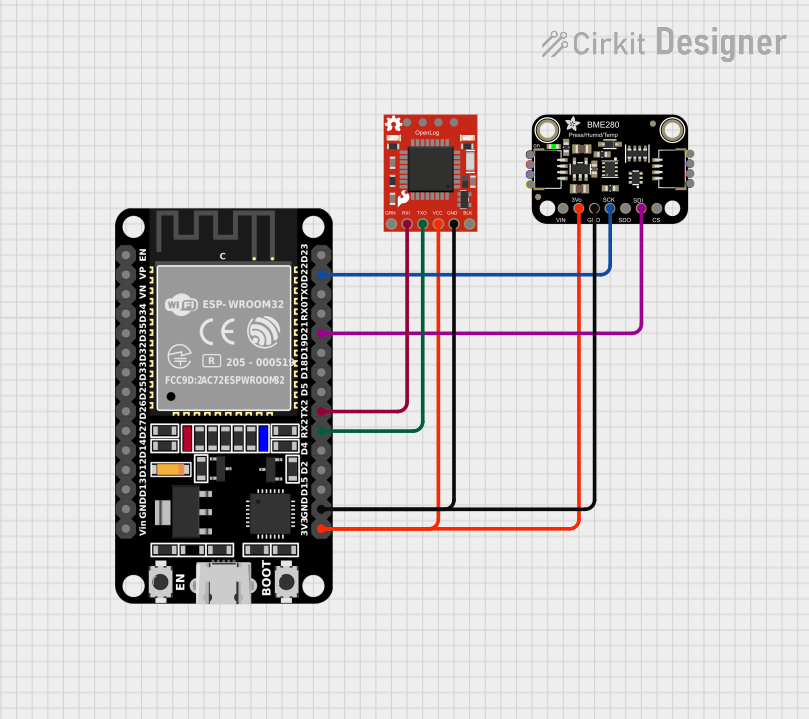
This document provides a detailed overview of a circuit that includes an ESP32 microcontroller, an Adafruit BME280 sensor, and a SparkFun OpenLog data logger. The ESP32 serves as the central processing unit, interfacing with the BME280 sensor to collect environmental data and logging this data to the OpenLog module. The document includes a list of components, wiring details, and any associated code.
Component List
ESP32 (30 pin)
- Description: A powerful microcontroller with integrated Wi-Fi and Bluetooth capabilities.
- Pins: EN, VP, VN, D34, D35, D32, D33, D25, D26, D27, D14, D12, D13, GND, Vin, D23, D22, TX0, RX0, D21, D19, D18, D5, TX2, RX2, D4, D2, D15, 3V3
Adafruit BME280
- Description: A sensor module that measures temperature, humidity, and barometric pressure.
- Pins: VCC, 3.3V, GND, SCK/SCL, SDO/ADR, SDI/SDA, CS
SparkFun OpenLog
- Description: A simple serial data logger that supports microSD cards.
- Pins: DTR, RXI, TXO, VCC, GND, RST, SCK, MOSI, MISO
Wiring Details
ESP32 (30 pin)
- D22 is connected to SCK/SCL of the Adafruit BME280.
- D21 is connected to SDI/SDA of the Adafruit BME280.
- TX2 is connected to RXI of the SparkFun OpenLog.
- RX2 is connected to TXO of the SparkFun OpenLog.
- GND is connected to GND of both the Adafruit BME280 and the SparkFun OpenLog.
- 3V3 is connected to 3.3V of the Adafruit BME280 and VCC of the SparkFun OpenLog.
Adafruit BME280
- SCK/SCL is connected to D22 of the ESP32.
- SDI/SDA is connected to D21 of the ESP32.
- GND is connected to GND of the ESP32 and the SparkFun OpenLog.
- 3.3V is connected to 3V3 of the ESP32.
SparkFun OpenLog
- RXI is connected to TX2 of the ESP32.
- TXO is connected to RX2 of the ESP32.
- GND is connected to GND of the ESP32 and the Adafruit BME280.
- VCC is connected to 3V3 of the ESP32.
Code
There is no code provided for this circuit.
This document provides a comprehensive overview of the circuit, including the components used and their interconnections. This should serve as a useful reference for anyone looking to understand or replicate the circuit.