
Arduino UNO-Based Smart Irrigation System with Soil Moisture Sensors and LCD Display
View and Edit Project In Cirkit Designer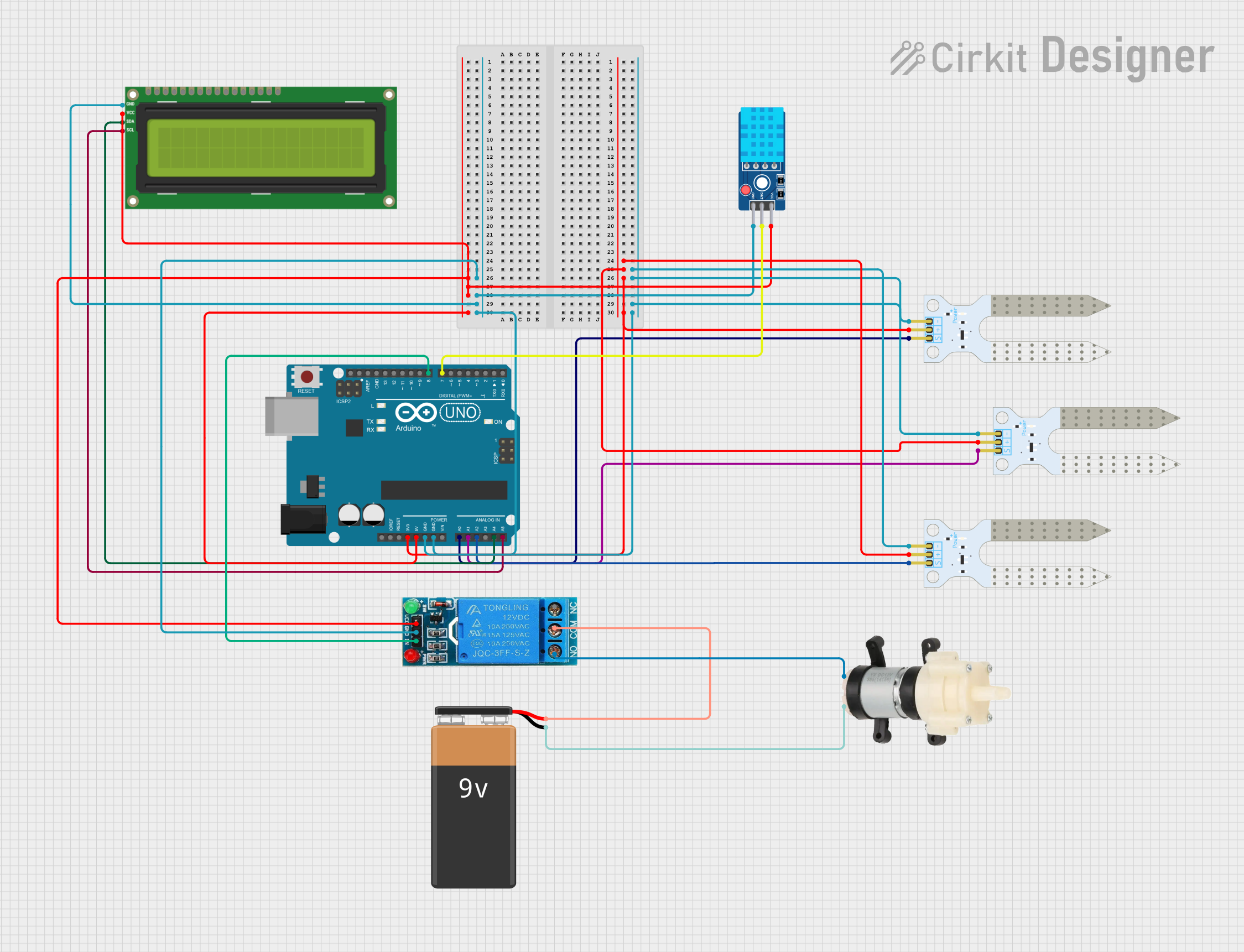
Circuit Documentation
Summary
This circuit is designed to monitor soil moisture levels using multiple soil moisture sensors, display the data on an I2C LCD screen, and control a water pump via a relay. The system is powered by an Arduino UNO microcontroller, which reads data from the sensors and controls the relay and LCD screen. A DHT11 sensor is also included to monitor temperature and humidity.
Component List
Arduino UNO
- Description: Microcontroller board based on the ATmega328P.
- Pins: UNUSED, IOREF, Reset, 3.3V, 5V, GND, Vin, A0, A1, A2, A3, A4, A5, SCL, SDA, AREF, D13, D12, D11, D10, D9, D8, D7, D6, D5, D4, D3, D2, D1, D0
Soil Moisture Sensor
- Description: Sensor to measure soil moisture levels.
- Pins: VCC, GND, SIG
9V Battery
- Description: Power source for the water pump.
- Pins: -, +
12V SINGLE CHANNEL RELAY
- Description: Relay module to control the water pump.
- Pins: NC, COM, NO, IN, GND, VCC
Mini Diaphragm Water Pump
- Description: Water pump to irrigate the soil.
- Pins: Positive (+), Negative (-)
I2C LCD 16x2 Screen
- Description: LCD screen to display sensor data.
- Pins: SCL, SDA, VCC (5V), GND, VDD, VO, RS, RW, E, D0, D1, D2, D3, D4, D5, D6, D7, BLA, BLK
DHT11 Sensor V2
- Description: Sensor to measure temperature and humidity.
- Pins: GND, DAT, VCC
Wiring Details
Arduino UNO
- 3.3V connected to VCC of all Soil Moisture Sensors.
- 5V connected to VCC of 12V SINGLE CHANNEL RELAY, DHT11 Sensor V2, and I2C LCD 16x2 Screen.
- GND connected to GND of all Soil Moisture Sensors, 12V SINGLE CHANNEL RELAY, DHT11 Sensor V2, and I2C LCD 16x2 Screen.
- A0 connected to SIG of Soil Moisture Sensor 1.
- A1 connected to SIG of Soil Moisture Sensor 2.
- A2 connected to SIG of Soil Moisture Sensor 3.
- A4 connected to SDA of I2C LCD 16x2 Screen.
- A5 connected to SCL of I2C LCD 16x2 Screen.
- D7 connected to DAT of DHT11 Sensor V2.
- D8 connected to IN of 12V SINGLE CHANNEL RELAY.
Soil Moisture Sensor 1
- VCC connected to 3.3V of Arduino UNO.
- GND connected to GND of Arduino UNO.
- SIG connected to A0 of Arduino UNO.
Soil Moisture Sensor 2
- VCC connected to 3.3V of Arduino UNO.
- GND connected to GND of Arduino UNO.
- SIG connected to A1 of Arduino UNO.
Soil Moisture Sensor 3
- VCC connected to 3.3V of Arduino UNO.
- GND connected to GND of Arduino UNO.
- SIG connected to A2 of Arduino UNO.
9V Battery
- - connected to Negative (-) of Mini Diaphragm Water Pump.
- + connected to COM of 12V SINGLE CHANNEL RELAY.
12V SINGLE CHANNEL RELAY
- VCC connected to 5V of Arduino UNO.
- GND connected to GND of Arduino UNO.
- IN connected to D8 of Arduino UNO.
- COM connected to + of 9V Battery.
- NO connected to Positive (+) of Mini Diaphragm Water Pump.
Mini Diaphragm Water Pump
- Positive (+) connected to NO of 12V SINGLE CHANNEL RELAY.
- Negative (-) connected to - of 9V Battery.
I2C LCD 16x2 Screen
- SCL connected to A5 of Arduino UNO.
- SDA connected to A4 of Arduino UNO.
- VCC (5V) connected to 5V of Arduino UNO.
- GND connected to GND of Arduino UNO.
DHT11 Sensor V2
- VCC connected to 5V of Arduino UNO.
- GND connected to GND of Arduino UNO.
- DAT connected to D7 of Arduino UNO.
Documented Code
Arduino UNO Code (sketch.ino)
void setup() {
  // put your setup code here, to run once:

}

void loop() {
  // put your main code here, to run repeatedly:

}
Additional Documentation (documentation.txt)