
Circuit Documentation
Summary of the Circuit
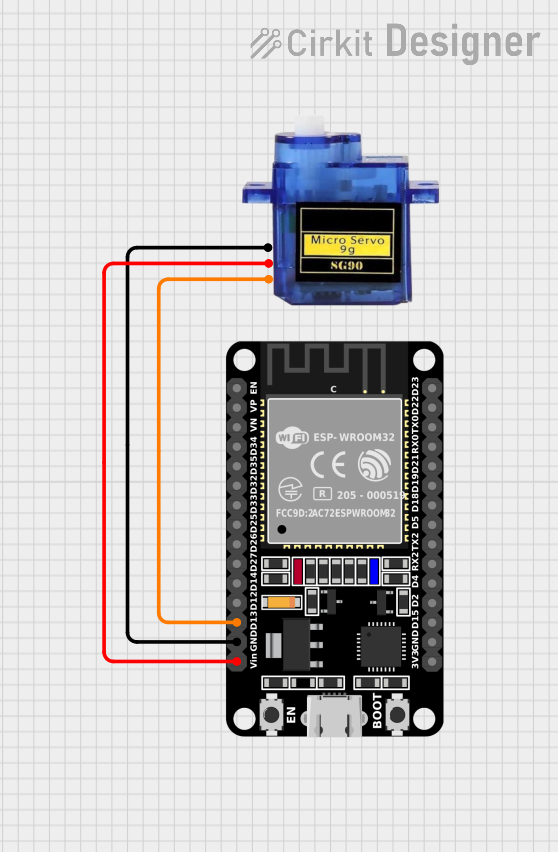
This circuit consists of an ESP32 microcontroller and a Micro servo 9G. The ESP32 is a versatile microcontroller with Wi-Fi and Bluetooth capabilities, which makes it suitable for a wide range of applications, including IoT projects. The Micro servo 9G is a small and lightweight servo motor commonly used for applications requiring simple motion tasks.
The ESP32 is used to control the servo motor by sending PWM (Pulse Width Modulation) signals from one of its digital pins. The ground and power supply pins of both components are interconnected to complete the circuit.
Component List
ESP32 (30 pin)
- Description: A 30-pin microcontroller with Wi-Fi and Bluetooth capabilities.
- Pins: EN, VP, VN, D34, D35, D32, D33, D25, D26, D27, D14, D12, D13, GND, Vin, D23, D22, TX0, RX0, D21, D19, D18, D5, TX2, RX2, D4, D2, D15, 3V3
- Purpose: Acts as the main controller for the circuit, generating PWM signals to control the servo motor.
Micro servo 9G
- Description: A compact and lightweight servo motor for basic motion control.
- Pins: GND, +5V, PWM
- Purpose: Executes physical movements based on the PWM signals received from the ESP32.
Wiring Details
ESP32 (30 pin)
- D13: Connected to the PWM pin of the Micro servo 9G to control the servo's position.
- GND: Common ground with the Micro servo 9G.
- Vin: Provides power to the Micro servo 9G through its +5V pin.
Micro servo 9G
- PWM: Receives PWM signals from the D13 pin of the ESP32.
- GND: Common ground with the ESP32.
- +5V: Powered by the Vin pin of the ESP32.
Documented Code
No code has been provided for the microcontroller. To control the Micro servo 9G, code should be written and uploaded to the ESP32. The code would typically initialize the ESP32's PWM capabilities on the D13 pin and then send appropriate PWM signals to control the position of the servo motor. Since no code is available, this section will remain empty until the code is provided.
Please note that the actual implementation of the circuit would require additional components such as a power supply and possibly resistors or capacitors for signal conditioning or power stabilization, which are not included in the provided documentation.