
Arduino UNO and ESP8266 Based Smart Weather Station with Load Cell and Piezo Sensor Integration
View and Edit Project In Cirkit Designer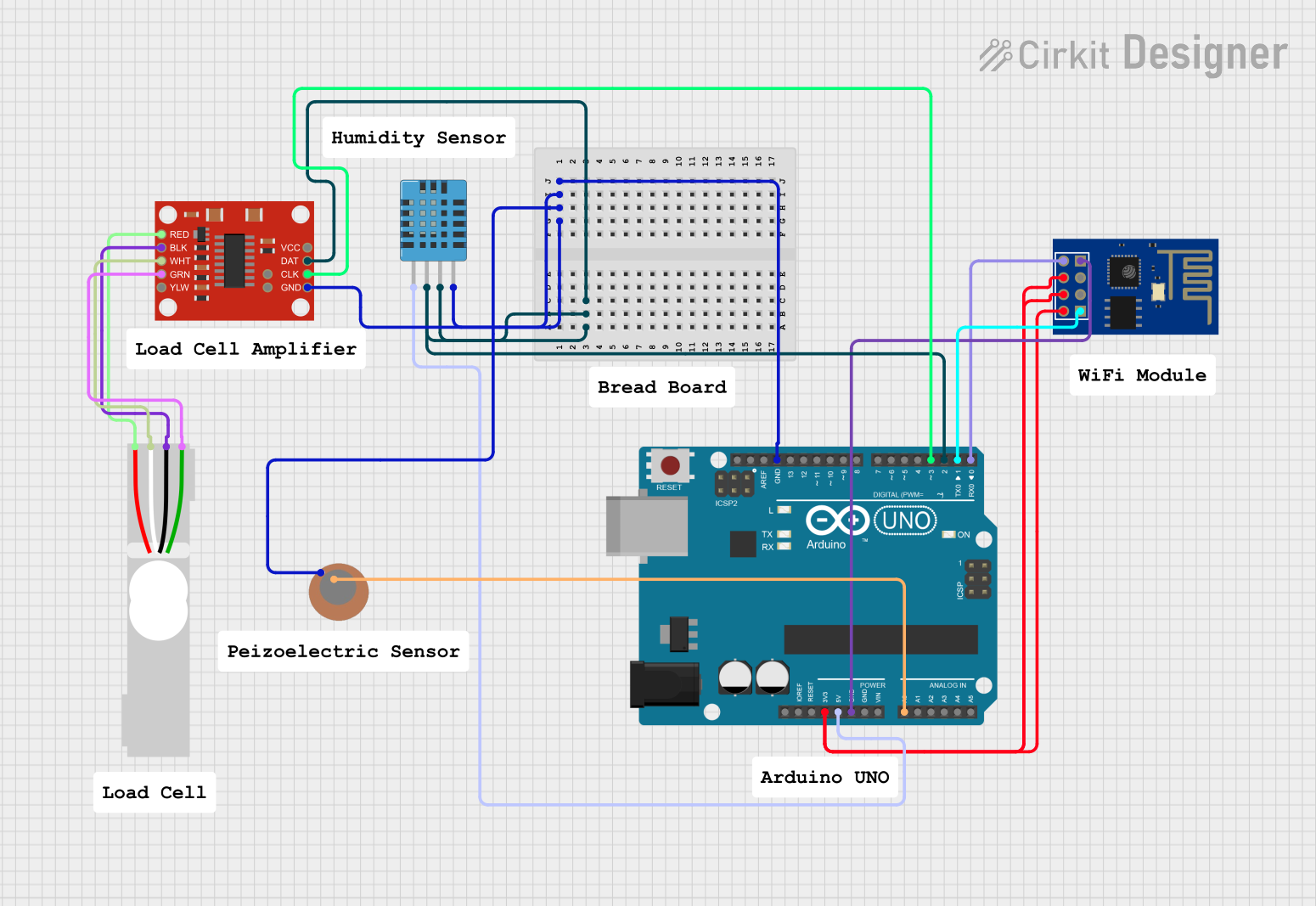
Circuit Documentation
Summary
The circuit in question is designed to interface an Arduino UNO with various sensors and modules, including an ESP8266 ESP-01 WiFi module, a DHT11 humidity and temperature sensor, a piezo sensor, and a load cell with an HX711 load cell amplifier. The Arduino UNO serves as the central microcontroller, managing sensor data and communication with the WiFi module. The DHT11 sensor provides environmental data, the piezo sensor detects vibrations or pressure changes, and the load cell measures weight or force. The ESP8266 module enables wireless communication capabilities.
Component List
Arduino UNO
- Microcontroller board based on the ATmega328P
- Features digital I/O pins, analog input pins, and various power pins
ESP8266 ESP-01 WiFi Module
- A low-cost WiFi module that can add internet connectivity to microcontroller projects
- Communicates with the Arduino via serial TX/RX pins
DHT11 Humidity and Temperature Sensor
- A basic, low-cost digital sensor for measuring ambient temperature and humidity
- Provides digital output data
Piezo Sensor
- A sensor that can detect pressure, impact, and vibrations
- Typically used for dynamic measurements
Load Cell - Red/white/black/green
- A transducer that converts force into an electrical signal
- Used in conjunction with the HX711 amplifier for accurate weight measurements
SparkFun Load Cell Amplifier - HX711
- A precision 24-bit analog-to-digital converter (ADC) designed for weigh scales and industrial control applications
- Interfaces with the load cell and provides digital output to the Arduino
Wiring Details
Arduino UNO
- GND: Connected to the ground pins of the DHT11 sensor, HX711 amplifier, and piezo sensor
- D2: Connected to the DATA pin of the DHT11 sensor
- 3.3V: Powers the ESP8266 module (CH_PD, RST, VCC pins)
- 5V: Powers the DHT11 sensor (VDD pin)
- A0: Connected to the positive pin of the piezo sensor
- D3: Connected to the CLK pin of the HX711 amplifier
- D1 (TX): Connected to the RXD pin of the ESP8266 module
- D0 (RX): Connected to the TXD pin of the ESP8266 module
ESP8266 ESP-01 WiFi Module
- TXD: Connected to the RX pin (D0) of the Arduino UNO
- CH_PD, RST, VCC: Powered by the 3.3V pin of the Arduino UNO
- GND: Connected to the ground pin of the Arduino UNO
- RXD: Connected to the TX pin (D1) of the Arduino UNO
DHT11 Humidity and Temperature Sensor
- VDD: Powered by the 5V pin of the Arduino UNO
- DATA: Connected to the D2 pin of the Arduino UNO
- GND: Connected to the ground pin of the Arduino UNO
Piezo Sensor
- +: Connected to the A0 pin of the Arduino UNO
- -: Connected to the ground pin of the Arduino UNO
Load Cell - Red/white/black/green
- E+: Connected to the RED pin of the HX711 amplifier
- A-: Connected to the WHT pin of the HX711 amplifier
- E-: Connected to the BLK pin of the HX711 amplifier
- A+: Connected to the GRN pin of the HX711 amplifier
SparkFun Load Cell Amplifier - HX711
- GND: Connected to the ground pin of the Arduino UNO
- CLK: Connected to the D3 pin of the Arduino UNO
- DAT: Connected to the D2 pin of the Arduino UNO
- VCC: Powered by the 5V pin of the Arduino UNO
- RED, WHT, BLK, GRN: Connected to the corresponding pins of the load cell
Documented Code
Arduino UNO Code (sketch.ino)
void setup() {
  // put your setup code here, to run once:

}

void loop() {
  // put your main code here, to run repeatedly:

}
Additional Notes
- The provided code for the Arduino UNO is a template with empty
setup()andloop()functions. Actual implementation code for initializing and reading from the sensors, as well as handling WiFi communication, should be added to these functions. - The ESP8266 module and the sensors are powered directly from the Arduino UNO, which simplifies the power distribution in the circuit.
- The DHT11 sensor's "NULL" pin is not connected in this circuit, as it is typically not used.
- The piezo sensor is connected to an analog input for detecting analog voltage variations due to pressure changes.
- The load cell and HX711 amplifier setup is typical for weight measurement applications, with the HX711 providing a digital interface to the Arduino UNO for reading the load cell data.